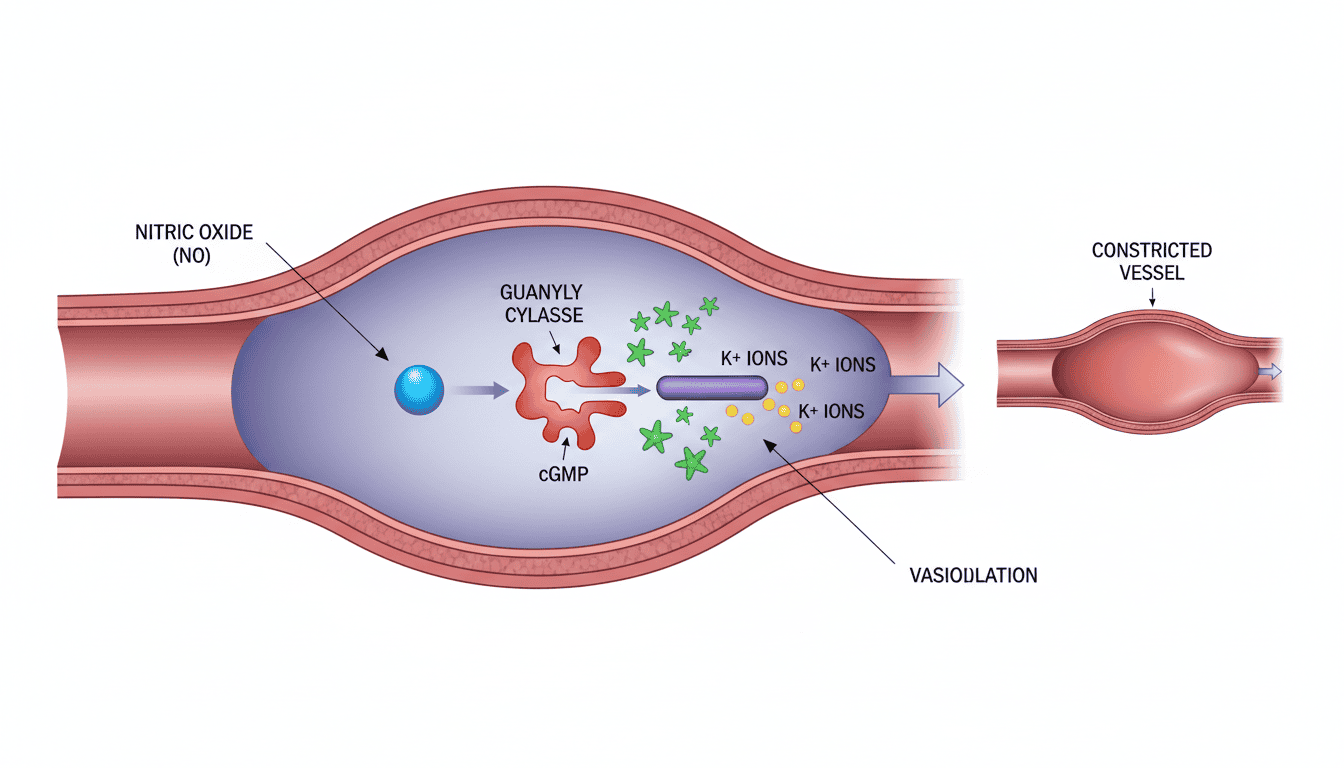
Your blood vessels produce a gas that would kill you in large amounts but keeps you alive in tiny doses. Nitric oxide, the same molecule that contributes to air pollution, acts as one of the most important signalling molecules in your cardiovascular system. Without it, your arteries would clamp shut and your blood pressure would skyrocket.
What is nitric oxide signalling
Nitric oxide is a simple molecule made of one nitrogen atom bonded to one oxygen atom. In your blood vessels, it acts like a molecular messenger that tells smooth muscle cells when to relax. The inner lining of your arteries, called the endothelium, produces nitric oxide when it detects changes in blood flow or receives signals from other molecules.
This process starts with an enzyme called nitric oxide synthase, which converts the amino acid L-arginine into nitric oxide. The newly formed nitric oxide then diffuses across cell membranes into the smooth muscle cells that surround your arteries. Once there, it activates an enzyme that produces cyclic GMP, a molecule that causes the muscle cells to relax. When these muscles relax, your blood vessels widen.
The entire process happens in seconds. But nitric oxide doesn’t hang around long. It has a half-life of only a few seconds before other molecules break it down or it reacts with oxygen to form other compounds.
What the research shows
Scientists have observed that healthy endothelial cells produce nitric oxide in response to several triggers. When blood flows faster through an artery, the physical force of that flow stimulates endothelial cells to make more nitric oxide. Researchers can measure this by looking at how arteries respond to increased blood flow during exercise.
Studies using specialised probes have shown that nitric oxide levels spike within seconds when certain molecules bind to receptors on endothelial cells. Acetylcholine, for example, triggers a rapid increase in nitric oxide production. Scientists use this response as a test of how well someone’s blood vessels can produce nitric oxide.
When researchers block nitric oxide production in laboratory animals, blood pressure rises dramatically within minutes. The animals’ arteries become stiffer and less responsive to changes in blood flow. This happens because the smooth muscle cells in blood vessel walls default to a contracted state when they don’t receive nitric oxide signals.
Research has also revealed that nitric oxide does more than just relax blood vessels. It prevents certain immune cells from sticking to artery walls and reduces the tendency of blood platelets to clump together. These effects suggest nitric oxide acts as a general protector of blood vessel function.
Why cells need this system
Evolution preserved nitric oxide signalling because blood vessels need to adapt constantly to changing demands. When you stand up, your cardiovascular system must redirect blood flow to prevent you from fainting. When you exercise, your muscles need more oxygen and nutrients delivered through expanded blood vessels.
The speed of nitric oxide signalling makes this system particularly valuable. Unlike hormonal signals that can take minutes to hours to take effect, nitric oxide works in seconds. This allows your cardiovascular system to make rapid adjustments to blood flow distribution throughout your body.
The local nature of nitric oxide action also provides precision. Because the molecule breaks down quickly, it mainly affects cells very close to where it was produced. This means your body can dilate specific blood vessels without affecting your entire cardiovascular system.
From an evolutionary perspective, organisms with better nitric oxide signalling could respond more effectively to physical challenges, changes in position, or threats requiring rapid movement. Those with impaired signalling would be at a survival disadvantage.
What affects nitric oxide production
Age significantly impacts how much nitric oxide your blood vessels produce. Research shows that endothelial cells from older adults make less nitric oxide when stimulated compared to cells from younger people. This decline appears to start in middle age and accelerates afterwards.
Physical activity influences nitric oxide production in multiple ways. Regular exercise increases the expression of nitric oxide synthase enzymes in blood vessel walls. The repeated increases in blood flow during exercise also appear to train endothelial cells to produce nitric oxide more efficiently.
Diet affects the raw materials available for nitric oxide production. Foods high in nitrates, like beetroot and leafy greens, can be converted into nitric oxide through a different pathway that doesn’t require nitric oxide synthase. This backup system becomes more important when the primary enzyme-based pathway isn’t working optimally.
Oxidative stress interferes with nitric oxide signalling by rapidly breaking down nitric oxide before it can reach its target cells. Smoking, high blood sugar, and chronic inflammation all increase oxidative stress in blood vessels. These conditions can effectively neutralise nitric oxide as soon as cells produce it.
What remains unknown
Scientists still don’t fully understand why nitric oxide production declines with age. Some research suggests that oxidative damage accumulates in the enzymes responsible for making nitric oxide, but other studies point to changes in the availability of cofactors these enzymes need to function properly.
The relationship between different sources of nitric oxide also needs more investigation. Your body can make nitric oxide through at least three different pathways, but researchers aren’t sure how these pathways interact or compensate for each other when one isn’t working well.
Individual variation in nitric oxide production presents another puzzle. Some people seem to maintain robust nitric oxide signalling well into old age, while others show early declines. Genetic factors likely play a role, but environmental influences probably matter too.
The precise mechanisms by which exercise improves nitric oxide production remain unclear. While scientists know that regular physical activity enhances nitric oxide signalling, they’re still working out whether this happens through increased enzyme production, better enzyme function, or improved cellular conditions for nitric oxide synthesis.
Understanding nitric oxide signalling reveals how your cardiovascular system maintains moment-to-moment control over blood flow distribution. This tiny, short-lived molecule demonstrates how cells use simple chemical signals to coordinate complex physiological responses. The more we learn about these fundamental signalling processes, the clearer it becomes that cellular health depends on intricate networks of molecular communication that evolution refined over millions of years.

Matt Elliott is the editor of Redox News Today, an independent publication covering peer-reviewed research on cellular health, redox signalling, and related biomedical science.