Your cells produce thousands of hydrogen peroxide molecules every second. While you might know this chemical as the antiseptic that fizzes on cuts, inside your body it works as something completely different: a sophisticated messaging molecule that helps cells coordinate their activities and respond to stress.
What is hydrogen peroxide signalling
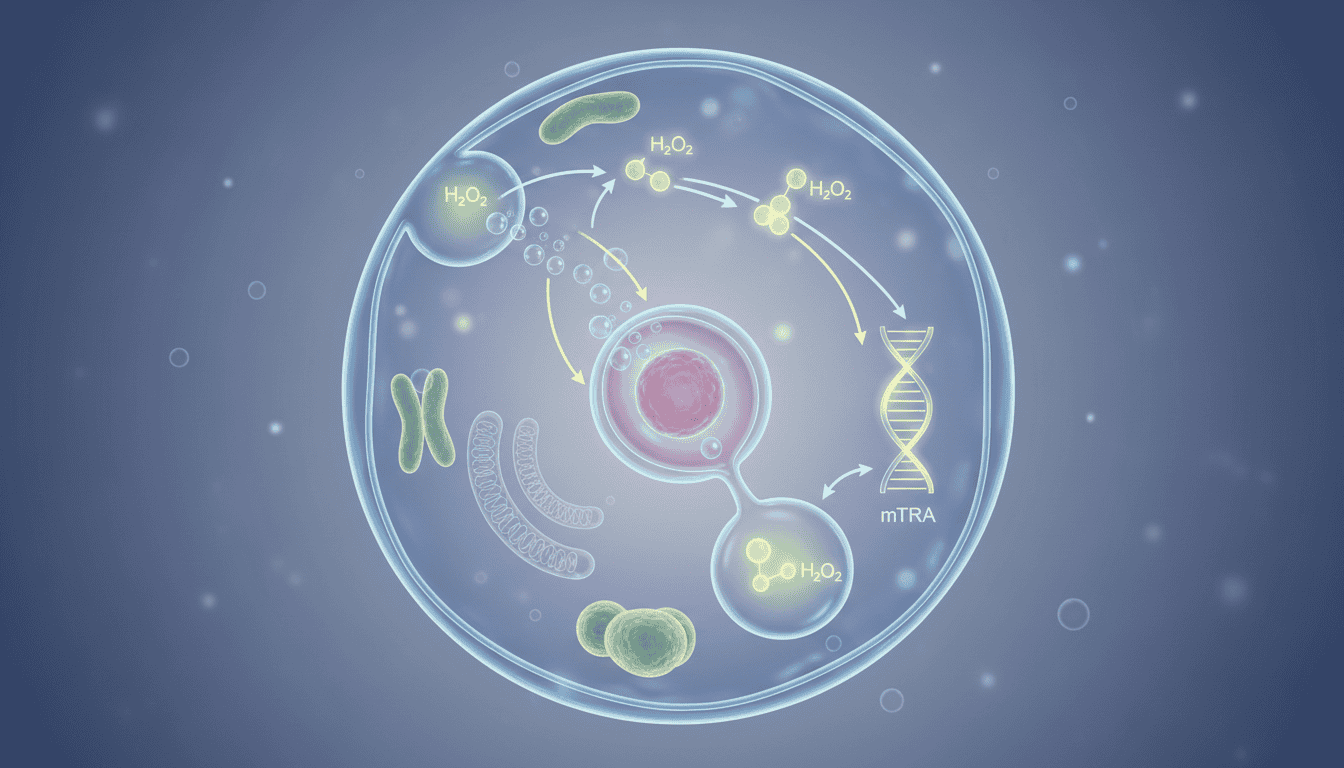
Hydrogen peroxide (H2O2) sits at the centre of cellular communication networks. Think of it as a molecular text message. When one part of a cell needs to alert another part about changing conditions, it releases precisely controlled amounts of hydrogen peroxide.
This molecule forms when oxygen picks up an extra electron, making it what scientists call a reactive oxygen species. But unlike its more destructive cousins, hydrogen peroxide is relatively stable and can travel short distances before breaking down. These properties make it perfect for short-range cellular communication.
The messaging happens through a simple but elegant mechanism. Hydrogen peroxide seeks out specific amino acids in proteins, particularly cysteine residues that contain sulfur. When it finds these targets, it temporarily modifies them, changing the protein’s shape and activity. This modification can switch enzymes on or off, alter gene expression, or trigger cascades of other molecular events.
What the research shows
Scientists have discovered that cells produce hydrogen peroxide in specific locations for specific purposes. Mitochondria, the cell’s power plants, release it when energy production ramps up. The endoplasmic reticulum uses it during protein folding. Even the cell membrane generates it in response to growth signals.
Researchers have tracked hydrogen peroxide messages in real time using fluorescent probes. They’ve watched it surge when cells detect damage, coordinate repair responses, and even influence whether cells live or die. The molecule appears in wound healing, immune responses, and normal development.
One striking finding involves exercise physiology. When muscle cells work hard, they produce hydrogen peroxide that activates protective pathways and signals for cellular adaptations. This helps explain why moderate oxidative stress can be beneficial rather than harmful.
Studies have also revealed sophisticated control mechanisms. Cells don’t just make hydrogen peroxide; they carefully regulate where and when it appears. Enzymes called NADPH oxidases generate it on demand, while catalases and peroxiredoxins rapidly clear it away. This creates sharp gradients and precise timing for cellular messages.
Why cells need this
Hydrogen peroxide signalling solves several biological problems at once. Cells need to respond quickly to changing conditions, but they also need their responses to be temporary and reversible. Traditional protein-based signals take time to produce and degrade. Hydrogen peroxide works instantly and disappears just as fast.
The system also provides built-in amplification. A single enzyme can generate thousands of hydrogen peroxide molecules in seconds. Each molecule can then modify multiple target proteins, creating a cascade effect that spreads the signal throughout the cell.
Evolution likely preserved this mechanism because it’s both simple and sophisticated. Hydrogen peroxide forms naturally whenever oxygen meets electrons, so early life forms could have co-opted this chemistry for communication. Over time, cells developed increasingly precise ways to control and interpret these signals.
The dual nature of hydrogen peroxide adds another layer of evolutionary logic. At low concentrations, it promotes cell survival and adaptation. At high concentrations, it triggers cell death. This gives cells a way to assess their own condition and make appropriate decisions about their fate.
What affects hydrogen peroxide signalling
Age appears to disrupt these messaging systems. Older cells often show chronic low-level hydrogen peroxide production that can interfere with normal signalling patterns. The precise control mechanisms become less efficient, leading to background noise in the communication network.
Exercise influences hydrogen peroxide production in complex ways. Acute physical activity triggers controlled bursts that activate beneficial pathways. Chronic overtraining can overwhelm the system’s capacity to manage these signals effectively.
Diet affects the cellular machinery that produces and processes hydrogen peroxide. Antioxidant nutrients don’t simply neutralise these molecules; they help maintain the delicate balance that makes signalling possible. Too little antioxidant capacity allows uncontrolled oxidation. Too much can suppress beneficial signals.
Environmental factors like pollution, radiation, and toxins can flood cells with unregulated hydrogen peroxide. This disrupts normal communication patterns and forces cells to shift resources toward damage control rather than productive signalling.
What remains unknown
Scientists are still mapping the full scope of hydrogen peroxide’s communication networks. New target proteins are discovered regularly, and researchers suspect many signalling pathways remain unidentified. The precise concentrations needed for different messages are often unclear.
The timing of these signals presents another puzzle. Some hydrogen peroxide messages last milliseconds, others persist for minutes. How cells encode different types of information in these temporal patterns isn’t fully understood.
Cross-talk between hydrogen peroxide and other signalling molecules adds layers of complexity that researchers are just beginning to explore. The molecule doesn’t work in isolation; it interacts with calcium signals, nitric oxide, and other cellular messengers in ways that aren’t always predictable.
Perhaps most intriguingly, scientists don’t know why some cells are more dependent on hydrogen peroxide signalling than others. Neurons, immune cells, and stem cells seem particularly reliant on these pathways, but the underlying reasons remain unclear.
The story of hydrogen peroxide reveals how evolution transforms potential problems into sophisticated solutions. What could be a destructive molecule becomes an elegant communication system, reminding us that cellular biology often operates through carefully balanced tensions rather than simple on-off switches. Understanding these molecular conversations opens new windows into how life maintains itself at the most fundamental level.

Matt Elliott is the editor of Redox News Today, an independent publication covering peer-reviewed research on cellular health, redox signalling, and related biomedical science.