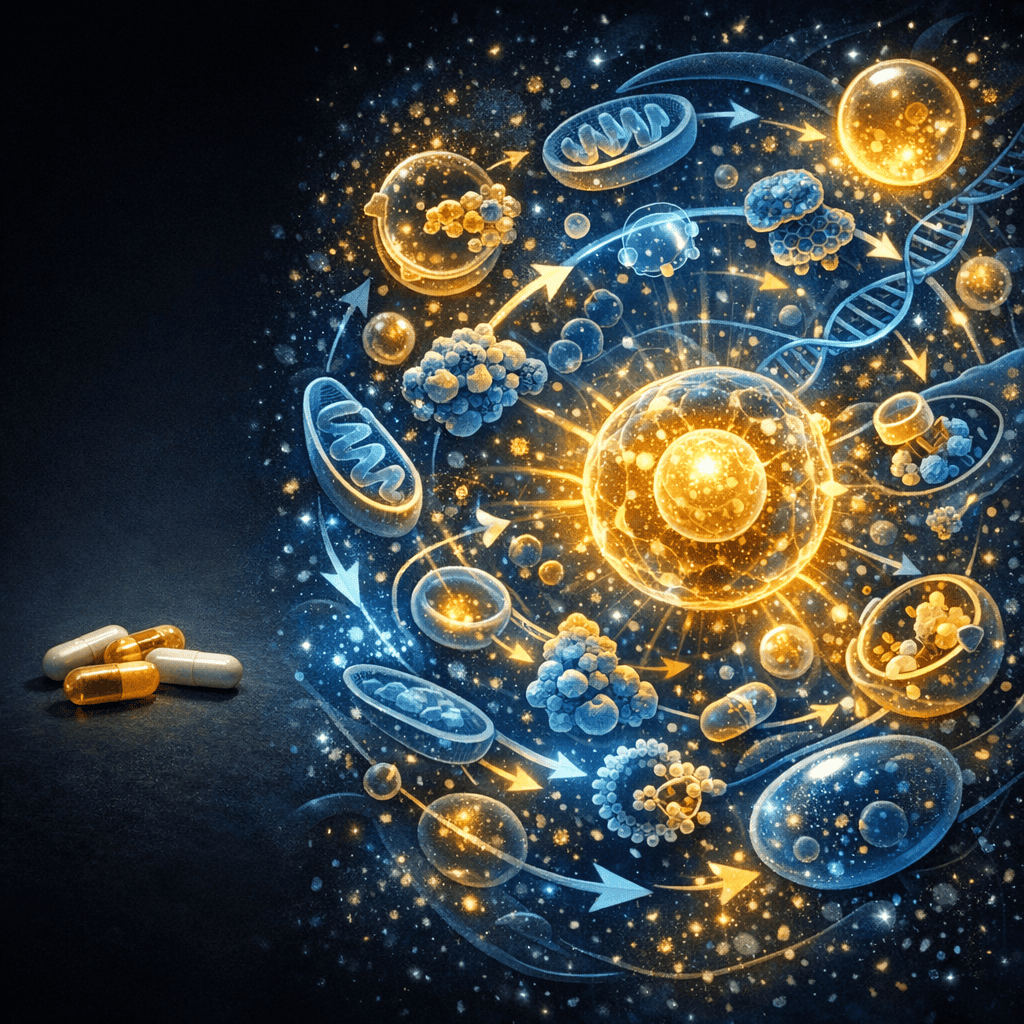

In 1956, Denham Harman proposed that ageing was caused by the accumulating damage of free radicals, the reactive molecular fragments produced as byproducts of cellular metabolism. The hypothesis was clean, testable, and it generated enormous research interest. It also produced a corollary that became one of the most commercially successful ideas in health history: if free radicals cause damage, antioxidants should prevent it. The supplement industry that grew around this idea was generating over $3 billion annually in the United States alone by the early 2000s.
The problem was that the clinical trials kept failing. High-dose antioxidant supplementation did not extend lifespan. It did not reliably prevent cancer or cardiovascular disease. Some trials found it actively made outcomes worse. The free radical theory of ageing was not wrong, exactly, but it was badly incomplete. The piece that was missing turned out to be significant: your body produces free radicals on purpose.
Dedicated Machinery for Producing Reactive Species
The clearest evidence that reactive oxygen species are not simply metabolic waste comes from NADPH oxidases, a family of enzymes whose only known function is to produce superoxide and hydrogen peroxide. These are not leaky mitochondria or malfunctioning proteins. They are purpose-built molecular machines, highly conserved across evolution, encoded in their own gene family (the NOX family), regulated by specific signalling inputs, and expressed in a tissue-specific pattern that reflects their distinct roles in different organs.
There are seven members of the NOX family in humans. NOX2 is expressed in phagocytic immune cells and is responsible for the oxidative burst used to kill pathogens. NOX4 is expressed at high levels in the kidney and produces hydrogen peroxide continuously as part of oxygen-sensing and blood pressure regulation. NOX5 is found in the testes and is involved in sperm function. DUOX1 and DUOX2 are expressed in the thyroid and airways, where they participate in thyroid hormone synthesis and airway defence, respectively.
Each of these has a specific job. None of them are accidents.
The Respiratory Burst: Intentional Chemical Warfare
The neutrophil oxidative burst is the most dramatic example of deliberate reactive oxygen species production in human biology. When a neutrophil — the most abundant white blood cell — engulfs a pathogen, it activates NOX2 at massive scale. The enzyme floods the phagosome, the compartment containing the captured pathogen, with superoxide. Superoxide is converted to hydrogen peroxide, which reacts with chloride ions via myeloperoxidase to produce hypochlorous acid — effectively household bleach, produced inside the neutrophil specifically to destroy the pathogen’s proteins and DNA.
People with chronic granulomatous disease, a genetic condition in which NOX2 is non-functional, cannot mount this oxidative burst. They suffer from severe, recurrent bacterial and fungal infections that are difficult to treat and frequently life-threatening. The absence of the free radical weapon leaves the immune system critically exposed. This is about as direct a demonstration as biology provides that reactive oxygen species are essential, not incidental.
Exercise and Hormesis: Stress That Strengthens
The concept of hormesis — biological systems becoming more robust in response to moderate stress — has accumulated substantial experimental support over the past three decades. Exercise is the paradigmatic example. Physical activity generates a burst of reactive oxygen species in working muscle, primarily from mitochondrial electron leakage at elevated metabolic rates and from NOX activity in contracting fibres.
This burst is the signal. It activates NRF2, which upregulates the cell’s antioxidant and repair machinery. It triggers mitochondrial biogenesis — the production of new mitochondria — via pathways including PGC-1α. It stimulates adaptations in muscle fibre composition, capillary density, and metabolic enzyme activity. The net result is a cell that is better equipped to handle future stress.
The hormetic nature of exercise-induced reactive species was demonstrated experimentally in a 2009 study by Ristow and colleagues, published in PNAS. Participants taking high-dose vitamin C and vitamin E supplements showed the same cardiovascular and metabolic improvements from exercise as the control group, but the cellular-level adaptations — the upregulation of antioxidant enzymes and insulin sensitivity pathways — were significantly blunted. The supplements had intercepted the signal before it could trigger the adaptive response. The free radical burst was not the problem. It was the point.
Hydrogen Peroxide as an Intercellular Messenger
Beyond immune function and exercise adaptation, hydrogen peroxide produced by NOX enzymes serves as a genuine intercellular signalling molecule in vascular biology, wound healing, and developmental processes. In blood vessel walls, hydrogen peroxide produced by NOX4 participates in the regulation of vascular tone and blood pressure through direct effects on smooth muscle cells. In wound healing, reactive oxygen species produced at the wound edge create a gradient that guides the migration of repair cells toward the injury site.
Research in zebrafish — which can be genetically modified and imaged in real time — has directly visualised hydrogen peroxide gradients spreading from wound sites and shown that disrupting these gradients impairs healing. The same gradient-forming chemistry is thought to operate in human wound repair, though direct visualisation in humans is technically harder.
What Remains Unknown
How the body maintains specificity — directing reactive species to the right place at the right time without collateral damage — is not fully understood. The concentrations, locations, and timing of intentional reactive species production must be precisely regulated for the beneficial functions to dominate over the damaging ones. The molecular mechanisms that achieve this specificity in different cell types and contexts are still being worked out.
The relationship between intentional reactive species production and the accumulation of oxidative damage in ageing is also unresolved. Does the beneficial signalling capacity of NOX-generated reactive species decline with age? Does the ratio of beneficial to damaging reactive species production shift with age, and if so, through what mechanisms? These questions have direct relevance to understanding why ageing biology looks the way it does.
The Revised Picture
Free radicals are not the story’s villains. They are dual-role players whose net effect depends on context, concentration, location, and timing. The same molecule that kills a pathogen in a neutrophil phagosome would cause damage if it escaped into surrounding tissue. The same burst of reactive species that signals exercise adaptation would be harmful if it occurred continuously at rest. Biology solved this problem through compartmentalisation, tight regulatory control, and rapid antioxidant clearance systems that mop up reactive species after they have delivered their signal.
Understanding this changes what “supporting antioxidant defences” means. It does not mean flooding the system with antioxidant supplements. It means supporting the regulatory systems — NRF2, glutathione synthesis, mitochondrial efficiency — that allow the cell to maintain appropriate reactive species levels for signalling while preventing uncontrolled accumulation. Those are meaningfully different targets.

Matt Elliott is the editor of Redox News Today, an independent publication covering peer-reviewed research on cellular health, redox signalling, and related biomedical science.