
Exercise and your cells at a glance
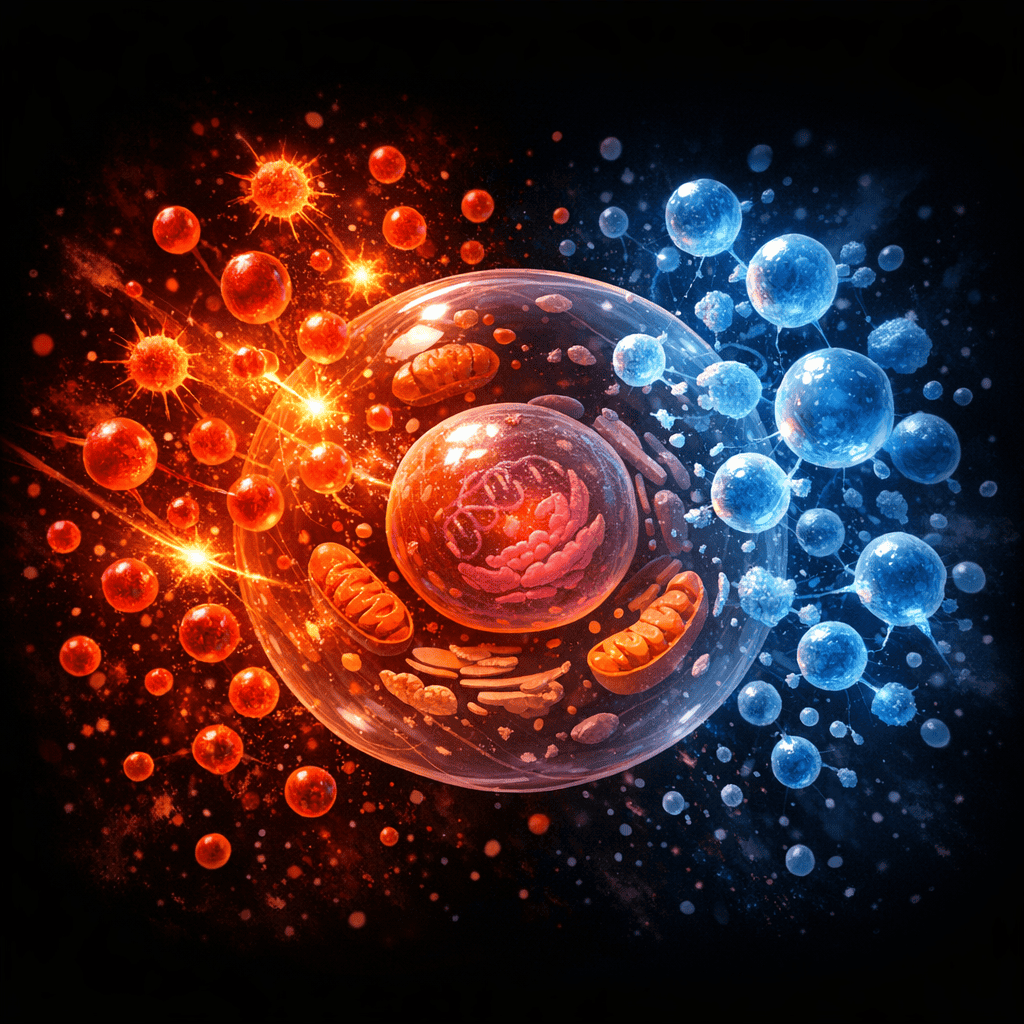
The principle: exercise is a short, controlled stress that prompts cells to adapt and become more resilient
The name for it: hormesis, a beneficial response to a moderate, usually intermittent stress
Key messengers: reactive oxygen species, NRF2 and PGC-1 alpha
What changes: more mitochondria, stronger antioxidant defences and better use of fuel
Guidelines: the WHO recommends 150 to 300 minutes of moderate activity a week for adults, plus muscle strengthening
Exercise is one of the most powerful influences on how cells work. A single session places muscles under strain, uses up fuel and produces reactive oxygen species. Repeated over weeks and months, those same stresses lead to lasting changes: more mitochondria, stronger defences and muscles that use energy more efficiently.
This guide explains what happens inside cells during and after exercise, why a moderate dose of stress can make cells stronger, how different types of training compare, and why high-dose antioxidant supplements may blunt some of the benefits. Every key point is linked to its source.
In this guide: How much exercise · Exercise as a controlled stress · Hormesis · The NRF2 response · Building mitochondria · Different types of training · Muscle as a messenger · The antioxidant question · What we still do not know · Common questions · References
How much exercise
The World Health Organization’s 2020 guidelines recommend that adults do 150 to 300 minutes of moderate-intensity aerobic activity, or 75 to 150 minutes of vigorous activity, each week, or a combination of the two. They also recommend muscle-strengthening activity on two or more days a week and reducing time spent sitting. The guidelines stress that some activity is better than none [1].
Those recommendations come from large population studies of health outcomes. The rest of this guide looks at what is happening inside cells that may help explain them.
Exercise as a controlled stress
During exercise, working muscles use far more energy and oxygen than at rest. A 2008 review in Physiological Reviews explains that both resting and contracting muscles produce reactive oxygen and nitrogen species, and that intense, prolonged exercise can cause oxidative damage to proteins and fats in muscle cells. The same review notes that these oxidants also act as signals, switching on pathways that change gene activity [2].
In other words, the oxidative stress of exercise is not simply damage to be avoided. At the right level and frequency, it is part of the message that tells cells to adapt. This idea is explained further in our guide to redox signalling.
Hormesis
The general principle has a name: hormesis. A 2008 review in Ageing Research Reviews by Mark Mattson defines it in biology and medicine as an adaptive response of cells and organisms to a moderate, usually intermittent stress. Exercise is one of the main examples, alongside dietary energy restriction and exposure to small amounts of certain plant compounds. The adaptive response involves switches such as NRF2 and increases production of protective proteins, including antioxidant enzymes [3].
A related idea, mitohormesis, proposes that a modest increase in reactive oxygen from mitochondria triggers adaptive responses that leave cells more resistant to stress. In a 2010 review, Michael Ristow and Kim Zarse suggested this may help explain some of the health-promoting effects of exercise [4]. Much of the evidence for mitohormesis comes from simple organisms, and how fully it applies to people is still debated.
The NRF2 response
NRF2 is the master regulator of the cell’s antioxidant defences, controlling more than 200 protective genes. A 2016 review in Redox Biology summarises evidence that single bouts of exercise briefly increase oxidative stress and activate NRF2, and that repeated exercise leads to a lasting increase in the body’s own antioxidant defences [5]. The review also notes that this response may weaken with age [5]. Our guide to the NRF2 pathway explains how it works.
Building mitochondria
One of the best-established effects of endurance training is an increase in mitochondria in muscle. In 1967, John Holloszy reported that endurance training in rats substantially increased the mitochondrial enzymes and oxygen-using capacity of their muscles [6], a founding finding of exercise biology.
A 2013 review in Cell Metabolism describes the molecular signals behind this response, including changes in energy levels, calcium and reactive oxygen during exercise, which converge on regulators such as PGC-1 alpha to switch on mitochondrial genes [7]. Our guide to mitochondria covers this in more detail.
Different types of training
Aerobic and resistance training sit at opposite ends of a spectrum and produce different adaptations. Endurance training mainly improves the muscle’s ability to use oxygen and fuel, while resistance training mainly increases muscle size and strength [7].
Interval training sits somewhere in between. In a 2006 study in the Journal of Physiology, 16 active young men did either six sessions of short, all-out sprint intervals or six sessions of traditional long endurance cycling over two weeks. Despite the sprint group spending about 2.5 hours exercising compared with about 10.5 hours, both groups showed similar improvements in muscle oxidative capacity and performance [8].
In a 2017 study in Cell Metabolism, younger and older adults did 12 weeks of high-intensity interval training, resistance training or a combination. All improved insulin sensitivity and lean mass, but only the interval and combined programmes improved aerobic capacity and muscle mitochondrial function. In older adults, interval training reversed many age-related differences in mitochondrial proteins [9].
Muscle as a messenger
Working muscles do not only respond to signals; they send them. A 2008 review in Physiological Reviews describes skeletal muscle as an endocrine organ, releasing proteins called myokines that act on other tissues. The first identified and most studied is interleukin-6, which can rise up to 100-fold in the blood during exercise [10].
Interleukin-6 is also known as an inflammatory signal, which created an apparent paradox. The review explains that when released by working muscle, it appears to act mainly as a metabolic signal and may have anti-inflammatory effects, illustrating how the same molecule can play different roles in different contexts [10]. Our guide to inflammation explains the wider picture.
The antioxidant question
If reactive oxygen helps trigger adaptation, it raises a question about antioxidant supplements. In a 2009 study in the Proceedings of the National Academy of Sciences, 39 young men did four weeks of exercise training, some with high-dose vitamin C and vitamin E supplements. Improvements in insulin sensitivity, along with increases in the body’s own defence genes, were seen only in those not taking the supplements [11].
A 2008 study in the American Journal of Clinical Nutrition, combining a small human trial with experiments in rats, reported that vitamin C supplementation hampered some training adaptations in endurance capacity [12].
Both studies were small, and later research has produced mixed results, so the question remains open. But they fit the broader picture described in our guide to oxidative stress: the aim of the body’s systems is balance, and blocking reactive oxygen indiscriminately may interfere with normal signals.
What we still do not know
Researchers are still working out how the many signals produced during exercise fit together, and why people vary so much in how they respond to the same training [7]. The question of whether and when antioxidant supplements blunt training adaptations in people has not been settled [11, 12].
It is also not fully understood how exercise adaptations change with age, or which forms of exercise best maintain cellular health in older adults, although studies such as the 2017 interval training trial suggest older muscle remains responsive [5, 9].
Common questions
Does exercise cause oxidative stress?
Yes, briefly. Exercising muscles produce more reactive oxygen species, and intense or prolonged exercise can cause some oxidative damage. These same molecules also act as signals that help cells adapt [2].
What is hormesis?
It is an adaptive response of cells and organisms to a moderate, usually intermittent stress, such as exercise, that leaves them more resilient [3].
Does exercise increase mitochondria?
Yes. Endurance and interval training increase mitochondrial content and function in muscle, a finding first shown in animals in the 1960s and confirmed in human studies [6, 8, 9].
Should you take antioxidants after exercise?
Small studies suggest high-dose vitamin C and E may blunt some training adaptations, though results are mixed [11, 12]. This guide reports research and is not a recommendation for or against any supplement.
How much exercise is recommended?
The WHO recommends 150 to 300 minutes of moderate activity, or 75 to 150 minutes of vigorous activity, a week for adults, plus muscle strengthening on two or more days [1].
Further reading: Glutathione explained · Ferroptosis explained · Oxidative stress explained · Sleep and cellular repair
References
- Bull FC, Al-Ansari SS, Biddle S, et al. (2020). World Health Organization 2020 guidelines on physical activity and sedentary behaviour. British Journal of Sports Medicine. https://doi.org/10.1136/bjsports-2020-102955
- Powers SK, Jackson MJ. (2008). Exercise-induced oxidative stress: cellular mechanisms and impact on muscle force production. Physiological Reviews. https://doi.org/10.1152/physrev.00031.2007
- Mattson MP. (2008). Hormesis defined. Ageing Research Reviews. https://doi.org/10.1016/j.arr.2007.08.007
- Ristow M, Zarse K. (2010). How increased oxidative stress promotes longevity and metabolic health: the concept of mitochondrial hormesis (mitohormesis). Experimental Gerontology. https://doi.org/10.1016/j.exger.2010.03.014
- Done AJ, Traustadóttir T. (2016). Nrf2 mediates redox adaptations to exercise. Redox Biology. https://doi.org/10.1016/j.redox.2016.10.003
- Holloszy JO. (1967). Biochemical adaptations in muscle: effects of exercise on mitochondrial oxygen uptake and respiratory enzyme activity in skeletal muscle. Journal of Biological Chemistry. https://doi.org/10.1016/S0021-9258(18)96046-1
- Egan B, Zierath JR. (2013). Exercise metabolism and the molecular regulation of skeletal muscle adaptation. Cell Metabolism. https://doi.org/10.1016/j.cmet.2012.12.012
- Gibala MJ, Little JP, van Essen M, et al. (2006). Short-term sprint interval versus traditional endurance training: similar initial adaptations in human skeletal muscle and exercise performance. Journal of Physiology. https://doi.org/10.1113/jphysiol.2006.112094
- Robinson MM, Dasari S, Konopka AR, et al. (2017). Enhanced protein translation underlies improved metabolic and physical adaptations to different exercise training modes in young and old humans. Cell Metabolism. https://doi.org/10.1016/j.cmet.2017.02.009
- Pedersen BK, Febbraio MA. (2008). Muscle as an endocrine organ: focus on muscle-derived interleukin-6. Physiological Reviews. https://doi.org/10.1152/physrev.90100.2007
- Ristow M, Zarse K, Oberbach A, et al. (2009). Antioxidants prevent health-promoting effects of physical exercise in humans. Proceedings of the National Academy of Sciences. https://doi.org/10.1073/pnas.0903485106
- Gomez-Cabrera MC, Domenech E, Romagnoli M, et al. (2008). Oral administration of vitamin C decreases muscle mitochondrial biogenesis and hampers training-induced adaptations in endurance performance. American Journal of Clinical Nutrition. https://doi.org/10.1093/ajcn/87.1.142
Redox News Today reports on published research for general interest. This guide is not medical advice. Last reviewed October 2026.

Matt Elliott is the editor of Redox News Today, an independent publication covering peer-reviewed research on cellular health, redox signalling, and related biomedical science.