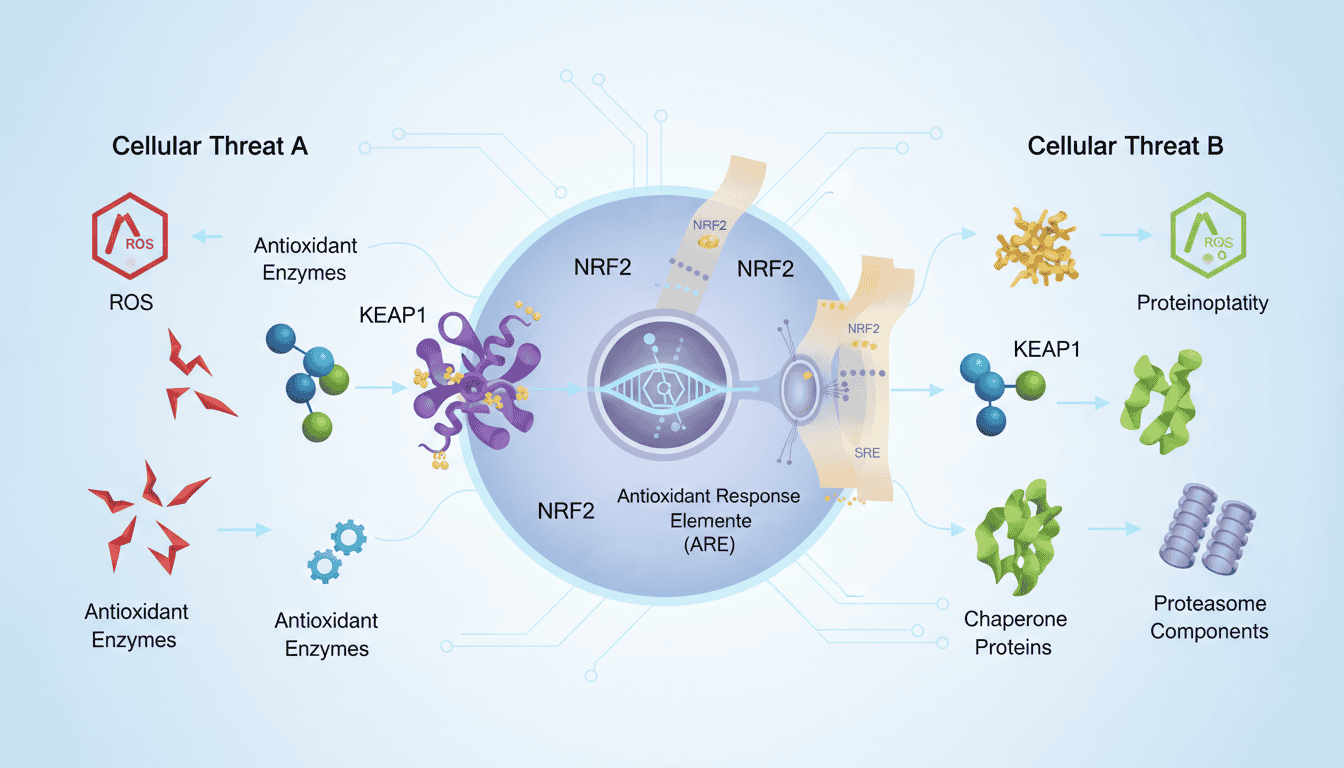
Your cells face a constant barrage of threats. Toxic chemicals sneak in through contaminated air, free radicals build up from normal metabolism, heavy metals accumulate from environmental exposure, and inflammatory signals cascade through tissues. Yet somehow, your cells mount surprisingly specific responses to each type of danger. The NRF2 pathway acts like a sophisticated security system, not just detecting trouble but tailoring its response to match the specific threat at hand.
What is the NRF2 stress response system
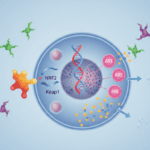
The NRF2 pathway functions as your cells’ primary defence coordinator against oxidative and chemical stress. NRF2 itself is a transcription factor that normally sits in the cytoplasm, bound to a protein called KEAP1 that keeps it inactive. Think of KEAP1 as a molecular anchor holding NRF2 in place.
When cells detect stress, this changes. KEAP1 contains multiple cysteine residues that act like molecular sensors, each responding to different types of cellular damage. When these sensors detect trouble, KEAP1 releases its grip on NRF2. The freed NRF2 then travels to the nucleus and switches on genes that produce antioxidant enzymes, detoxification proteins, and repair mechanisms.
But here’s where it gets interesting. The pathway doesn’t just turn on or off like a simple switch. Different stressors trigger different patterns of gene activation, creating tailored cellular responses.
What the research shows
Scientists have discovered that NRF2 responds distinctly to different categories of stress. Electrophilic compounds, like those found in exhaust fumes or certain plant chemicals, directly modify KEAP1’s cysteine sensors. This triggers rapid NRF2 activation and upregulates phase II detoxification enzymes within hours.
Oxidative stress from free radicals creates a different response pattern. Here, NRF2 activation is often slower but more sustained, prioritising antioxidant enzyme production over detoxification pathways. Researchers have observed that hydrogen peroxide exposure, for instance, leads to prolonged activation of genes like those encoding glutathione peroxidase and catalase.
Heavy metal exposure presents yet another pattern. Lead, cadmium, and mercury don’t just trigger general stress responses. They activate specific NRF2 target genes involved in metal sequestration and transport, whilst simultaneously boosting general antioxidant defences. The cellular response recognises both the direct toxicity of metals and the oxidative damage they cause.
Inflammatory stress adds another layer of complexity. Pro-inflammatory cytokines can activate NRF2, but they also compete with it. The balance determines whether cells mount an effective antioxidant response or get overwhelmed by chronic inflammation.
Why cells need this adaptive response
Evolution preserved this sophisticated detection system because different threats require different solutions. A cell facing pesticide exposure needs different tools than one dealing with radiation damage or bacterial toxins.
Consider the efficiency problem. Constantly running every possible defence mechanism would waste enormous amounts of cellular energy and resources. Instead, cells evolved to match their response to the specific challenge. When NRF2 detects electrophilic stress, it prioritises enzymes that neutralise reactive chemicals. When it senses metal toxicity, it ramps up proteins that bind and remove metals.
This specificity also prevents cellular chaos. Different stress responses can sometimes work against each other if activated simultaneously. The NRF2 system coordinates these potentially conflicting pathways, ensuring cells mount coherent rather than contradictory responses.
The pathway also integrates information from multiple stress signals. Real-world exposures rarely involve just one type of damage. Cigarette smoke contains oxidants, heavy metals, and organic toxins all at once. NRF2 weighs these different inputs and creates a composite response that addresses the full spectrum of threats.
What affects NRF2 stress responses
Age significantly impacts how well NRF2 responds to different stressors. Research shows that KEAP1 sensitivity decreases with age, meaning older cells often show delayed or blunted responses to chemical threats. The genes NRF2 activates also change their expression patterns over time, leading to less effective stress responses in ageing tissues.
Genetic variations play a major role too. Polymorphisms in NRF2 itself or in KEAP1 can alter how sensitive the pathway is to different types of stress. Some variants make people more responsive to dietary compounds that activate NRF2, whilst others may increase vulnerability to environmental toxins.
Chronic stress exposure creates another complication. Repeated activation of NRF2 by the same stressor can lead to adaptation, where cells become less responsive over time. Paradoxically, this can make cells more vulnerable to different types of stress they haven’t encountered before.
Diet influences NRF2 stress responses in unexpected ways. Compounds in cruciferous vegetables, green tea, and turmeric can prime the pathway, making it more responsive to subsequent stressors. But this isn’t always beneficial. An over-activated NRF2 system might interfere with normal cellular signalling.
Sleep and circadian rhythms also matter. NRF2 activity follows daily cycles, with peak responsiveness occurring at specific times. Shift work and sleep disruption can desynchronise these rhythms, potentially making cells more vulnerable to stress at certain times of day.
What remains unknown
Scientists still don’t fully understand how NRF2 integrates complex, multi-faceted stress signals. When cells face simultaneous oxidative stress, chemical exposure, and inflammation, the exact mechanisms that determine the final response remain unclear. Why does the pathway sometimes prioritise one type of response over another?
The role of tissue-specific factors presents another puzzle. NRF2 responses vary dramatically between different cell types and organs, but researchers are still mapping these differences. Liver cells respond differently to the same stressor than brain or lung cells, yet the underlying mechanisms aren’t well understood.
Timing questions persist as well. Some research suggests that brief, mild stress activation of NRF2 might be beneficial, whilst chronic activation could be harmful. But the thresholds between helpful and harmful remain poorly defined for different types of stressors.
The interaction between NRF2 and other cellular stress pathways also needs more research. Heat shock responses, DNA damage checkpoints, and metabolic stress pathways all crosstalk with NRF2 signalling, but scientists are still working out how these systems coordinate their activities.
The NRF2 pathway reveals something profound about cellular biology: even our smallest components are far more sophisticated than they first appear. Rather than simple on-off switches, cells operate nuanced defence systems that evaluate threats, weigh options, and deploy targeted responses. Understanding these mechanisms helps explain not just how cells survive in a hostile environment, but how they maintain the delicate balance between protection and normal function that keeps complex organisms alive.

Matt Elliott is the editor of Redox News Today, an independent publication covering peer-reviewed research on cellular health, redox signalling, and related biomedical science.