Your cells face the same challenge every day for decades: staying functional while under constant attack. Free radicals bombard cellular structures. Toxins slip past defences. Proteins misfold and pile up like biological rubbish. Yet some people maintain sharp minds and strong bodies well into their 90s while others decline rapidly. The difference often comes down to how well their cells can activate a master regulator called NRF2.
What is NRF2
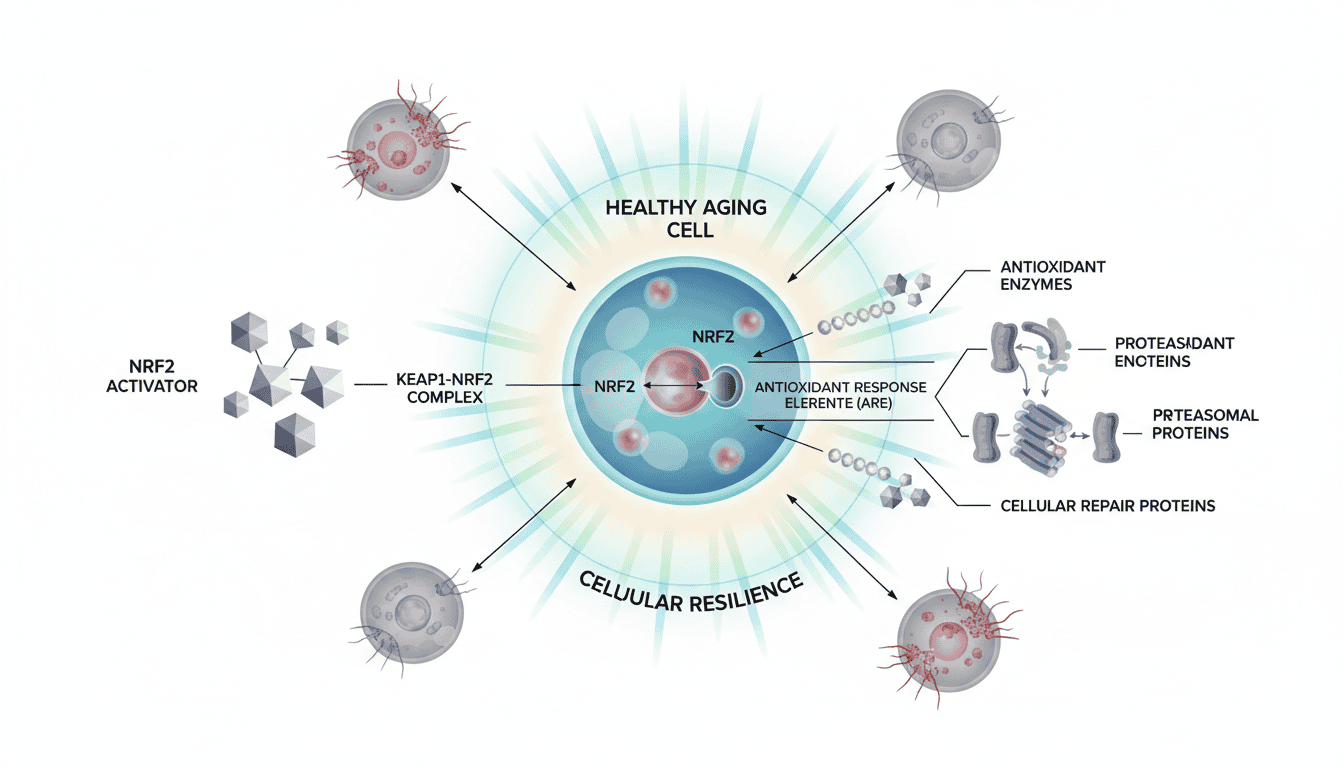
NRF2 stands for Nuclear factor erythroid 2-related factor 2. The name sounds like committee jargon, but this protein acts as your cell’s emergency coordinator. Under normal conditions, NRF2 stays locked in the cytoplasm by its molecular jailer, KEAP1. This protein partnership keeps the system quiet when cells don’t need extra protection.
When oxidative stress strikes, everything changes. Reactive molecules modify KEAP1, loosening its grip on NRF2. The freed transcription factor rushes to the nucleus and binds to DNA sequences called antioxidant response elements. Within minutes, NRF2 switches on over 200 protective genes.
Think of it like a fire station. Most of the time, firefighters wait on standby. But when the alarm sounds, they spring into coordinated action. NRF2 works similarly, mobilising cellular defences only when needed. This on-demand system prevents cells from wasting energy on unnecessary protection while ensuring rapid response to real threats.
What the research shows
Studies reveal that NRF2 activity declines with age. Researchers found that older adults show reduced NRF2 signalling compared to younger people, even in the absence of disease. This decline correlates with increased cellular damage and slower repair processes.
Laboratory experiments demonstrate what happens when NRF2 stops working properly. Mice engineered without functional NRF2 age faster than normal mice. Their organs accumulate more damage. Their cells struggle to clear waste products. They develop age-related problems earlier and more severely.
The opposite also holds true. When scientists activate NRF2 in laboratory animals, the results paint a different picture. These animals maintain better organ function as they age. Their cells produce more antioxidant enzymes. They clear damaged proteins more efficiently. Some studies show extended healthy lifespan, though the animals don’t necessarily live longer overall.
Human studies reveal similar patterns. People with genetic variations that boost NRF2 activity often show markers of healthier ageing. Their cells produce more protective enzymes. They have lower levels of inflammatory markers. Their cellular powerhouses, the mitochondria, function more efficiently even in advanced age.
Why cells need this
Ageing creates a perfect storm of cellular stress. Mitochondria produce more damaging byproducts as they wear out. DNA repair systems slow down, allowing mutations to accumulate. Proteins lose their shape more easily and stick together in toxic clumps. Meanwhile, the cellular cleanup crew becomes less efficient at removing this molecular debris.
NRF2 activation addresses multiple aspects of this problem simultaneously. It ramps up antioxidant enzyme production to neutralise free radicals before they cause damage. It enhances protein quality control systems that identify and remove misfolded proteins. It supports mitochondrial function by boosting protective factors and improving energy production efficiency.
The system also coordinates with cellular recycling processes called autophagy. When NRF2 activates, it helps cells break down and recycle damaged components more effectively. This prevents the accumulation of cellular junk that characterises aged tissues.
Evolution preserved this mechanism because organisms that could better handle cellular stress lived longer and reproduced more successfully. Those with more robust NRF2 systems survived environmental challenges, passed on their genes, and maintained function during extended lifespans that allowed for greater reproductive success.
What affects NRF2
Age itself represents the biggest factor reducing NRF2 function. The protein doesn’t disappear, but cells become less responsive to signals that should trigger its activation. This phenomenon, called inflammaging, creates a vicious cycle where reduced protection leads to more damage, which further impairs protective systems.
Lifestyle factors significantly influence NRF2 activity. Regular exercise activates the pathway by creating controlled oxidative stress that triggers protective responses. Physical activity essentially teaches cells to respond more robustly to challenges.
Certain compounds in foods can also influence the system. Sulforaphane from cruciferous vegetables, curcumin from turmeric, and compounds found in green tea all interact with the KEAP1-NRF2 pathway. These molecules don’t directly activate NRF2 but create mild stress that prompts cells to boost their defences.
Environmental toxins have the opposite effect. Chronic exposure to pollutants, cigarette smoke, and industrial chemicals can overwhelm NRF2 systems. The pathway becomes exhausted from constant activation, eventually losing its ability to respond effectively to new threats.
Sleep quality affects NRF2 function through its connection to cellular stress and repair cycles. Poor sleep increases oxidative stress while reducing the time cells have for maintenance and recovery. Chronic sleep deprivation correlates with reduced NRF2 activity and accelerated cellular ageing markers.
What remains unknown
Scientists still puzzle over why NRF2 activity declines with age in the first place. Is this programmed obsolescence, an evolutionary feature that prevents very old individuals from competing with younger ones? Or does it represent accumulated damage to the regulatory system itself? The answer could determine whether this decline is reversible or inevitable.
Researchers also debate optimal NRF2 activity levels. Too little leaves cells vulnerable to damage. But constant high activation might interfere with normal cellular processes or even promote certain types of cancer cell survival. Finding the sweet spot between protection and function remains an active area of investigation.
The interaction between NRF2 and other longevity pathways needs more research. How does it coordinate with systems like AMPK, mTOR, and sirtuins? Understanding these connections could reveal new approaches to supporting healthy ageing at the cellular level.
Individual variation in NRF2 function also raises questions. Some people maintain robust activation well into old age while others show early decline. Genetics plays a role, but environmental factors and lifestyle choices clearly matter too. Identifying what creates these differences could help explain why some individuals age more successfully than others.
The NRF2 story illustrates a fundamental principle of cellular biology: successful ageing depends on maintaining quality control systems that prevent damage from accumulating faster than cells can repair it. As researchers unravel more details about this pathway, they’re building a clearer picture of how cellular defence mechanisms influence the pace and quality of human ageing. The question isn’t whether we can stop ageing entirely, but whether we can help our cells age more gracefully by supporting the systems evolution already gave us.

Matt Elliott is the editor of Redox News Today, an independent publication covering peer-reviewed research on cellular health, redox signalling, and related biomedical science.