Inflammation at a glance
What it is: the body’s coordinated response to infection, injury and tissue stress
Two faces: short-lived inflammation is essential for survival; persistent low-grade inflammation is linked to many chronic diseases
Key switches: NF-kappaB and protein complexes called inflammasomes
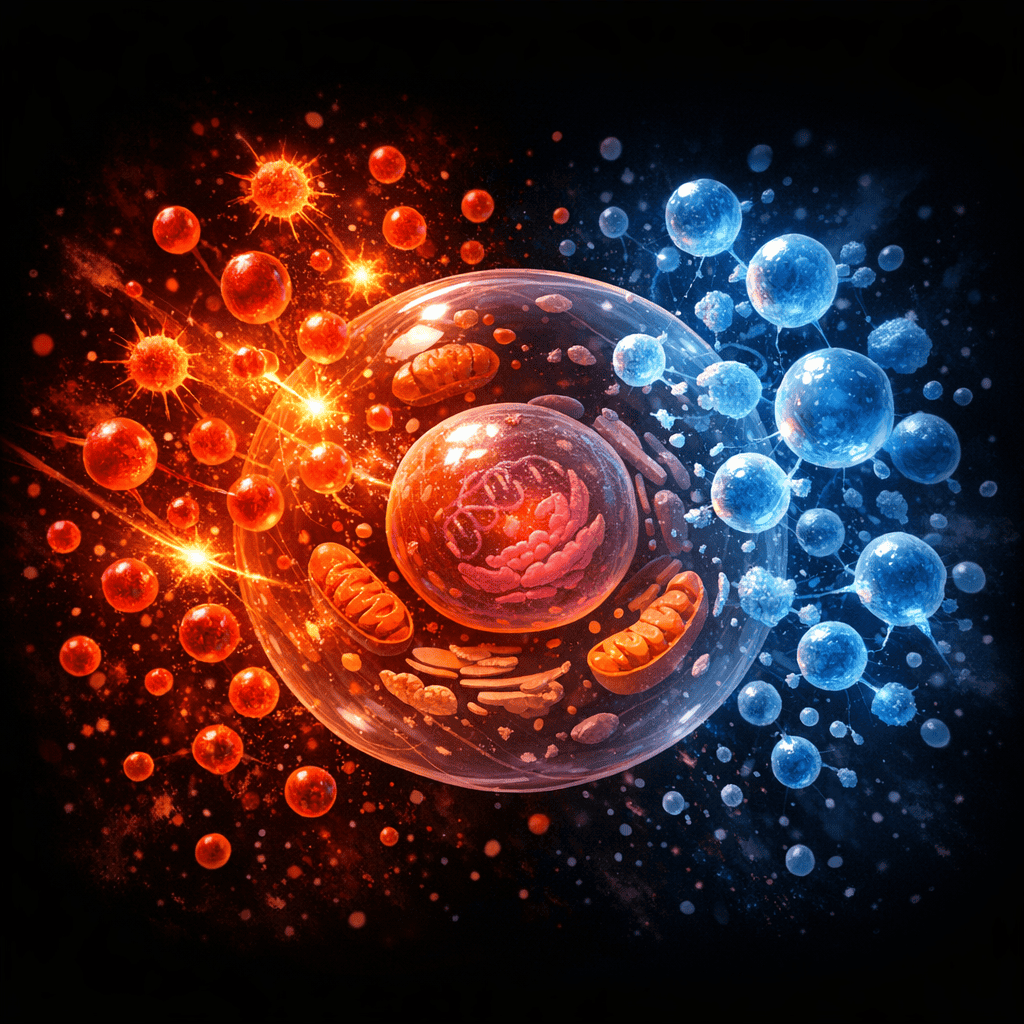
The redox link: immune cells use bursts of reactive oxygen to kill microbes, and reactive oxygen helps trigger inflammatory signals
Switching it off: an active process, driven partly by specialised lipid mediators
Inflammation is one of the body’s oldest and most important defences. The redness, heat, swelling and pain around a cut or infection are signs of immune cells and proteins arriving to fight invaders and begin repairs. Without inflammation, minor infections could become fatal.
Yet inflammation is also implicated in many of the chronic diseases of modern life, from heart disease to type 2 diabetes. This guide explains what inflammation is at the level of cells, how it is switched on and off, how it connects to redox biology, and what the research shows about its chronic, low-grade form. Every key point is linked to its source.
In this guide: What inflammation is · How inflammation switches on · The redox connection · How inflammation switches off · Chronic low-grade inflammation · How inflammation is measured · Testing the inflammation idea · What we still do not know · Common questions · References
What inflammation is
In a 2008 review in Nature, the immunologist Ruslan Medzhitov describes inflammation as an adaptive response to harmful conditions. Infection and tissue injury are its classic triggers, drawing white blood cells and blood proteins to the affected area. But Medzhitov also describes a milder, intermediate state he calls para-inflammation, a response to tissue stress or malfunction carried out mainly by immune cells already living in the tissue. He suggests that this state is probably responsible for the chronic inflammatory conditions associated with many modern diseases [1].
That framework is useful because it shows inflammation as a spectrum. At one end is the vigorous, short-lived response to an infection. At the other is a persistent, low-level activation that may continue for years without obvious symptoms.
How inflammation switches on
Sensing danger. Immune cells carry receptors that recognise features common to microbes, as well as signals released by damaged cells. When these receptors are triggered, they activate signalling pathways inside the cell.
NF-kappaB. One of the central switches is a transcription factor called NF-kappaB. A 2008 review in Cell describes how a wide range of stimuli activate it and how it controls a large number of genes, including many that produce inflammatory signalling proteins called cytokines [2].
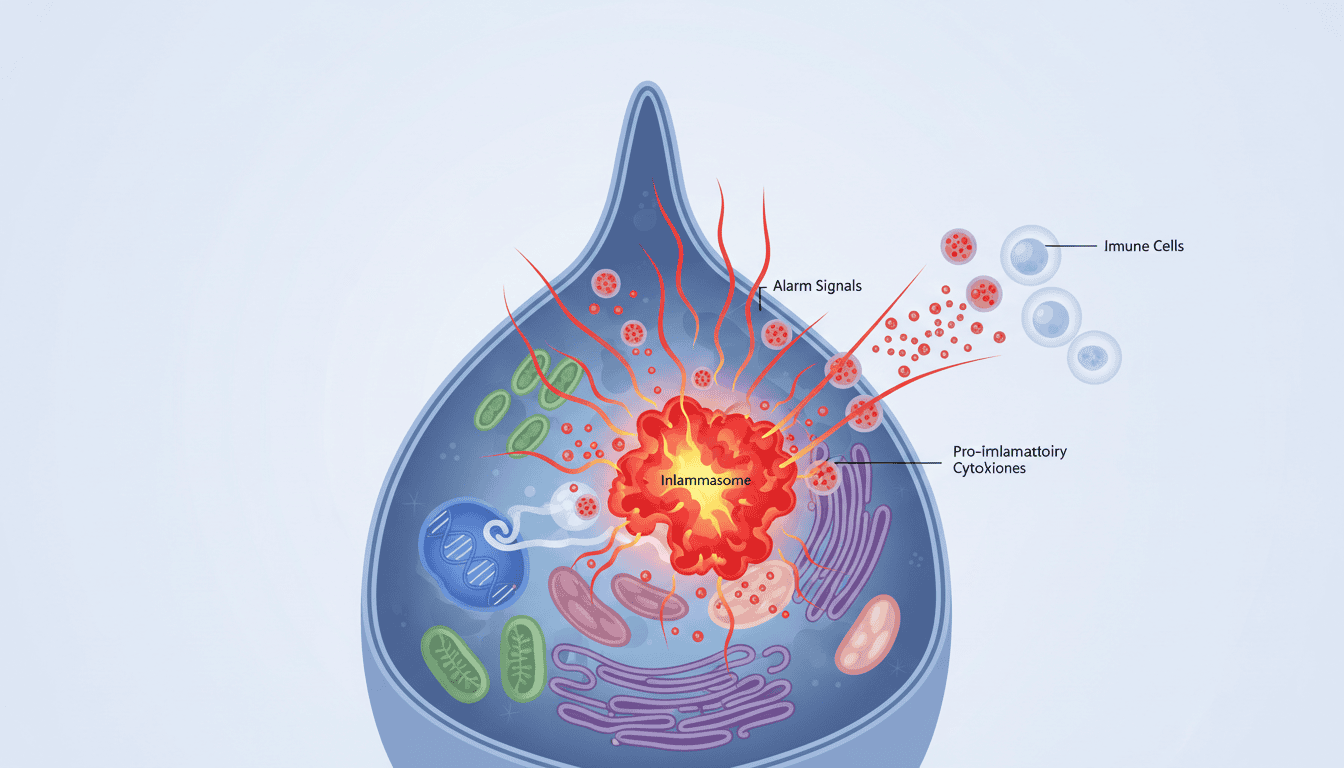
Inflammasomes. In 2002, Jürg Tschopp and colleagues described a protein complex they named the inflammasome. It activates an enzyme that converts an inactive precursor into interleukin-1 beta, one of the most powerful inflammatory cytokines [3]. Inflammasomes act as alarm systems, responding to infection and to signs of cellular stress.
The redox connection
Inflammation and redox biology are closely linked in both directions.
Reactive oxygen as a weapon. White blood cells called neutrophils use an enzyme, NADPH oxidase, to produce a rapid burst of reactive oxygen that helps kill bacteria and fungi. A 2004 review in Nature Reviews Immunology describes this system and how related NOX enzymes in other tissues produce reactive oxygen for signalling [4].
Reactive oxygen as a trigger. Reactive oxygen can also help switch inflammation on. A 2011 study in Nature found that when damaged mitochondria are not cleared away, they accumulate and produce reactive oxygen that activates one of the main inflammasomes, NLRP3 [5]. This links mitochondrial health, described in our guide to mitochondria, directly to inflammation.
The same reactive molecules that drive inflammation also act as normal signals at low levels, as explained in our guide to redox signalling. As elsewhere in redox biology, the amount, timing and location matter.
How inflammation switches off
For a long time, the end of inflammation was assumed to be passive: once the trigger was gone, the signals simply faded. Research led by Charles Serhan has shown that resolution is an active process. A 2014 review in Nature describes a family of molecules made from fatty acids, including omega-3 fatty acids, called specialised pro-resolving mediators. They include lipoxins, resolvins, protectins and maresins, and in animal experiments they help end inflammation, clear debris and microbes, and support tissue repair [6].
This matters because chronic inflammation may reflect not only too much switching on but also a failure to switch off properly. Much of the evidence for these mediators comes from animal studies, and their role in human disease is still being explored [6].
Chronic low-grade inflammation
A 2019 perspective in Nature Medicine by an international group of researchers describes systemic chronic inflammation as a state that differs from the short, intense response to injury or infection. The authors argue that it contributes to several of the leading causes of disability and death worldwide, including cardiovascular disease, cancer, diabetes, chronic kidney disease, fatty liver disease, and autoimmune and neurodegenerative disorders. They list factors that may promote it, including infections, physical inactivity, poor diet, environmental pollutants and psychological stress [7].
With age, many people develop this kind of persistent inflammation, which researchers call inflammaging. A 2018 review describes its sources, including cell debris, senescent cells, excess nutrients and signals from gut microbes [8]. Our guide to the biology of ageing covers chronic inflammation as one of the hallmarks of ageing. Sleep also plays a part, as described in our guide to sleep and cellular repair.
How inflammation is measured
The most widely used blood marker is C-reactive protein, or CRP, produced by the liver in response to inflammatory signals. A 2003 review in the Journal of Clinical Investigation describes how CRP levels rise sharply during infection and injury, and how slightly raised levels in otherwise healthy people have been associated with cardiovascular risk [9]. Other commonly measured markers include the cytokines interleukin-6 and tumour necrosis factor.
These markers are useful in research and in some clinical settings, but a single reading reflects many influences, including recent infections, and does not show where in the body inflammation is happening.
Testing the inflammation idea
Showing that inflammation contributes to disease, rather than simply accompanying it, requires trials that reduce inflammation and measure outcomes. The best known is CANTOS, published in the New England Journal of Medicine in 2017. More than 10,000 people who had previously had a heart attack and had raised CRP were given an antibody that blocks interleukin-1 beta or a placebo [10].
At one of the doses tested, the treatment reduced recurrent cardiovascular events by about 15 per cent compared with placebo, without lowering cholesterol. However, it was also associated with more fatal infections, and there was no significant difference in overall death rates [10]. The trial supported the idea that inflammation contributes to heart disease, while illustrating the risks of suppressing a system the body depends on for defence.
What we still do not know
It is still unclear how best to define and measure chronic low-grade inflammation in individuals, and which markers best predict disease [7, 9]. It is also uncertain how much chronic inflammation causes disease and how much is a consequence of it, since the relationship appears to run in both directions [7, 8].
Finally, as CANTOS showed, dampening inflammation can bring benefits and costs at the same time [10]. Finding ways to restore balance, including by supporting resolution rather than simply blocking inflammation, is an active area of research [6].
Common questions
Is inflammation good or bad?
Both. Short-lived inflammation is essential for fighting infection and healing injury. Persistent low-grade inflammation is linked to many chronic diseases [1, 7].
What is the difference between acute and chronic inflammation?
Acute inflammation is a rapid, intense and short-lived response to infection or injury. Chronic inflammation is persistent and often low-grade, and may continue without obvious symptoms [1, 7].
How is inflammation linked to oxidative stress?
Immune cells use reactive oxygen to kill microbes, and reactive oxygen from damaged mitochondria can help trigger inflammatory signalling [4, 5].
What is inflammaging?
It is the persistent, low-grade inflammation that tends to develop with age, sustained by sources such as cell debris, senescent cells and signals from gut microbes [8].
How does inflammation end?
Through an active process involving specialised pro-resolving mediators made from fatty acids, which help clear debris and restore tissue [6].
Further reading: Glutathione explained · Ferroptosis explained · Oxidative stress explained · Exercise and your cells
References
- Medzhitov R. (2008). Origin and physiological roles of inflammation. Nature. https://doi.org/10.1038/nature07201
- Hayden MS, Ghosh S. (2008). Shared principles in NF-kappaB signaling. Cell. https://doi.org/10.1016/j.cell.2008.01.020
- Martinon F, Burns K, Tschopp J. (2002). The inflammasome: a molecular platform triggering activation of inflammatory caspases and processing of proIL-beta. Molecular Cell. https://doi.org/10.1016/S1097-2765(02)00599-3
- Lambeth JD. (2004). NOX enzymes and the biology of reactive oxygen. Nature Reviews Immunology. https://doi.org/10.1038/nri1312
- Zhou R, Yazdi AS, Menu P, et al. (2011). A role for mitochondria in NLRP3 inflammasome activation. Nature. https://doi.org/10.1038/nature09663
- Serhan CN. (2014). Pro-resolving lipid mediators are leads for resolution physiology. Nature. https://doi.org/10.1038/nature13479
- Furman D, Campisi J, Verdin E, et al. (2019). Chronic inflammation in the etiology of disease across the life span. Nature Medicine. https://doi.org/10.1038/s41591-019-0675-0
- Franceschi C, Garagnani P, Parini P, et al. (2018). Inflammaging: a new immune-metabolic viewpoint for age-related diseases. Nature Reviews Endocrinology. https://doi.org/10.1038/s41574-018-0059-4
- Pepys MB, Hirschfield GM. (2003). C-reactive protein: a critical update. Journal of Clinical Investigation. https://doi.org/10.1172/JCI18921
- Ridker PM, Everett BM, Thuren T, et al. (2017). Antiinflammatory therapy with canakinumab for atherosclerotic disease. New England Journal of Medicine. https://doi.org/10.1056/NEJMoa1707914
Redox News Today reports on published research for general interest. This guide is not medical advice. Last reviewed October 2026.

Matt Elliott is the editor of Redox News Today, an independent publication covering peer-reviewed research on cellular health, redox signalling, and related biomedical science.