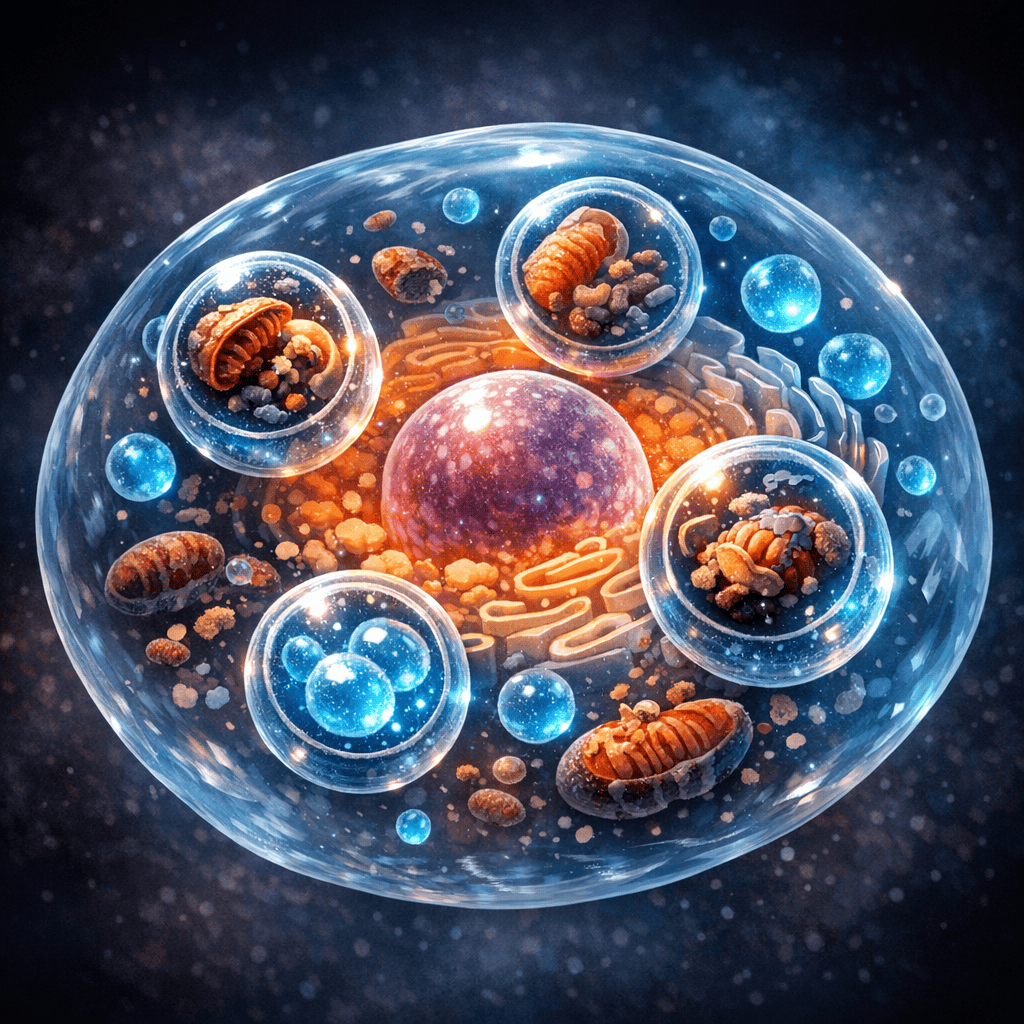
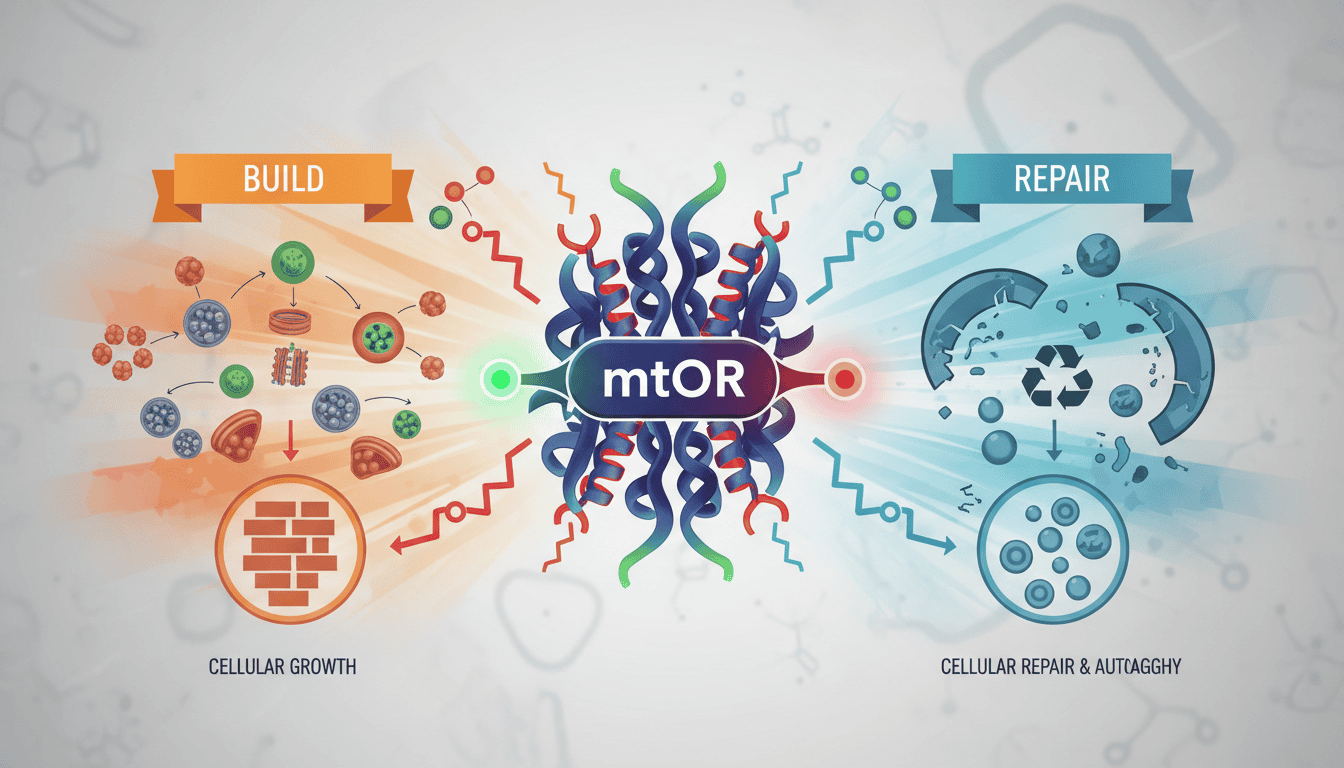
Inside every cell in your body sits a molecular switch that decides whether to build new proteins, grow bigger, or hunker down and repair damage. This switch, called mTOR, constantly monitors the cell’s environment for nutrients, energy levels, and growth signals. When resources are abundant, mTOR flicks on and the cell enters construction mode. When times are lean, it switches off and the cell focuses on maintenance instead.
What is mTOR
mTOR stands for mechanistic Target of Rapamycin, named after the drug rapamycin that blocks its activity. Think of mTOR as a cellular foreman who decides when to start building projects and when to call them off. This protein sits at the centre of a complex signalling network that integrates information from multiple sources: available amino acids, glucose levels, cellular energy status, growth hormones, and even oxygen levels.
The protein exists in two distinct complexes called mTORC1 and mTORC2. mTORC1 handles most of the growth-related decisions. When it’s active, it tells ribosomes to crank out new proteins, pushes cells to make more mitochondria, and encourages the synthesis of lipids for new membranes. mTORC2 focuses more on cell survival and metabolism, helping cells respond to insulin and organise their internal structure.
Every cell type uses mTOR, but the consequences of its activation vary dramatically. In muscle cells, active mTOR promotes protein synthesis that builds bigger, stronger fibres. In immune cells, it drives rapid multiplication to fight infections. In neurons, it supports the growth of new connections between brain cells.
What the research shows
Scientists have discovered that mTOR activity follows predictable patterns throughout life and responds to environmental changes in remarkable ways. When researchers feed laboratory animals high-protein diets, mTOR activity spikes and the animals grow faster but often age more quickly too. Conversely, when they restrict calories or use rapamycin to block mTOR, animals typically live longer and show fewer age-related diseases.
Studies in human cells reveal that mTOR becomes dysregulated with age. Older cells often show chronically elevated mTOR activity even when nutrients are scarce. This persistent activation appears to contribute to cellular dysfunction because the cells keep trying to grow instead of focusing on repair and maintenance.
Exercise creates particularly interesting mTOR patterns. Resistance training temporarily spikes mTOR activity in muscle cells, promoting the protein synthesis that builds strength. But endurance exercise can suppress mTOR activity, potentially triggering beneficial stress responses that improve cellular resilience.
Cancer research has revealed mTOR’s darker side. Tumour cells hijack mTOR signalling to fuel uncontrolled growth and survival. Many cancer cells show hyperactive mTOR even when normal growth-limiting signals are present, which helps explain their aggressive behaviour.
Why cells need this
Evolution preserved mTOR because cells face a fundamental trade-off between growth and longevity. Building new proteins and cellular components requires enormous energy and resources. A cell that’s constantly in construction mode will eventually accumulate damage and wear out faster than one that balances growth with repair.
mTOR helps cells navigate this trade-off intelligently. When food is plentiful and conditions are favourable, it makes evolutionary sense to grow, reproduce, and build tissues rapidly. But when resources become scarce or stress levels rise, cells need to shift into conservation mode, recycling damaged components and maintaining essential functions until better times return.
This switching mechanism becomes particularly important during development and reproduction. Growing children and pregnant women need robust mTOR activity to build new tissues. But the same level of activity that supports healthy development in youth can become problematic in later life when the focus should shift toward maintenance and quality control.
The system also provides crucial flexibility for different cell types to respond appropriately to changing demands. Muscle cells can ramp up protein production after exercise, immune cells can multiply rapidly during infections, and brain cells can strengthen connections during learning, all while maintaining the ability to dial back activity when the immediate need passes.
What affects mTOR
Diet exerts perhaps the strongest influence over mTOR activity. Amino acids, particularly leucine, directly activate the mTORC1 complex. This explains why protein-rich meals trigger anabolic responses in muscle tissue. Glucose and insulin also stimulate mTOR, creating the metabolic conditions that favour growth and storage over breakdown and repair.
Physical activity creates complex mTOR responses that depend on the type, intensity, and duration of exercise. High-intensity resistance training typically increases mTOR activity in worked muscles for several hours afterward. Prolonged endurance exercise often suppresses mTOR activity, potentially contributing to the cellular adaptations that improve endurance capacity.
Age gradually shifts mTOR signalling patterns. Older cells often lose their ability to properly regulate mTOR in response to nutrient availability. This dysregulation may contribute to age-related changes in muscle mass, immune function, and cellular repair capacity.
Sleep and circadian rhythms also influence mTOR activity. Sleep deprivation can disrupt normal mTOR cycling, while healthy sleep patterns help maintain the natural ebb and flow of cellular growth and repair activities. Stress hormones like cortisol can modulate mTOR signalling, generally suppressing activity during acute stress but potentially causing chronic activation under prolonged stress conditions.
What remains unknown
Scientists are still working to understand how different tissues coordinate their mTOR responses and whether systemic mTOR activity influences overall ageing patterns. The timing of mTOR activation and suppression appears crucial, but researchers haven’t yet mapped out optimal patterns for different life stages or health conditions.
The relationship between mTOR and cellular senescence remains particularly puzzling. Some studies suggest that chronic mTOR activation contributes to cellular ageing, while others indicate that appropriate mTOR activity is necessary for healthy cellular function. The key seems to lie in the pattern and context of activation rather than simply high or low activity levels.
Researchers are also investigating how mTOR interacts with other major cellular pathways, particularly those involved in stress response and DNA repair. These interactions likely determine whether mTOR activity promotes healthy growth or contributes to cellular dysfunction.
The therapeutic implications of mTOR research remain largely unexplored in humans. While rapamycin extends lifespan in laboratory animals, scientists don’t yet know how to safely modulate mTOR activity in people or whether the benefits observed in animal studies translate to human biology.
Understanding mTOR reveals something profound about cellular life: the constant negotiation between building and maintaining, growing and surviving. Every cell must make these decisions thousands of times each day, balancing immediate needs against long-term consequences. As research continues to unravel these molecular conversations, we gain deeper insight into the fundamental processes that shape cellular health, development, and ageing across all living organisms.

Matt Elliott is the editor of Redox News Today, an independent publication covering peer-reviewed research on cellular health, redox signalling, and related biomedical science.