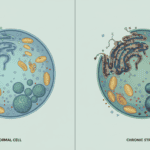

Your immune cells are some of the most energy-hungry cells in your body. When they spring into action against an infection or injury, their mitochondria work overtime to fuel the response. But here’s what researchers have discovered: when these cellular powerhouses get pushed too hard, they don’t just run out of steam. They actively release a molecule called haem that tells the immune system to shut down.
What is mitochondrial haem release
Mitochondria contain haem, the iron-containing molecule that gives blood its red colour. In healthy mitochondria, haem sits snugly within proteins like cytochrome c, helping shuttle electrons through the energy production process. Think of it like a perfectly fitted gear in a complex machine.
When mitochondria become stressed or damaged, this changes dramatically. The protective proteins break down or get overwhelmed. Haem molecules break free from their protein homes and leak out into the cell’s interior. Once loose, haem becomes something entirely different: a danger signal that cells recognise as a threat.
This free haem doesn’t stay put. It can cross cellular membranes and travel between cells, carrying its stress signal far beyond the original site of mitochondrial damage. What started as an energy crisis in one cell’s mitochondria becomes a neighbourhood-wide alarm.
What the research shows
Scientists have observed this process most clearly in immune cells during prolonged activation. When T cells fight chronic infections or tumours, their mitochondria eventually reach a breaking point. Researchers can measure rising levels of free haem as the immune response progresses.
The haem release follows a predictable pattern. Early in immune activation, mitochondria ramp up energy production without problems. But after sustained activity, the organelles show signs of structural damage. Electron microscopy reveals swollen mitochondria with disrupted internal membranes. That’s when haem starts appearing outside its normal protein complexes.
Once free haem accumulates, immune cells begin shutting down their most energy-intensive functions. They stop dividing rapidly. They reduce production of inflammatory signals. They even start expressing proteins that actively suppress immune responses. The cells aren’t dead, but they’re functionally exhausted.
This exhaustion isn’t limited to the cells releasing haem. Neighbouring immune cells detect the free haem through specific cellular sensors and respond by downregulating their own activity. The effect spreads through immune cell populations like a wave.
Why cells need this mechanism
At first glance, a system that shuts down immune responses seems counterproductive. But evolutionary biology suggests otherwise. Immune activation consumes enormous amounts of cellular resources and can cause significant tissue damage through inflammation.
The haem release mechanism acts as an emergency brake. When mitochondria in immune cells start failing from overuse, the resulting haem signal prevents the cells from pushing further into dangerous territory. It’s better to temporarily reduce immune activity than to have immune cells die en masse from metabolic collapse.
This system also helps prevent autoimmune responses. Chronic immune activation can lead cells to attack healthy tissue. The haem-triggered exhaustion pathway provides a way to wind down immune responses before they cause excessive collateral damage.
From an energy management perspective, the mechanism makes perfect sense. Immune responses compete with other vital cellular processes for limited ATP. When energy supplies run low, cells need a way to prioritise survival over continued immune activation.
What affects mitochondrial haem release
The timing and extent of haem release depends heavily on the metabolic demands placed on immune cells. Chronic infections create sustained activation that pushes mitochondria toward the breaking point faster than acute infections that resolve quickly.
Age plays a significant role. Mitochondria in older individuals show baseline structural changes that make them more susceptible to stress-induced haem release. The proteins that normally keep haem contained become less stable over time.
Nutritional factors influence this process too. Iron availability affects how much haem cells can produce and potentially release. Antioxidant systems help protect mitochondrial structures from the oxidative damage that promotes haem leakage.
Environmental stressors add another layer. Cells exposed to toxins, radiation, or other oxidative challenges show accelerated mitochondrial damage and earlier onset of haem release during immune activation.
The metabolic environment matters enormously. Cells operating in low-oxygen conditions or with limited glucose availability reach the point of mitochondrial stress much sooner than cells with abundant energy substrates.
What remains unknown
Researchers still don’t fully understand the molecular sensors that detect free haem in recipient cells. Multiple pathways seem involved, but the relative importance of each remains unclear.
The reversibility of haem-induced exhaustion poses another puzzle. Some immune cells recover their function when free haem levels drop, while others seem permanently altered. Scientists haven’t identified what determines which cells can bounce back.
Timing questions persist too. Why do some mitochondria release haem much earlier in the stress response than others? Individual organelles within the same cell can show dramatically different susceptibility to haem release.
The broader tissue effects of haem release need more investigation. Most research focuses on immune cells, but other cell types also contain haem-rich mitochondria that could contribute to the signalling network.
Perhaps most intriguingly, scientists are still working out whether this process can be modulated without disrupting normal immune function. The challenge lies in distinguishing beneficial immune regulation from problematic immune suppression.
This research reveals how cellular energy crisis and immune function intertwine at the molecular level. When mitochondria fail, they don’t fail quietly. They actively reshape immune responses through the molecules they release, creating a feedback loop between cellular metabolism and immune regulation that evolution has preserved across species. Understanding this connection offers a window into why our immune systems sometimes struggle during chronic challenges and how cellular stress signals propagate through complex biological networks.

Matt Elliott is the editor of Redox News Today, an independent publication covering peer-reviewed research on cellular health, redox signalling, and related biomedical science.