You’ve probably heard about microplastics in your bloodstream or lungs by now. What’s less discussed is what happens inside your cells when these particles show up. It turns out your cells have a sophisticated alarm system that recognises microplastics as trouble, and they deploy one of their most powerful defence mechanisms in response. This isn’t speculation. Researchers have observed it happening in real time.
What is oxidative stress and the NRF2 pathway
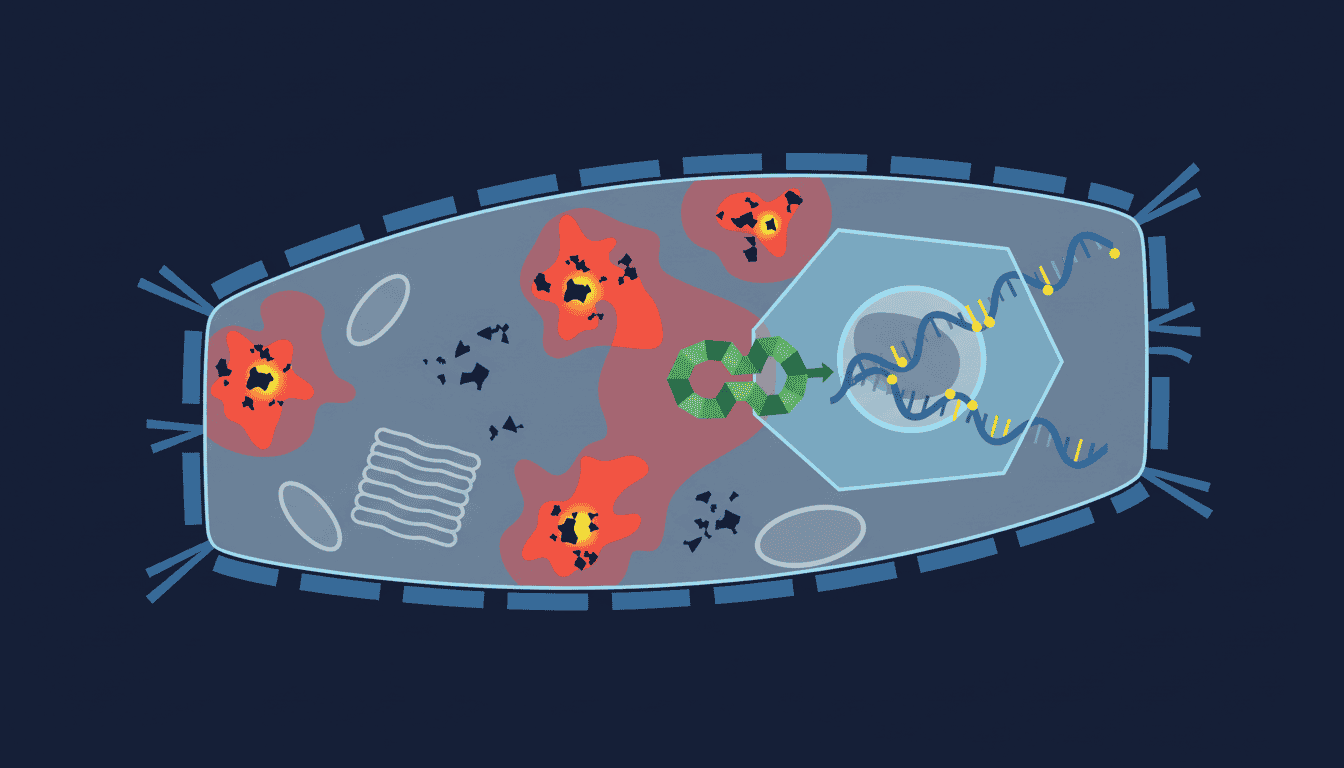
Inside every cell, electrons bounce around during normal metabolism. Sometimes they get loose. When an electron escapes and bonds with oxygen, you get a reactive oxygen species, or ROS. Free radicals, as people call them. A few are fine. Your cells handle them constantly. But when particles like microplastics enter the picture, the volume of free radicals skyrockets.
This overwhelming flood of reactive molecules is oxidative stress. Think of it as a chemical fire spreading faster than the cell can extinguish it. The cell’s normal antioxidant defences (glutathione, superoxide dismutase, catalase) start getting overwhelmed. That’s when NRF2 steps in.
NRF2 is a protein that acts like a master switch. When oxidative stress reaches critical levels, NRF2 detaches from a regulatory protein that normally keeps it anchored in the cytoplasm. Free now, NRF2 travels into the cell nucleus and binds to DNA sequences called antioxidant response elements. When it does, it activates dozens of protective genes simultaneously. We’re talking about genes encoding antioxidant enzymes, proteins that repair damaged molecules, and genes that help eliminate cellular debris. It’s a coordinated emergency response, and the cell launches it when things get bad enough.
What the research shows
Studies examining cells exposed to microplastics have found consistent patterns. When polystyrene microbeads, polyethylene fragments, or other plastic particles enter cells, they generate immediate oxidative stress. Researchers measure this by detecting increased ROS levels in real time. The cells don’t sit passively. Within hours, NRF2 activity increases significantly, and downstream antioxidant genes switch on.
In human lung cells, the response is pronounced. Microplastics with smaller diameters (under 5 micrometres) trigger stronger NRF2 activation than larger fragments, probably because they penetrate deeper into cells and cause more direct irritation. The particle surface matters too. Plastics with additives or those that have degraded and become rougher generate more oxidative stress than pristine particles.
What’s striking is that the response intensity varies with exposure dose. Cells exposed to low microplastic concentrations show moderate NRF2 activation. But push the dose higher, and something shifts. At excessive concentrations, the protective response starts to plateau while oxidative stress continues climbing. This suggests the cell’s emergency system has limits. Beyond a certain point, NRF2 activation alone cannot keep pace with the damage being inflicted.
Why cells need this defence
Oxidative stress is fundamentally incompatible with life. Free radicals damage DNA, degrade proteins, corrupt lipids in cell membranes, and trigger apoptosis (cell death) when damage accumulates. Evolution has equipped cells with NRF2 specifically because oxidative challenges are constant. UV radiation, environmental pollutants, metabolic byproducts, pathogens, and now microplastics all generate ROS. The cells that survive are the ones that can sense oxidative stress quickly and mobilise a proportionate defence.
NRF2 is elegant precisely because it’s scalable. Low-level stress activates a modest response. High-level stress triggers maximum mobilisation. This prevents cells from wasting energy on unnecessary defences while ensuring they escalate when needed. With microplastics, this system is being tested in ways evolution never anticipated.
What affects the microplastic NRF2 response
Cell type matters considerably. Immune cells and lung epithelial cells show strong NRF2 responses to microplastic exposure. Liver cells also activate NRF2 readily. Other cell types respond more slowly or less intensely. This partly reflects baseline antioxidant capacity in different tissues.
Age influences the picture too. Cells from older organisms generally have higher baseline oxidative stress and a somewhat diminished capacity to upregulate antioxidant defences rapidly. This doesn’t mean NRF2 stops working with age, but the margin between challenge and overwhelm narrows. Pre-existing oxidative stress (from smoking, pollution, diet, or illness) also raises baseline levels, meaning microplastic exposure stacks on top of existing cellular strain.
Particle characteristics shape the response. Microplastics from different sources vary in size, surface texture, chemical additives, and degradation state. Particles containing heavy metals or other contaminants trigger more aggressive oxidative stress than clean plastic fragments. The polymer type (polystyrene, polyethylene, PVC, polypropylene) influences how readily cells internalise the particles and how much inflammation they provoke alongside oxidative stress.
Nutritional status matters too. Cells with adequate selenium, zinc, copper, and vitamins C and E can synthesise antioxidant enzymes more effectively. People consuming diets rich in polyphenols and phytonutrients maintain higher baseline antioxidant capacity. These factors influence how well cells can manage the NRF2 response when microplastics arrive.
What remains unknown
The long-term consequences of repeated microplastic exposure remain uncertain. Laboratory studies typically examine acute exposure, where cells are hit with high doses over hours or days. Real-world exposure is chronic and lower-dose. Does constant NRF2 activation eventually deplete the cell’s ability to respond? Can NRF2 signalling become dysregulated with persistent exposure? These questions remain open.
We also don’t fully understand what happens when NRF2 can’t keep pace with microplastic-induced oxidative stress. Cells have other emergency mechanisms (autophagy, mitochondrial quality control, apoptosis). Researchers are still mapping how these systems work together under persistent microplastic pressure. Which kicks in first? Do they work in concert or compete?
The tissue specificity of microplastic accumulation and NRF2 response needs more work too. We know microplastics reach the lungs and gastrointestinal tract easily. Recent evidence suggests they cross into the bloodstream and accumulate in other organs. But how does NRF2 signalling behave in tissues like the brain or heart when exposed to microplastics? The data is sparse.
Finally, the interaction between microplastic exposure and other oxidative stressors remains poorly characterised. What happens when a person simultaneously experiences air pollution, UV exposure, and dietary oxidative load, then adds microplastic ingestion on top? The synergistic effects are largely unexplored.
Microplastics represent a novel environmental challenge that our cells’ ancient defence systems never evolved to handle. The NRF2 pathway responds the way it’s designed to respond, mobilising antioxidant defences when plastic particles generate oxidative stress. But this system was built for sporadic threats, not the chronic, ubiquitous exposure humans now experience. Understanding how cells cope with this modern problem is revealing both the sophistication and the limits of cellular adaptation.

Matt Elliott is the editor of Redox News Today, an independent publication covering peer-reviewed research on cellular health, redox signalling, and related biomedical science.