
Opening
Bacteria have spent billions of years evolving defences against the body’s immune system. They produce enzymes that neutralise reactive oxygen species, they pump out toxins faster than cells can deliver them, and they form biofilms that shield entire communities from attack. Yet a particle smaller than most viruses, made of the same material jewellers use to craft engagement rings, can cut through these defences with remarkable efficiency. Gold nanoparticles generate a form of cellular chaos that bacteria simply cannot tolerate.
What is oxidative stress from nanoparticles
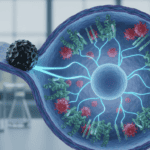
When gold nanoparticles interact with bacterial cells, they trigger a cascade of chemical reactions that flood the cell with reactive oxygen species (ROS). These are unstable molecules with unpaired electrons that behave like loose cannons inside the cell, attacking DNA, proteins, and lipids indiscriminately. Under normal circumstances, bacteria manage low levels of ROS using antioxidant enzymes like superoxide dismutase and catalase. But gold nanoparticles don’t just create a few extra ROS molecules. They generate oxidative stress at a scale the bacterial defence systems cannot handle.
The mechanism works through electron transfer. Gold nanoparticles have unique optical and electronic properties due to their size. When they contact bacterial cell membranes or enter the cytoplasm, electrons can jump from the nanoparticle to oxygen molecules, creating superoxide radicals and other reactive species faster than the cell can neutralise them. The smaller the nanoparticle, generally, the more reactive it becomes. This is why size matters as much as material composition.
What the research shows
Scientists have observed that gold nanoparticles kill bacteria far more effectively than traditional antibiotics against certain strains, particularly antibiotic-resistant ones. Studies comparing nanoparticles of different sizes and surface coatings show consistent patterns. Particles between 5 and 50 nanometres generate the most efficient ROS production relative to their mass. Larger particles are less effective because they have less surface area per unit volume. Smaller particles become unstable and aggregate, losing their individual antimicrobial properties.
The effects are dose-dependent and time-dependent. Bacteria exposed to gold nanoparticles show signs of oxidative damage within minutes: membrane integrity fails, leakage of cellular contents accelerates, and DNA damage accumulates. Researchers using electron microscopy have directly observed cells rupturing and their internal structures disintegrating. Some bacteria exhibit what appears to be an attempt to activate stress response genes, but these defences prove inadequate against the rate of ROS generation.
What’s striking is the lack of resistance development. In laboratory cultures, bacteria exposed repeatedly to gold nanoparticles over many generations do not develop tolerance the way they do with conventional antibiotics. This suggests the nanoparticles exploit a vulnerability too fundamental for bacteria to evolve around quickly, if at all.
Why cells need to understand this
From an evolutionary perspective, bacterial antioxidant systems evolved to defend against ROS produced by competing bacteria, by the host immune system, and by metabolic accidents. These threats typically involve modest increases in ROS levels over minutes or hours. A gold nanoparticle generating ROS at a localised concentration orders of magnitude higher represents a threat unlike anything evolution prepared bacteria to face. The defence systems simply lack the capacity to respond.
This reveals something important about oxidative stress biology. The cell’s ability to tolerate stress depends not just on the total amount of damage but on the rate at which damage accumulates relative to repair capacity. Gold nanoparticles essentially overwhelm the kinetics of bacterial defence. They turn a cell’s core vulnerability to oxidative damage into a lethal weakness, not by introducing a new toxin but by exploiting an existing one beyond its tolerable limits.
What affects gold nanoparticle effectiveness
Several factors influence how efficiently gold nanoparticles generate oxidative stress in bacteria. Nanoparticle size is primary. The surface-to-volume ratio determines how many atoms can participate in electron transfer reactions simultaneously. Shape matters too. Spherical particles behave differently from rods or triangles, affecting how they interact with cell membranes.
Surface coating changes the game significantly. Bare gold nanoparticles aggregate in salt solutions, which reduces their antimicrobial activity. Coating them with stabilising molecules or bioactive compounds like peptides or polysaccharides keeps them dispersed and sometimes enhances their ability to penetrate bacterial cells or bind to specific targets. Some coatings make nanoparticles accumulate preferentially in bacterial membranes, concentrating ROS damage where it matters most.
The bacterial species itself influences susceptibility. Gram-negative bacteria with thinner cell walls show greater vulnerability than gram-positive strains. Environmental pH and the presence of organic matter like proteins or lipids can increase or decrease nanoparticle reactivity. Anaerobic bacteria, which rely less on oxygen metabolism, tolerate some aspects of oxidative stress better than aerobic competitors, though ROS still damages them regardless of metabolic strategy.
What remains unknown
The precise location where ROS generation occurs inside bacterial cells remains unclear in many cases. Do gold nanoparticles generate most oxidative stress at the cell membrane, inside the cytoplasm, or in multiple compartments simultaneously? The answer matters for predicting which bacteria are most vulnerable and whether targeting strategies could improve effectiveness.
Long-term environmental fate is another gap. Gold is stable, but what happens to gold nanoparticles once they kill bacteria? Do they aggregate, precipitate, remain suspended in biofilm matrices, or get taken up by host cells? This has implications not just for resistance development but for any potential application beyond laboratory conditions. Researchers also lack clear understanding of whether mammalian cells near an infection site would experience harmful oxidative stress from the same nanoparticles, or whether selectivity for bacterial cells is reliable enough for therapeutic use.
Finally, the question of resistance development needs longer observation. In principle, bacteria could eventually evolve enhanced antioxidant enzymes, altered membrane compositions, or efflux mechanisms to handle nanoparticles. Whether this actually happens over meaningful timescales in complex environments is genuinely unknown. The absence of resistance in laboratory studies could reflect either a fundamental biological barrier or simply insufficient time for rare advantageous mutations to emerge.
Closing
Gold nanoparticles expose something elementary about cellular vulnerability. Bacteria have evolved elaborate defences against oxidative stress, yet these same defences become useless when the threat exceeds not just severity but the speed at which cells can respond. This points to a broader principle in cellular biology: defence systems have limits defined not by their sophistication but by their kinetic capacity. Understanding how materials can exploit these limits offers insights into what makes antioxidant systems tick and where their breaking points really lie. That knowledge has applications well beyond antimicrobial therapy.

Matt Elliott is the editor of Redox News Today, an independent publication covering peer-reviewed research on cellular health, redox signalling, and related biomedical science.