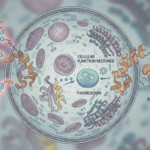

Your cells are constantly burning fuel, and like any combustion process, this creates toxic byproducts. Reactive oxygen species accumulate faster than cells can clean them up. Without an enzyme called thioredoxin glutathione reductase, this molecular garbage would overwhelm your cells within hours. This single protein does something remarkable: it acts as a recycling depot that restores spent antioxidant molecules back to working condition, letting your cells keep fighting oxidative stress indefinitely.
What is thioredoxin glutathione reductase
Thioredoxin glutathione reductase, often called TGR or TR, is a flavoprotein enzyme with an unusual job. Most enzymes build or break down molecules. TGR does something different: it moves electrons around. Specifically, it takes electrons from NADPH, a molecule that cells use as a general energy currency, and hands them to two separate antioxidant systems in the cell.
The enzyme’s structure makes this work possible. It contains a flavin cofactor that acts like an electron shuttle station. Electrons arrive from NADPH on one side, get temporarily held in the flavin, then get transferred to either thioredoxin or glutathione molecules on the other side. These two antioxidant systems then fan out through the cell, disarming reactive oxygen and protecting proteins from damage.
Think of it as a post office that processes two types of mail simultaneously. NADPH brings in the energy, TGR’s flavin processes it, and thioredoxin and glutathione carry the antioxidant payload out into the cell. The enzyme’s architecture makes it efficient at this three-way handoff.
What the research shows
When scientists have examined TGR’s structure using X-ray crystallography, they’ve found it contains two distinct domains. The first domain houses the flavin cofactor and interacts with NADPH. The second domain contains active sites where thioredoxin and glutathione dock to receive their electrons. This two-domain arrangement turns out to be crucial for the enzyme’s function.
Research has shown that when TGR’s structure is intact, it can simultaneously reduce both thioredoxin and glutathione substrates. When researchers mutate key amino acids in either domain, the enzyme loses efficiency dramatically. A single structural change can slow electron transfer by half or more. The enzyme’s specificity is encoded in its 3D shape: only substrates that fit the active sites properly get recycled.
Studies examining cells where TGR is inhibited reveal what happens without it. Cells rapidly lose their ability to regenerate antioxidants. Thioredoxin and glutathione get oxidised faster than they can be reduced back to active form. Within hours, the cell’s redox defence collapses, triggering stress responses and eventually cell death. This shows TGR isn’t just helpful; it’s fundamental to cell survival under oxidative pressure.
The enzyme also displays interesting regulatory properties. Its activity responds to the cell’s NADPH levels, meaning it works hardest when the cell has energy to spare. This prevents wasteful cycling when the cell is already stressed and low on resources.
Why cells need this
Cells generate reactive oxygen constantly as a side effect of respiration. Mitochondria leak electrons from the electron transport chain. Peroxisomes generate hydrogen peroxide as part of normal fatty acid breakdown. Immune cells deliberately produce reactive oxygen to kill pathogens. This oxidative load is inevitable in any living system.
Antioxidants like thioredoxin and glutathione are the cell’s main defence. They donate electrons to reactive species, converting them into harmless products. But this neutralisation reaction oxidises the antioxidant molecules themselves, rendering them inactive. A cell that can’t recycle these antioxidants would need to manufacture new ones constantly, an enormous metabolic cost.
TGR solves this problem by restoring oxidised antioxidants back to their reduced, active form. A single thioredoxin or glutathione molecule can neutralise multiple reactive oxygen species before needing recycling. Evolution preserved this enzyme across virtually all living organisms because it provides exceptional metabolic efficiency. Without TGR, cells would exhaust their antioxidant supply rapidly and succumb to oxidative damage.
What affects thioredoxin glutathione reductase
TGR activity depends heavily on NADPH availability. Cells that are actively reducing biosynthesis, such as rapidly dividing cells or those synthesising fat, have abundant NADPH and can therefore recycle antioxidants aggressively. Cells under energy stress with low NADPH struggle to maintain TGR function, making them more vulnerable to oxidative damage. This creates an interesting vulnerability: cells that are already stressed have a harder time defending against additional oxidative stress.
Ageing affects TGR function gradually. Some research suggests that TGR expression or activity declines slightly with age, though the mechanisms remain unclear. This reduced recycling capacity may contribute to the accumulation of oxidative damage seen in older organisms, though TGR is just one piece of a larger picture involving multiple antioxidant systems.
Specific nutrients influence TGR activity. The flavin cofactor embedded in TGR requires riboflavin, the B vitamin also called vitamin B2. Cells lacking adequate riboflavin cannot assemble functional TGR. Selenium is another critical nutrient; it’s incorporated into several related enzymes in the thioredoxin system. Environmental factors matter too. Oxidative stress itself upregulates TGR expression in many cells, as though the cell recognises the increased demand and produces more enzyme to meet it.
What remains unknown
Researchers still don’t fully understand how cells regulate TGR expression in response to oxidative stress. The signalling pathway that detects high reactive oxygen and triggers TGR production involves NRF2 and other transcription factors, but the precise mechanism remains partially opaque. Different cell types seem to upregulate TGR differently, suggesting specialised regulation depending on cellular function.
The interaction between TGR and its substrates is also incompletely understood at the molecular level. Scientists know the basic electron transfer occurs, but the precise kinetics of how thioredoxin or glutathione bind, receive electrons, and release vary under different cellular conditions. Whether TGR preferentially recycles one substrate over the other depending on the cell’s redox state is still being investigated.
The enzyme’s role in cell signalling deserves more attention too. Thioredoxin and glutathione don’t just defend against oxidative damage; they also directly participate in redox signalling, where the oxidation state of specific proteins conveys information throughout the cell. How TGR regulates this signalling separately from its antioxidant role remains an open question.
Finally, how TGR dysfunction contributes to disease progression is poorly mapped. Certain cancers show altered TGR levels, and some parasites have evolved TGR enzymes structurally different from their hosts, making them potential drug targets. Understanding these applications requires more work connecting TGR structure to disease biology.
TGR represents something elegant about how cells solve problems: they don’t waste energy making new molecules when recycling works better. This enzyme sits at the intersection of energy metabolism and defence, using NADPH to keep antioxidant systems charged. As research continues to uncover how cells regulate and deploy TGR, we’re learning more about the hidden architecture that keeps living systems functioning under constant oxidative pressure.

Matt Elliott is the editor of Redox News Today, an independent publication covering peer-reviewed research on cellular health, redox signalling, and related biomedical science.