
Your liver cells are under constant attack. Free radicals from metabolism, pollution, alcohol, and everyday stress generate oxidative damage that accumulates over decades. Most of the time your cells handle this quietly, activating defence genes almost automatically. But what if you could amplify that response? Researchers studying gentiopicroside, a bitter compound from plants like gentian root, have found that it hijacks one of your liver’s master control switches: a protein called NRF2.
What is NRF2 signalling
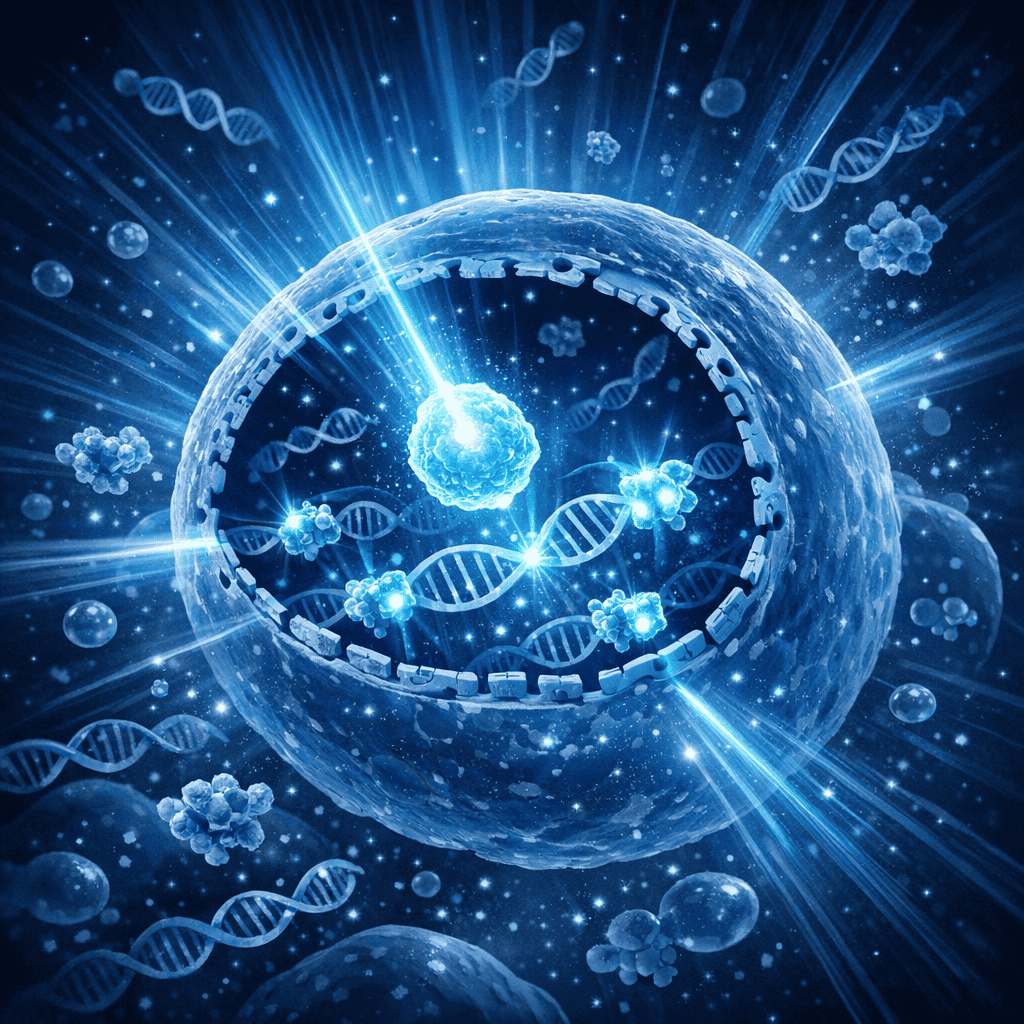
NRF2 is not an enzyme or a hormone. Think of it as a molecular lockpick that your cells keep stored away until trouble arrives. Under normal conditions, NRF2 sits in the cytoplasm (the gel-like substance inside cells) bound to a protein called KEAP1, which acts like a guard. When oxidative stress hits, KEAP1 releases NRF2. Free now, NRF2 travels into the nucleus where your DNA lives. Once inside, it binds to specific DNA sequences called antioxidant response elements (AREs). This unlocks dozens of genes that code for protective proteins: glutathione S-transferases, NAD(P)H quinone oxidoreductase, and superoxide dismutase among them. These proteins then neutralise free radicals and repair damage.
The whole process is called nuclear translocation. It is the physical movement of NRF2 from one compartment to another that fundamentally changes what your cell produces. This is cellular defence at the molecular level, and it happens thousands of times daily in your liver without you noticing.
What the research shows
When scientists exposed liver cells to gentiopicroside, something predictable happened: NRF2 moved into the nucleus faster and in greater numbers than in untreated cells. The compound does not directly grab NRF2. Instead, it appears to trigger the release from KEAP1, the same way oxidative stress does. The effect was dose dependent. More gentiopicroside meant more NRF2 translocation, up to a point.
Researchers measured this by looking at NRF2 protein in isolated nuclei after gentiopicroside treatment. They also tracked the expression of downstream genes, confirming that NRF2 was actually doing its job once inside: activating protective genes. The magnitude of the response was comparable to what happens when cells encounter genuine oxidative stress. In other words, gentiopicroside essentially tells liver cells “defend yourselves” without requiring actual damage first.
This happened in cultured hepatocytes, the main functional cell type in your liver. Lab conditions are tidy and controlled, so the question of whether this occurs in living organisms remains partly open.
Why cells need this
Evolution has spent millions of years refining cellular defence systems because survival depends on it. Your liver processes every chemical that enters your body: food, drugs, environmental toxins. Metabolism itself produces free radicals as a byproduct of energy production. Damage accumulates. Cells with robust antioxidant defences live longer and function better. Those without them struggle.
NRF2 is the strategic response. Rather than relying on a single antioxidant enzyme, NRF2 activates a coordinated suite of protective genes. This is efficient. When NRF2 switches on, a whole orchestra of defensive proteins begins playing simultaneously. Cells that have evolved to respond quickly to stress signals have a survival advantage. That is why NRF2 signalling appears in virtually every cell type across mammals, and why it has been preserved across species.
The fact that a plant compound can trigger this same pathway suggests that plants have evolved molecules that interact with animal defence systems, possibly because they evolved alongside them in shared environments for thousands of years.
What affects NRF2 activation
Gentiopicroside is just one molecule that can trigger NRF2 translocation. Sulforaphane from cruciferous vegetables, polyphenols from tea and berries, and curcumin from turmeric all show similar effects in cell cultures. Exercise, caloric restriction, and heat stress also activate NRF2. On the flip side, ageing appears to blunt NRF2 responsiveness. Older cells do not activate NRF2 as robustly in response to the same signals.
Genetic background matters too. Some people carry variants in genes that encode KEAP1 or other proteins in the pathway, affecting how readily NRF2 gets released. Chronic exposure to some chemicals actually suppresses NRF2 signalling, a form of adaptation that might backfire when cells need the defence. Diet, liver health status, and even sleep deprivation influence how effectively this pathway functions.
The pathway itself has feedback loops. Sustained high NRF2 activation can eventually trigger responses that dampen the signal. This is protective: a defence system stuck permanently on would waste resources and could itself become harmful.
What remains unknown
The gap between cultured cells and living organisms is real. Gentiopicroside triggers NRF2 translocation in a dish. Whether it does so meaningfully in your liver when you actually consume it depends on bioavailability: how much reaches your liver intact, how long it persists, and whether it survives digestion and metabolism. These questions have not been fully answered.
We also do not know the optimal dose or timing. Is there a window where activation helps, and beyond that it does not? Does repeated exposure sensitise cells or desensitise them? Does gentiopicroside work synergistically with other compounds, or does one plant chemical interfere with another? The mechanisms that turn off NRF2 signalling are also less well understood than the activation process itself.
Most importantly, researchers are still working out what level of NRF2 activation translates to measurable benefits at the organism level. More activation is not automatically better. Understanding the dose-response relationship in actual human livers, not just cells in a petri dish, is where the real work lies.
What this research points to is that your cells possess elegant machinery for detecting and responding to stress. Plant compounds from your diet can engage with these same systems that evolved over millennia. The conversation between what you consume and how your cells defend themselves is ongoing and intricate. Scientists are learning the grammar of that conversation one molecule at a time.

Matt Elliott is the editor of Redox News Today, an independent publication covering peer-reviewed research on cellular health, redox signalling, and related biomedical science.