
Your cells are under constant attack. Free radicals, byproducts of normal metabolism and exposure to environmental stressors, damage proteins, lipids, and DNA. Every second, your body produces antioxidant molecules to neutralise these threats. But here’s what most people don’t realise: the enzymes that activate this defence system are themselves controlled by a molecular gatekeeper called USP7. And when USP7 isn’t working properly, your cells’ protective mechanisms can fail.
What is the USP7 and NRF2 system
USP7 is a deubiquitinating enzyme. That means it removes molecular tags called ubiquitin from other proteins. Think of ubiquitin as a post-it note that cells use to mark proteins for destruction or degradation. Most of the time, this marking system works perfectly. Cells need to eliminate damaged or unnecessary proteins to stay healthy.
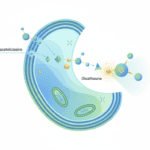
NRF2 is a transcription factor that acts as a master switch for antioxidant defence. When oxidative stress threatens a cell, NRF2 should spring into action, moving into the nucleus and activating dozens of genes that produce antioxidant enzymes and protective molecules. Glutathione synthase. Superoxide dismutase. NAD(P)H quinone oxidoreductase. These genes represent the cell’s chemical arsenal against free radical damage.
But NRF2 has a problem. Under normal conditions, a protein called KEAP1 binds to NRF2 and marks it with ubiquitin, essentially putting it into storage. This keeps NRF2 inactive until the cell actually needs it. When oxidative stress arrives, KEAP1’s grip should loosen, allowing NRF2 to escape and do its job. Here’s where USP7 enters the picture. USP7 removes ubiquitin from NRF2, freeing it from KEAP1’s control and allowing the antioxidant response to proceed. Without USP7, NRF2 stays tagged and trapped, and your cells can’t mount an effective defence.
What the research shows
When researchers examined cells under oxidative stress, they found that USP7 activity increases precisely when cells need it most. The enzyme rapidly deubiquitinates NRF2, releasing it from KEAP1 suppression within minutes. This timing is critical. The antioxidant response isn’t a slow process. Cells need to act quickly or damage accumulates.
In experimental systems where USP7 was inhibited or reduced, NRF2 remained trapped in its inactive state even when cells faced severe oxidative stress. The antioxidant genes stayed silent. Protective molecules weren’t produced. The cells became vulnerable. By contrast, when USP7 levels were optimised, NRF2 activated rapidly and antioxidant defences ramped up efficiently.
Researchers also discovered that USP7 itself is regulated. Its activity responds to cellular stress signals, meaning the system has built-in feedback. When cells detect oxidative damage, not only does NRF2 need to escape KEAP1, but USP7 itself needs to be active enough to make that escape happen. This creates a coordinated response where multiple components work together.
Why cells need this
Evolution preserved this system because it solves a fundamental problem: cells need antioxidant defences, but they can’t afford to run them constantly. Running maximal antioxidant production all the time costs energy and resources. It also creates metabolic drag that slows growth and reproduction. So cells evolved a system where antioxidant defences sit dormant until they’re actually needed.
The KEAP1-NRF2-USP7 circuit is essentially a sensor and switch mechanism. KEAP1 senses oxidative stress through its cysteine residues, which respond to reactive molecules. When stress arrives, KEAP1 changes shape, loosens its grip on NRF2, and USP7 steps in to strip away the ubiquitin tags holding NRF2 back. This allows rapid activation without needing to synthesise new NRF2 protein. The response happens in minutes, not hours.
This is why the system evolved deubiquitination rather than simple protein synthesis. Speed matters. A cell drowning in free radicals can’t wait hours for new NRF2 to be made from scratch. It needs to mobilise existing NRF2 molecules immediately.
What affects USP7 and NRF2 signalling
Several factors influence how well this system works. Ageing appears to reduce USP7 activity. Older cells show slower NRF2 activation in response to stress, which correlates with declining antioxidant defences in aged tissues. This may partially explain why older organisms accumulate more oxidative damage.
Environmental exposures matter too. Chronic exposure to mild oxidative stress can actually upregulate USP7 and NRF2, creating a kind of cellular adaptation. The system recognises ongoing threat and amplifies its response capacity. However, acute severe stress can overwhelm the system entirely, flooding cells with more free radicals than USP7 and NRF2 can handle.
Nutrition plays a role. Certain compounds found in vegetables and plant foods can activate KEAP1 sensing pathways, essentially mimicking oxidative stress signals and triggering NRF2 activation through the USP7 mechanism. This is one biological basis for why dietary variety influences cellular health.
Genetic variation also matters. People carry different versions of the genes encoding USP7, KEAP1, and NRF2. Some variants result in more active enzymes, others less so. These differences likely contribute to individual variation in how effectively cells defend against oxidative damage.
What remains unknown
Scientists still don’t fully understand what turns USP7 activity up or down during stress. The enzyme clearly responds to signals, but the complete picture of how oxidative stress itself regulates USP7 remains incomplete. Is USP7 activity controlled by phosphorylation, by its own ubiquitination, or by binding to other proteins? Probably all of these, but the relative importance of each mechanism isn’t settled.
The tissue specificity question is also open. Different cell types show different sensitivities to USP7 inhibition. Some tissues depend heavily on this pathway while others seem to have backup systems. Why? Researchers don’t yet know whether this reflects different expression levels, different stress profiles, or whether some tissues have evolved alternative deubiquitinating enzymes that can partially compensate.
There’s also the question of chronic regulation. What happens to this system over weeks and months? Does USP7 activity plateau? Do cells develop tolerance? How does the system maintain balance between protecting against oxidative stress and avoiding metabolic waste? These questions matter for understanding how ageing and disease affect cellular defences.
Cells live in a constant negotiation between threat and resource. The USP7-NRF2-KEAP1 system represents an elegant solution to one specific problem: activating defences quickly when needed, without wasting energy when threats are absent. Understanding how this system works at the molecular level teaches us something deeper about how cells maintain stability in an unstable world. This isn’t just academic interest. The mechanisms that govern antioxidant activation also influence how cells respond to other stressors, how they age, and how disease processes unfold.

Matt Elliott is the editor of Redox News Today, an independent publication covering peer-reviewed research on cellular health, redox signalling, and related biomedical science.