Key evidence at a glance
Landmark studies: Hara and colleagues, and Komatsu and colleagues, both in Nature, 2006
What they did: switched off an essential autophagy gene in the brain cells of mice
Main finding: abnormal proteins built up inside neurons and the mice developed progressive neurodegeneration
Type of evidence: animal experiments, supported by studies of human brain tissue
Neurons are among the longest-lived cells in the body. Most are never replaced, so they cannot dilute accumulated damage by dividing, as many other cells do. Instead they depend on constant internal cleaning to remove worn-out proteins and organelles. Research over the past two decades has shown that when this cleaning fails, neurons are at serious risk, and that cleanup problems appear in many neurodegenerative diseases.
How cells take out the trash
Cells have two main disposal systems. The ubiquitin-proteasome system tags individual damaged proteins with a small protein called ubiquitin and feeds them into a barrel-shaped machine, the proteasome, which breaks them down.
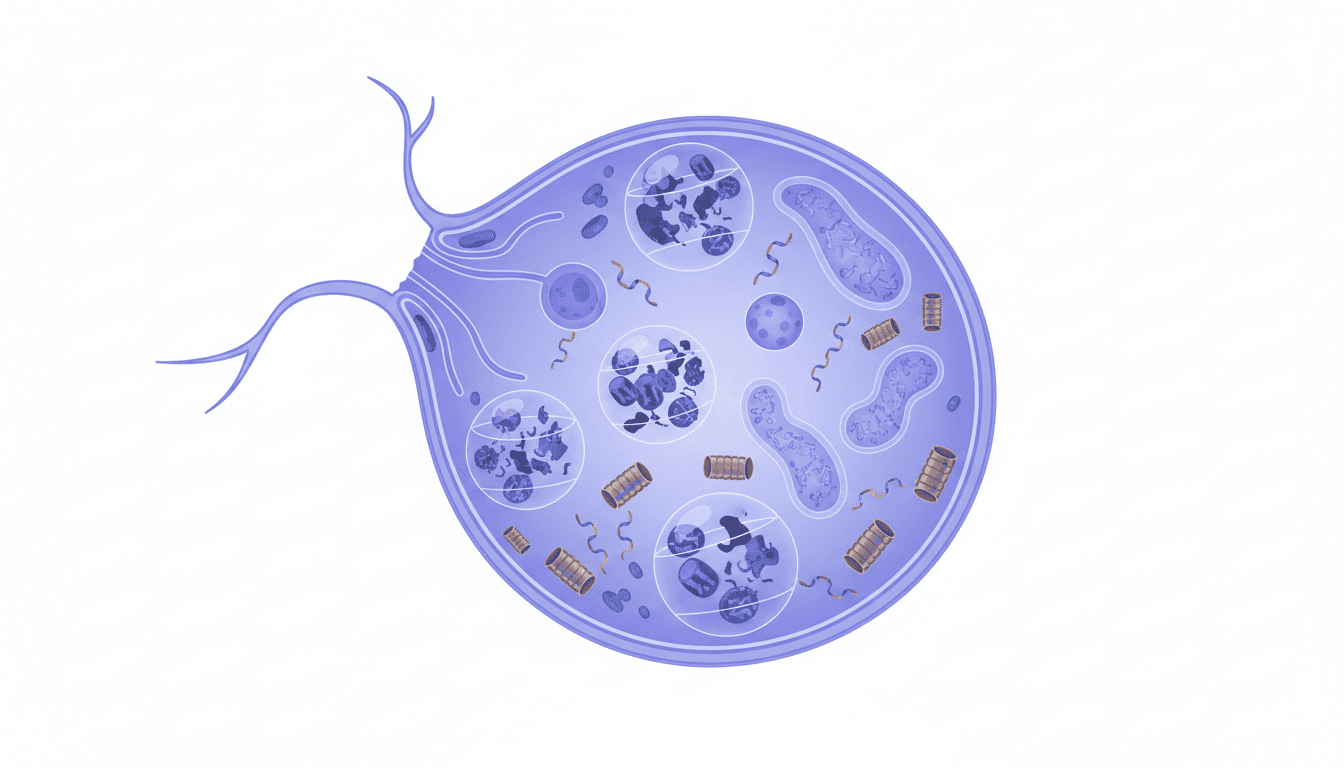
The second system, autophagy, handles larger loads. The cell wraps damaged components, including protein clumps and whole organelles, in a double membrane to form a vesicle called an autophagosome, which then fuses with a lysosome containing digestive enzymes. A 2011 review in Cell describes autophagy not simply as waste disposal but as a recycling system that produces new building blocks and energy, and that is central to quality control inside cells [1].
What happens when autophagy is switched off
Two studies published together in Nature in 2006 showed how important autophagy is for neurons. In one, mice lacking the autophagy gene Atg5 in their nervous system developed progressive problems with movement, and abnormal proteins accumulated and formed clumps inside their neurons, even though the mice carried no disease-causing mutant protein [2]. In the other, mice lacking a different essential gene, Atg7, in the brain showed behavioural defects, extensive loss of neurons and early death [3].
Together, the studies showed that routine, background autophagy is essential for neurons to survive, and that failing to clear proteins continuously can by itself lead to neurodegeneration in mice [2, 3].
Cleanup failure in human disease
Alzheimer’s disease. A 2005 study in the Journal of Neuropathology and Experimental Neurology examined brain tissue from people with Alzheimer’s disease using electron microscopy. Autophagic vesicles were rare in brains without Alzheimer’s pathology but abundant in affected brains, building up in large numbers within damaged nerve fibres, a pattern consistent with a failure to complete the clearance process [4].
Parkinson’s disease. In 1997, researchers reported in Nature that the protein alpha-synuclein is a major component of Lewy bodies, the protein clumps found in the brains of people with Parkinson’s disease [5]. Later research has linked the build-up of such proteins to problems with cellular clearance, including the removal of damaged mitochondria, as described in our guide to mitochondria.
A 2017 review in Neuron describes how autophagy is affected across a range of neurodegenerative conditions, including Alzheimer’s, Parkinson’s and Huntington’s diseases, and discusses whether increasing autophagy could become a treatment strategy [6].
Sleep and the brain’s wider clean-up
Waste clearance also happens outside cells. A 2013 study in Science found that in mice, the space between brain cells widens during sleep, allowing fluid to flush through brain tissue and clear beta-amyloid, a protein linked to Alzheimer’s disease, more quickly than during waking [7]. This is covered in our guide to sleep and cellular repair.
What remains unknown
It is still debated whether failing cleanup systems cause neurodegeneration in people or result from it, or both [6]. How the proteasome and autophagy systems coordinate, and why some neurons are more vulnerable than others, are open questions.
Drugs that increase autophagy protect neurons in some animal models, but none has yet been shown to slow neurodegenerative disease in people [6]. Much of the evidence comes from mice, and turning it into treatments remains a long-term challenge.
References
- Mizushima N, Komatsu M. (2011). Autophagy: renovation of cells and tissues. Cell. https://doi.org/10.1016/j.cell.2011.10.026
- Hara T, Nakamura K, Matsui M, et al. (2006). Suppression of basal autophagy in neural cells causes neurodegenerative disease in mice. Nature. https://doi.org/10.1038/nature04724
- Komatsu M, Waguri S, Chiba T, et al. (2006). Loss of autophagy in the central nervous system causes neurodegeneration in mice. Nature. https://doi.org/10.1038/nature04723
- Nixon RA, Wegiel J, Kumar A, et al. (2005). Extensive involvement of autophagy in Alzheimer disease: an immuno-electron microscopy study. Journal of Neuropathology and Experimental Neurology. https://doi.org/10.1093/jnen/64.2.113
- Spillantini MG, Schmidt ML, Lee VM, et al. (1997). Alpha-synuclein in Lewy bodies. Nature. https://doi.org/10.1038/42166
- Menzies FM, Fleming A, Caricasole A, et al. (2017). Autophagy and neurodegeneration: pathogenic mechanisms and therapeutic opportunities. Neuron. https://doi.org/10.1016/j.neuron.2017.01.022
- Xie L, Kang H, Xu Q, et al. (2013). Sleep drives metabolite clearance from the adult brain. Science. https://doi.org/10.1126/science.1241224
Redox News Today reports on published research for general interest. This article is not medical advice. Last reviewed October 2026.

Matt Elliott is the editor of Redox News Today, an independent publication covering peer-reviewed research on cellular health, redox signalling, and related biomedical science.