Right now, inside every cell in your body, a precise chemical balancing act is playing out. If the pH drops even slightly below 7.0 or climbs above 7.4, proteins start unfolding, enzymes stop working, and cellular machinery grinds to a halt. Yet somehow, your cells maintain this narrow range despite constantly producing acids and bases as they burn fuel, build proteins, and clear out waste.
What is cellular pH balance
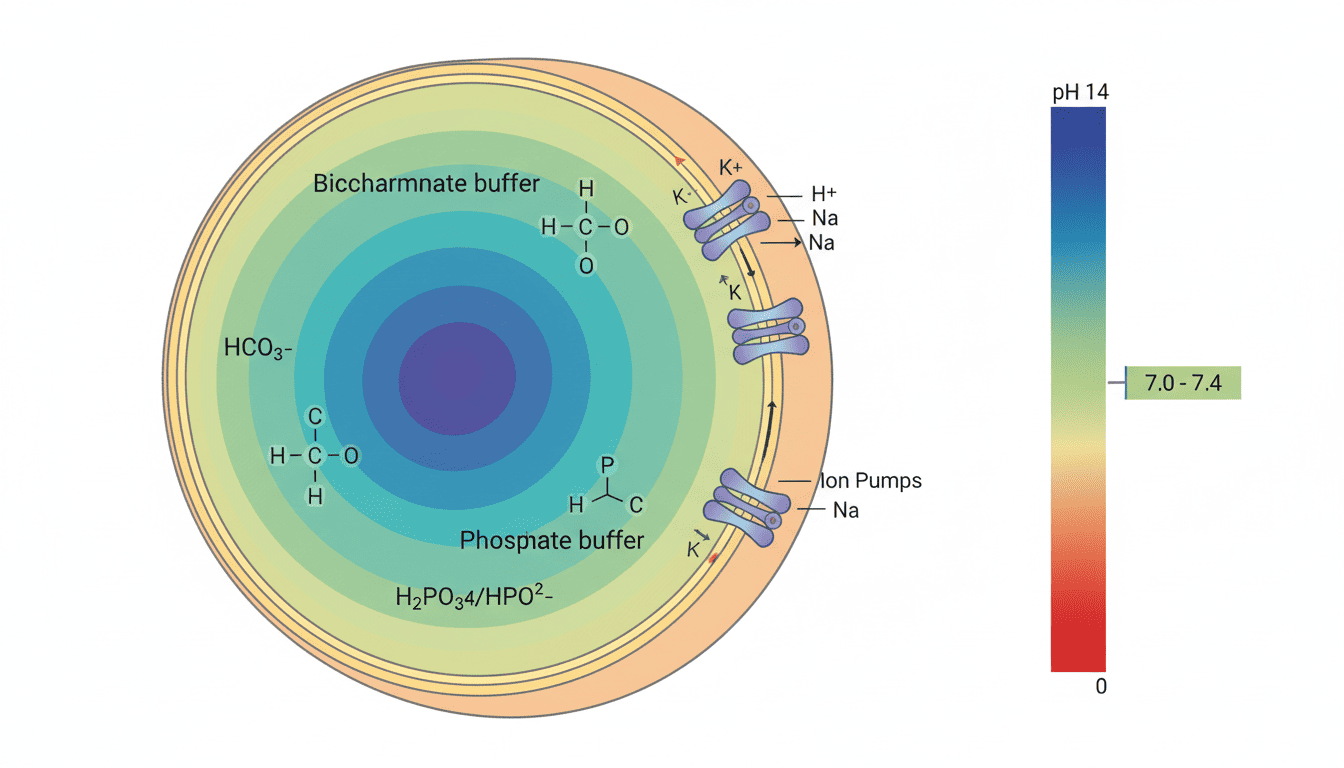
Think of pH as a measure of how acidic or basic something is, running from 0 (battery acid territory) to 14 (household bleach). Most of your cells hover around 7.2, just slightly basic. This isn’t arbitrary.
At the molecular level, pH reflects the concentration of hydrogen ions floating around inside your cells. Too many hydrogen ions and you’ve got an acid problem. Too few and things swing basic. The difference matters because hydrogen ions are sticky little things that love to bind to proteins and change their shape.
When proteins change shape, they change function. An enzyme that normally helps break down glucose might suddenly become useless. A transport protein that shuttles nutrients across membranes might stop working entirely. Your cellular machinery depends on proteins maintaining their precise three-dimensional structures, and pH is the invisible hand keeping everything in proper formation.
What the research shows
Scientists have discovered that cells use multiple systems working together to maintain pH balance. The most immediate response comes from buffer systems, molecules that can soak up excess hydrogen ions or release them when needed.
Bicarbonate acts as the cell’s primary buffer, readily switching between absorbing and releasing hydrogen ions as conditions change. Phosphate groups do similar work, particularly inside cells where they’re abundant. Proteins themselves can act as buffers, though this ties up their normal functions.
Beyond buffering, cells actively pump hydrogen ions across their membranes. Researchers have identified specialised transport proteins that work like molecular bouncers, ejecting excess acids or importing bases as needed. These pumps consume energy, but they’re essential for maintaining the precise pH range that cellular life requires.
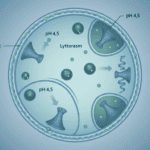
Studies using pH-sensitive dyes have revealed that different parts of cells maintain different pH levels. Lysosomes, the cellular recycling centres, deliberately keep their interiors acidic to help break down waste. Mitochondria maintain specific pH gradients across their membranes to generate energy. The cell manages these micro-environments whilst keeping its overall chemistry stable.
Why cells need this
Evolution preserved elaborate pH control systems because cellular chemistry is ruthlessly precise. Enzymes that catalyse metabolic reactions have optimal pH ranges, often spanning just a few tenths of a unit.
Take glycolysis, the process that breaks down glucose for energy. The enzymes involved work best at slightly different pH levels, but all within that narrow physiological range. Shift the pH too far in either direction and energy production stumbles. Cells that couldn’t maintain proper pH would quickly find themselves outcompeted by those that could.
DNA repair provides another example. The enzymes that fix damaged genetic material are exquisitely pH-sensitive. When cellular pH drifts outside normal ranges, DNA repair slows down, allowing mutations to accumulate. Over evolutionary time, this would prove fatal.
pH control also enables cells to create specialised environments for different functions. By maintaining acidic conditions in certain compartments, cells can break down worn-out components and recycle their building blocks. By keeping other areas more basic, they optimise conditions for protein synthesis and other construction projects.
What affects cellular pH
Normal metabolism constantly challenges cellular pH balance. Breaking down glucose produces lactate, which releases hydrogen ions. Burning fats generates ketones, also acidic. Even protein synthesis creates acidic byproducts as amino acids link together.
Exercise intensifies these challenges. During intense physical activity, muscle cells produce lactate faster than they can clear it, temporarily dropping intracellular pH. This is part of what causes that burning sensation in working muscles. Well-trained cells become better at managing these pH swings.
Age appears to affect pH regulation systems. Research suggests that some of the ion pumps responsible for maintaining cellular pH become less efficient over time. This could contribute to age-related declines in cellular function, though the connections are still being mapped out.
Environmental factors play a role too. Cells exposed to toxins often show disrupted pH regulation as their buffering systems become overwhelmed. Temperature changes can shift the balance of pH control systems, which is why extreme heat or cold can be cellular stressors.
What remains unknown
Researchers are still working out how cells coordinate pH control across different compartments. How does a cell manage to keep its cytoplasm at one pH whilst maintaining completely different conditions in its various organelles? The signalling systems that orchestrate this remain partially mysterious.
The relationship between cellular pH and ageing continues to puzzle scientists. Some research hints that declining pH control might be both a cause and consequence of cellular ageing, but teasing apart cause and effect proves challenging.
Scientists are also investigating how different cell types fine-tune their pH control systems. Nerve cells face different pH challenges than muscle cells or liver cells. Understanding these specialisations could reveal new aspects of how different tissues function.
Perhaps most intriguingly, researchers are exploring how cells use pH changes as signals. Rather than just maintaining steady conditions, some cells deliberately create pH fluctuations to communicate information or trigger specific responses. This adds another layer of complexity to an already sophisticated system.
The story of cellular pH balance reveals something profound about the constraints that shape life. Every cell must solve the same fundamental problem: maintaining the precise chemical conditions that allow the molecular machinery of life to function. The solutions they’ve evolved, from simple buffers to complex transport systems, demonstrate how life operates within remarkably narrow parameters whilst still achieving extraordinary complexity and adaptability.

Matt Elliott is the editor of Redox News Today, an independent publication covering peer-reviewed research on cellular health, redox signalling, and related biomedical science.