
Your cells are running two different genetic programs simultaneously. The nucleus holds the main blueprint with about 20,000 genes, while hundreds of mitochondria scattered throughout each cell carry their own tiny genomes with just 37 genes. These cellular powerhouses don’t just quietly pump out energy. They’re constantly sending status reports to the nucleus, influencing which genes get switched on and off.
What is mitochondrial-nuclear communication
Think of mitochondria as remote factories that need to stay connected to corporate headquarters. The nucleus controls most cellular decisions, but mitochondria have crucial information about energy production, metabolic state, and stress levels that the nucleus needs to know.
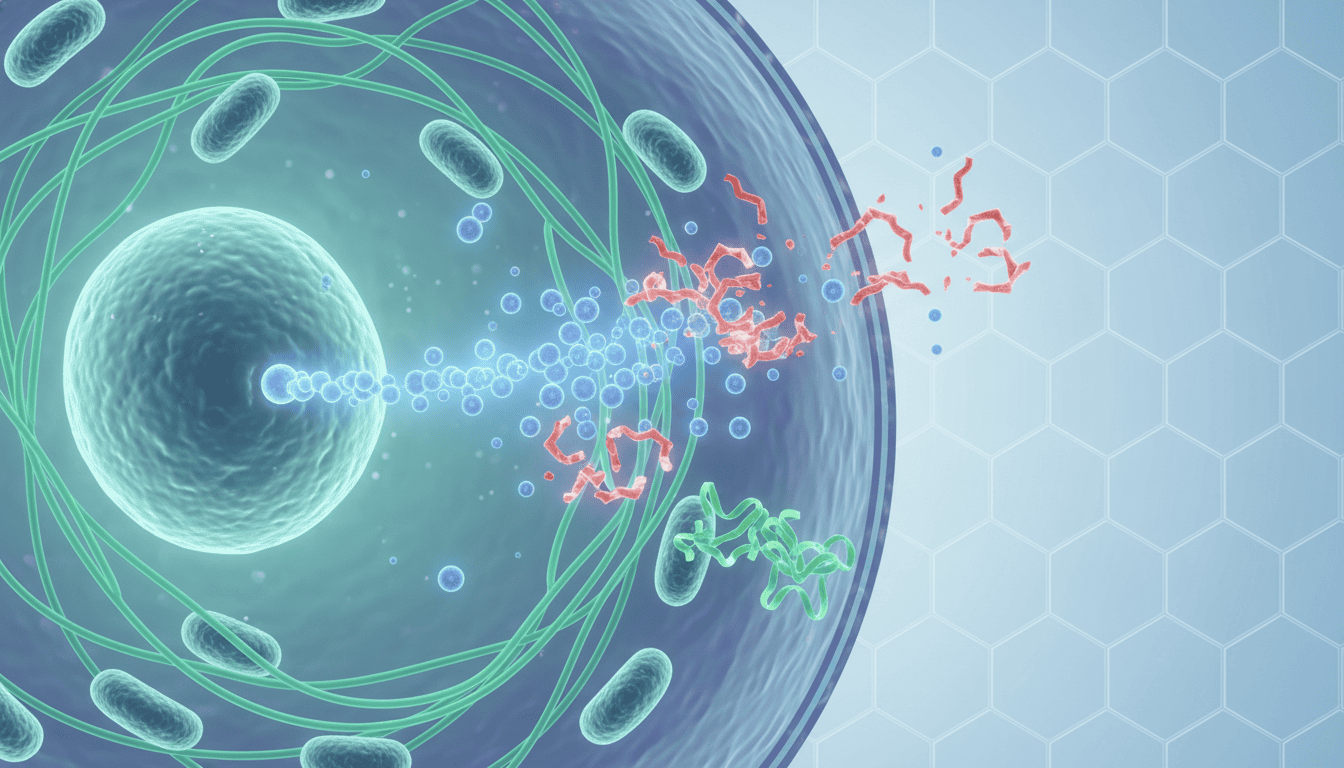
This communication happens through several channels. Mitochondria release specific molecules that travel to the nucleus and directly influence gene expression. When mitochondria are struggling to produce enough ATP, they send chemical distress signals. When they’re damaged by oxidative stress, they dispatch different messengers entirely.
The conversation isn’t one-way. The nucleus responds by ramping up production of proteins that mitochondria need, adjusting the cell’s metabolic program, or even triggering the creation of new mitochondria. It’s a continuous feedback loop that keeps cellular energy supply matched to demand.
What the research shows
Scientists have identified several key signalling pathways that mitochondria use to communicate with the nucleus. One involves reactive oxygen species (ROS), which might sound purely destructive but actually serve as important messengers at low levels.
When mitochondria produce more ROS than usual, these molecules can travel to the nucleus and activate specific transcription factors. This triggers the expression of antioxidant genes and proteins involved in mitochondrial maintenance. The cell essentially receives a message saying “we’re under oxidative stress down here” and responds accordingly.
Another pathway involves calcium ions. Mitochondria act as cellular calcium buffers, absorbing excess calcium when levels spike. Changes in mitochondrial calcium handling send signals to the nucleus about the cell’s metabolic state and stress levels. Researchers have observed that disrupting this calcium communication affects everything from energy metabolism to cell survival decisions.
Perhaps most intriguingly, scientists have discovered that mitochondrial DNA itself can act as a danger signal. When mitochondria are severely damaged, fragments of their DNA escape into the cell’s interior, where they’re recognised as foreign material. This triggers inflammatory responses and stress signalling pathways that alert the nucleus to mitochondrial problems.
Why cells need this communication system
Energy demands fluctuate wildly depending on what cells are doing. A muscle cell during exercise needs vastly more ATP than the same cell at rest. Brain cells firing rapidly burn through energy at different rates than quiet neurons.
Without constant communication between mitochondria and nucleus, cells couldn’t adapt their energy infrastructure to changing demands. The nucleus needs real-time information about mitochondrial capacity to decide whether to make more mitochondrial proteins, trigger mitochondrial division, or shift the cell’s metabolic strategy entirely.
This signalling system also serves as a quality control mechanism. Damaged mitochondria that can’t produce energy efficiently are essentially toxic to cells. The communication pathways allow cells to detect mitochondrial problems early and either repair the damage or eliminate faulty mitochondria before they cause broader cellular dysfunction.
From an evolutionary perspective, this makes perfect sense. Mitochondria were once independent bacteria that formed a partnership with early eukaryotic cells. Over billions of years, most mitochondrial genes transferred to the nucleus, but the need for coordination between these two genetic systems remained.
What affects mitochondrial-nuclear communication
Age significantly impacts this cellular conversation. Research shows that mitochondrial signalling becomes less efficient as organisms get older, potentially contributing to age-related decline in cellular function. The signals become weaker and the nuclear responses less coordinated.
Exercise appears to strengthen these communication pathways. Physical activity increases mitochondrial ROS production in a controlled way, which enhances the signalling between mitochondria and nucleus. This leads to better coordination of energy production and improved mitochondrial maintenance.
Environmental stresses also influence these pathways. Heat, cold, toxins, and nutrient availability all affect how mitochondria communicate with the nucleus. Cells exposed to chronic stress often show disrupted mitochondrial-nuclear communication, which can impair their ability to adapt to further challenges.
Certain nutrients play roles in maintaining effective communication. B vitamins, which are essential for mitochondrial function, affect signalling pathways. Antioxidants can modulate ROS-based communication, though the relationship is complex since some ROS signalling is beneficial.
What remains unknown
Scientists are still mapping out all the molecular messengers that travel between mitochondria and nucleus. New signalling molecules are regularly discovered, suggesting this communication network is more elaborate than originally thought.
The timing of these signals remains poorly understood. How quickly do mitochondria respond to changing energy demands? How long does it take for nuclear responses to translate into functional changes in mitochondrial capacity? These temporal dynamics are crucial for understanding how cells maintain energy balance.
Researchers are also investigating whether mitochondrial-nuclear communication differs between cell types. Brain cells, muscle cells, and liver cells all have different energy requirements and stress exposures. The signalling pathways might be fine-tuned differently in each tissue.
Perhaps most intriguingly, scientists are exploring whether mitochondria in the same cell communicate with each other before sending signals to the nucleus. Do mitochondria coordinate their messages, or does each organelle signal independently?
The relationship between cellular energy production and gene expression represents one of biology’s most elegant feedback systems. As researchers continue mapping these communication networks, we’re gaining new appreciation for how cells coordinate their complex internal operations. The conversation between mitochondria and nucleus isn’t just about energy. It’s about cellular adaptation, survival, and the fundamental processes that keep multicellular life functioning.

Matt Elliott is the editor of Redox News Today, an independent publication covering peer-reviewed research on cellular health, redox signalling, and related biomedical science.