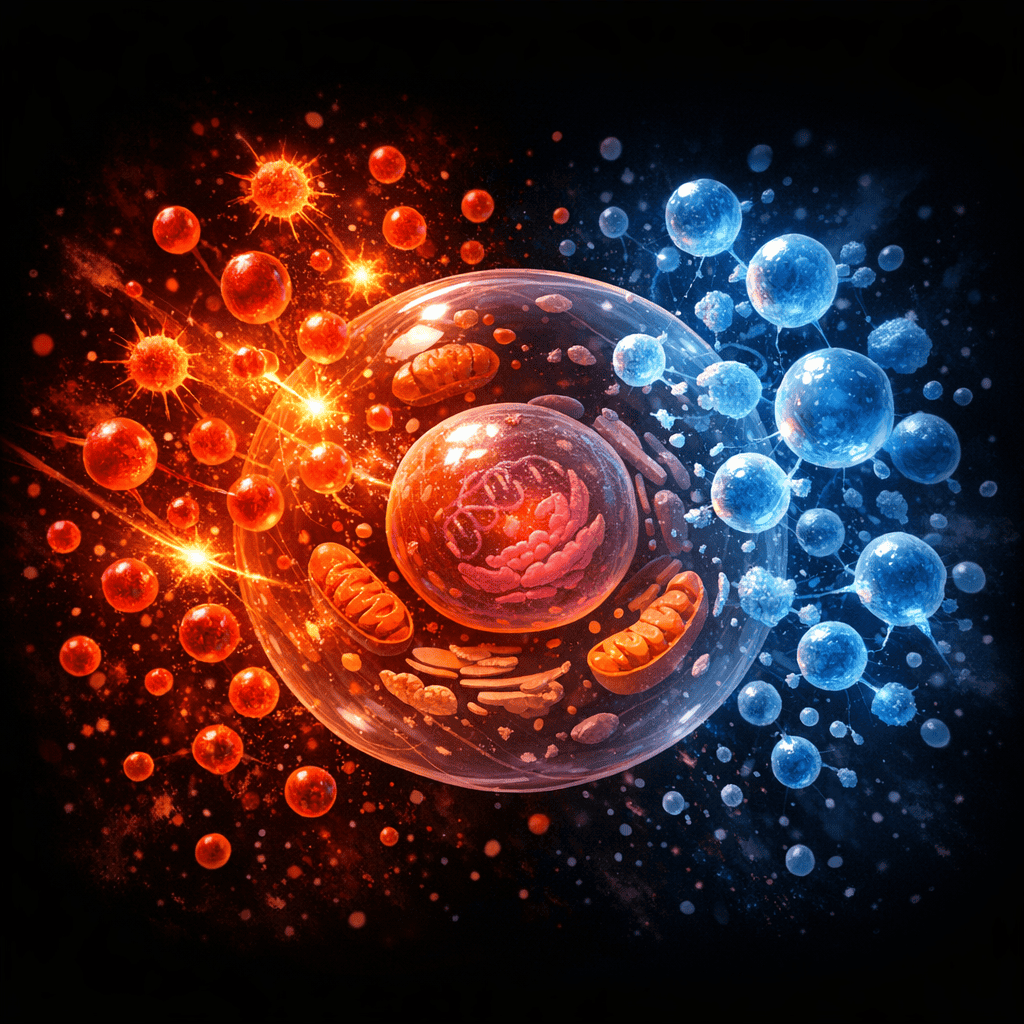

When you freeze a cell, you are essentially stopping time. But the freeze itself is violent. Ice crystals form, osmotic pressure builds, and the membrane systems that cells depend on get yanked out of their normal state. What happens next, in those first moments after thawing, is where things get interesting. The cell faces a surge of reactive oxygen species, free radicals that can shred proteins and lipids faster than the cell’s own repair crews can respond. This is oxidative stress in its rawest form, triggered not by infection or inflammation but by the simple physics of temperature change.
Scientists studying cell preservation have discovered something useful: certain molecules appear to act as a shield during this dangerous window. Polyunsaturated fatty acids and melatonin, added before freezing, seem to reduce the damage that cells sustain when thawed. The effect is modest but real, and it points to something deeper about how cells manage stress at the molecular level.
What is oxidative damage during cryopreservation
Cryopreservation is the practice of freezing biological material, whether cells, tissues, or embryos, for long-term storage. It works because frozen cells enter a state of metabolic suspension. Chemical reactions slow almost to a standstill. In theory, a frozen cell should survive indefinitely.
But the process of freezing and thawing is not gentle. Ice crystals grow and can puncture cell membranes. The water inside the cell freezes, forcing solutes into higher concentrations. Cryoprotectants like dimethyl sulfoxide are used to reduce ice formation, yet some damage is unavoidable. When the cell is thawed and warmed back to normal temperature, metabolism restarts. Mitochondria fire up, electrons leak from the respiratory chain, and before antioxidant defences can fully engage, reactive oxygen species accumulate.
These free radicals attack lipids in cell membranes, proteins involved in energy production, and even DNA. Unlike oxidative stress from ageing or disease, cryopreservation-induced stress is acute and predictable. It happens in a compressed window of time after thawing. This actually makes it easier to study how cells defend themselves.
What the research shows
Experiments adding polyunsaturated fatty acids (PUFAs) to cell cultures before freezing show a measurable reduction in oxidative damage after thawing. Researchers observe lower levels of lipid peroxidation, the breakdown of fats in cell membranes that occurs when free radicals attack them. The cells also show better metabolic recovery, with mitochondrial function rebounding faster compared to controls.
Melatonin produces similar protective effects. When added to freezing media, it reduces reactive oxygen species levels in the hours after thawing. What makes melatonin interesting is its mechanism. Unlike vitamins C and E, which work mainly by donating electrons to free radicals, melatonin appears to work through multiple pathways simultaneously. It acts as a direct antioxidant, yes, but it also stimulates the cell’s own endogenous antioxidant enzymes, the ones the cell manufactures itself.
The combination of PUFAs and melatonin appears to offer additive protection in some experimental systems. Whether this translates to better long-term outcomes for preserved cells, tissues, or organs is still being investigated. The research so far suggests both molecules help cells tolerate the metabolic shock of thawing, but they do not eliminate the problem entirely.
Why cells need this protection
To understand why cells are vulnerable during thaw, you need to think about what happens at the moment oxygen returns. Most cells are stored at very low temperatures in the absence of oxygen or with minimal aerobic metabolism. The moment they warm up, oxygen availability increases, and the electron transport chain in mitochondria begins operating at normal speed again. Electrons are passed from one carrier to another, driving the pumping of protons across the inner mitochondrial membrane and creating the electrical gradient that powers ATP synthesis.
But this process is not 100 percent efficient. Electrons sometimes escape and react directly with oxygen, forming superoxide. The cell has enzymatic defences for this, superoxide dismutase and catalase among them, but these defences take time to reach full capacity. During the thaw window, there is a mismatch between the rate of free radical production and the rate at which the cell can neutralise them.
Polyunsaturated fatty acids sit in the membrane and can donate electrons to free radicals, essentially sacrificing themselves to protect more critical molecules. Melatonin circulates through both aqueous and lipid compartments of the cell, so it can intervene in multiple locations. Evolutionarily, melatonin evolved as a direct antioxidant in ancient organisms before mitochondria even existed. That chemical versatility remains useful today, even in the artificial context of cryopreservation.
What affects protection during freezing
The protective effect of PUFAs and melatonin is not uniform across all cell types. Cells with high metabolic rates, like neurons and cardiomyocytes, appear more vulnerable to freeze-thaw damage and also more responsive to protective molecules. Cells with lower baseline metabolism show less benefit, possibly because their antioxidant demand after thawing is lower.
Temperature matters. The speed of freezing influences how much damage occurs in the first place. Slower freezing allows ice formation, which can be more damaging mechanistically, but faster freezing increases osmotic stress. The optimal addition of PUFAs and melatonin varies depending on this balance. Too much can interfere with cryoprotectant function.
Concentration and timing also change the outcome. The molecules need to be present before freezing, incorporated into the cellular environment so they are available when the thaw-induced oxidative burst occurs. Post-thaw addition is far less effective because by then, critical damage has already started.
Age of the cell matters as well. Cells from older organisms often have pre-existing mitochondrial dysfunction or reduced antioxidant capacity. These cells show greater benefit from supplemental protection, suggesting that exogenous antioxidants can partially compensate for impaired endogenous defences.
What remains unknown
The biggest unanswered question is whether improved short-term protection translates to better long-term cell viability and function. A cell that survives the immediate thaw window might still have accumulated DNA damage or epigenetic changes that affect its behaviour days or weeks later. Long-term studies following cryopreserved cells over extended culture periods are still limited.
The optimal combination and concentration of protective molecules is not yet defined. Individual variation matters too, yet we do not fully understand why some cell preparations respond robustly to PUFA and melatonin supplementation while others show minimal benefit. Is it related to the baseline antioxidant capacity of the source tissue? The age of the donor? The specific cell type?
Mechanistically, we still cannot fully explain how PUFAs and melatonin coordinate with the cell’s own antioxidant signalling systems. Do they upregulate genes encoding catalase or superoxide dismutase? Do they suppress pro-oxidant pathways? The molecular choreography during the thaw period remains incompletely understood, and filling that gap would point toward smarter protective strategies.
The question of whether we can use these molecules to improve cryopreservation of complex tissues and organs, where cell-to-cell signalling and vascular function matter, remains largely open. Most research has focused on individual cell suspensions, which is simpler but also further removed from clinical reality.
What this research reveals is that cells are not passive victims of the freeze-thaw cycle. They have genuine biological machinery for detecting and neutralising oxidative stress, and that machinery can be supported with the right molecules added at the right time. The challenge now is understanding this process well enough to make it reliably practical. That requires moving beyond observing that a treatment works to grasping why it works and how to optimise it for different biological contexts. That is the real frontier in preservation biology.

Matt Elliott is the editor of Redox News Today, an independent publication covering peer-reviewed research on cellular health, redox signalling, and related biomedical science.