Your red blood cells carry oxygen through 60,000 miles of blood vessels every day, but their flexible membranes take a beating from oxidative stress. Now scientists can watch this cellular damage happen in real time using light analysis technology that reads the molecular fingerprints of membrane breakdown.
What is hyperspectral imaging of red blood cells
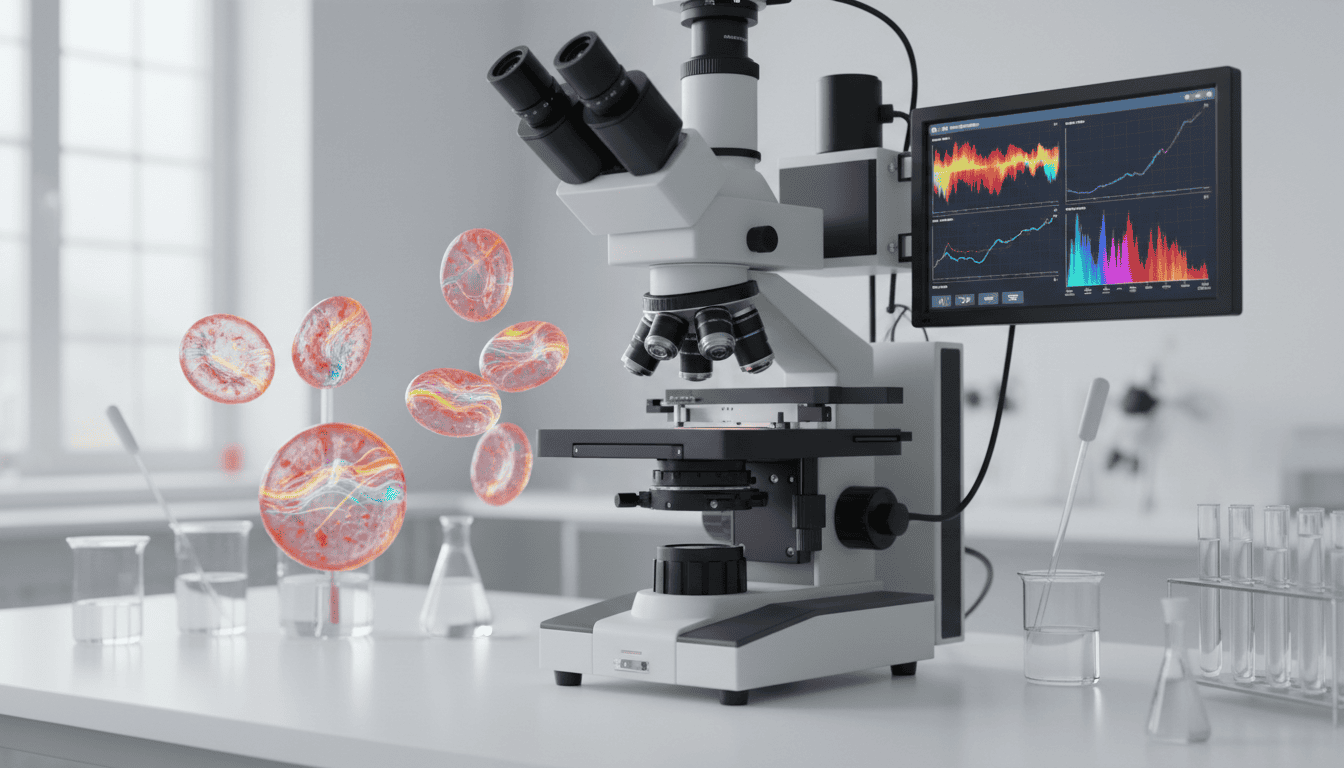
Hyperspectral imaging works like a sophisticated colour scanner that sees far beyond human vision. While our eyes detect three basic colours, this technology captures hundreds of wavelengths across the light spectrum. Each molecule reflects and absorbs light in its own unique pattern.
Red blood cell membranes contain lipids, proteins, and haemoglobin that each have distinct spectral signatures. When oxidative stress damages these components, their molecular structure changes. These changes alter how they interact with light, creating new spectral fingerprints that the imaging system can detect.
The technology maps these spectral changes across individual cells or entire samples. Scientists can see which specific molecules are being damaged and track how the damage spreads through cell populations over time.
What the research shows
Studies using hyperspectral imaging reveal oxidative damage patterns that weren’t visible before. Researchers observe lipid peroxidation beginning at specific membrane sites rather than happening uniformly across the cell surface.
The imaging shows that membrane cholesterol and phospholipids respond differently to oxidative stress. Cholesterol-rich regions often resist damage longer than areas dominated by polyunsaturated fatty acids. This creates a patchwork of healthy and damaged membrane zones within single cells.
Protein oxidation appears as distinct spectral changes separate from lipid damage. Scientists can watch as membrane proteins lose their normal structure, which affects how red blood cells squeeze through tiny capillaries. The technology also detects early-stage damage before cells show visible signs of dysfunction under conventional microscopy.
Time-lapse hyperspectral imaging reveals that oxidative damage accelerates once it reaches certain thresholds. Cells can maintain normal function despite moderate membrane damage, but reach a tipping point where deterioration rapidly cascades.
Why cells need this membrane protection
Red blood cells lack nuclei and most organelles, so they can’t manufacture new proteins or repair themselves like other cells. Their membranes must last the entire 120-day lifespan while maintaining the flexibility needed to navigate capillaries narrower than the cell diameter.
The membrane’s lipid composition isn’t random. Evolution optimised it for durability under oxidative stress while preserving the deformability that lets cells carry oxygen to every tissue. Too much membrane rigidity and cells get stuck in small vessels. Too little and they burst under pressure.
Red blood cells carry antioxidant systems including catalase, superoxide dismutase, and glutathione to protect their membranes. But these defences diminish as cells age, making older red blood cells more vulnerable to oxidative damage that hyperspectral imaging can track.
What affects red blood cell membrane integrity
Age systematically weakens antioxidant defences in red blood cells. Research shows that cells from older individuals display more baseline membrane damage and respond more severely to oxidative challenges when examined with hyperspectral imaging.
Environmental factors leave spectral signatures in red blood cell membranes. Air pollution, UV radiation, and chemical exposures create oxidative stress that appears as specific damage patterns. Even exercise generates oxidative stress, though regular physical activity also upregulates protective mechanisms.
Dietary antioxidants influence membrane composition and resistance to damage. Vitamin E incorporates directly into membrane lipids, while other compounds support the cellular antioxidant systems that protect membrane integrity. Hyperspectral analysis can detect these protective effects at the molecular level.
Medical conditions affecting circulation or metabolism alter oxidative stress patterns in red blood cells. The imaging technology reveals how different disease states create characteristic membrane damage signatures.
What remains unknown
Scientists still puzzle over why some membrane regions resist oxidative damage while others succumb quickly. The molecular basis for these vulnerability differences needs more investigation before researchers can predict which cells will fail first.
The relationship between spectral changes and actual cell function remains unclear in many cases. Researchers can see membrane damage occurring but don’t always know how much damage cells can tolerate before losing their ability to deliver oxygen effectively.
Whether hyperspectral signatures can predict red blood cell lifespan in living organisms stays an open question. Laboratory studies show promise, but translating these findings to understand cell ageing in the human body requires more work.
The technology’s sensitivity raises questions about what constitutes normal versus pathological membrane changes. Establishing baseline patterns across different populations and conditions will take years of systematic research.
This convergence of advanced imaging and cell biology opens new windows into how our most abundant cells handle the oxidative stress of simply existing. As the technology develops, it may reveal fundamental principles about cellular resilience that apply far beyond red blood cells to understand how all our cells balance function with survival under constant molecular attack.

Matt Elliott is the editor of Redox News Today, an independent publication covering peer-reviewed research on cellular health, redox signalling, and related biomedical science.