
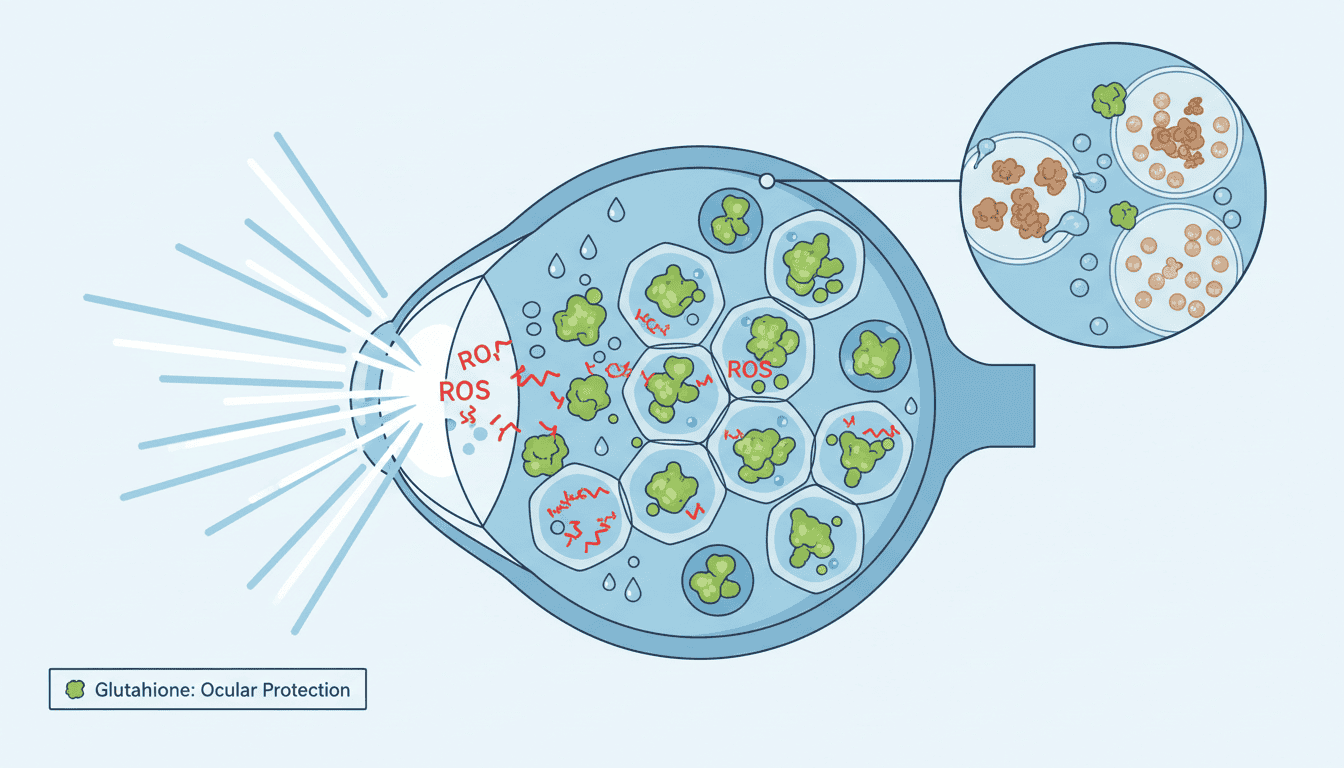
Your eyes face a brutal daily assault. Every photon of light that helps you see also carries the potential to damage the delicate cellular machinery of your retina. Yet most people maintain clear vision for decades, even with constant exposure to everything from morning sunlight to computer screens. The reason lies partly in glutathione, a small molecule that works around the clock to neutralise the oxidative damage that light inevitably creates in your eyes.
What is glutathione’s role in the eye
Glutathione functions as the eye’s primary antioxidant defence system. This tripeptide molecule, made from three amino acids, exists in particularly high concentrations throughout eye tissues. The lens alone contains glutathione levels that are among the highest found anywhere in the body.
When light hits your retina, it triggers a cascade of chemical reactions that allow you to see. But these same reactions produce reactive oxygen species as an unavoidable byproduct. Think of it like combustion in a car engine. The process generates the energy you need, but it also creates exhaust that must be managed.
Glutathione neutralises these reactive oxygen species before they can damage proteins, lipids, or DNA in eye cells. It works both directly, by chemically reacting with oxidants, and indirectly, by recycling other antioxidants like vitamin C back to their active forms. The cornea, lens, retina, and vitreous fluid all depend on robust glutathione systems to maintain their function.
What the research shows
Studies consistently reveal dramatically reduced glutathione levels in eyes affected by age-related conditions. Researchers have measured glutathione concentrations in human lens tissue and found steep declines with advancing age. By age 70, lens glutathione levels typically drop to less than 15% of what they were at age 20.
The retina shows similar patterns. Scientists examining retinal tissue have documented progressive glutathione depletion in the macula, the central region responsible for detailed vision. This decline correlates strongly with increased oxidative damage markers in the same tissues.
Animal studies provide more direct evidence of glutathione’s protective role. When researchers genetically modify mice to have reduced glutathione production specifically in eye tissues, the animals develop lens opacity and retinal degeneration much earlier than normal. Conversely, treatments that boost glutathione levels in animal models consistently protect against light-induced retinal damage.
Perhaps most tellingly, cells from the retinal pigment epithelium, which support photoreceptor function, show rapid death when their glutathione production is blocked. These cells normally contain some of the highest glutathione concentrations in the eye, reflecting their critical role in processing visual pigments and managing oxidative stress.
Why cells need this protection
Vision requires an inherently dangerous biochemical process. Photoreceptor cells in your retina contain millions of visual pigment molecules that must constantly cycle through light-sensitive reactions. Each reaction generates oxidative byproducts that can damage the very cells responsible for sight.
The eye’s anatomy compounds this challenge. The lens must remain completely transparent to function, which means it contains no blood vessels to deliver fresh antioxidants or remove waste products. Instead, the lens relies entirely on its internal antioxidant systems, with glutathione serving as the primary defence.
Meanwhile, the retina has one of the highest metabolic rates of any tissue in the body. It consumes oxygen at a rate comparable to the heart muscle, but unlike the heart, it also faces direct exposure to light energy. This combination creates an oxidative stress environment that would quickly destroy most other tissues without robust protection.
Evolution preserved multiple glutathione recycling pathways specifically in eye tissues. The enzyme glutathione reductase, which regenerates used glutathione molecules, shows particularly high activity in the lens and retina. This suggests that maintaining glutathione function has been critical for vision throughout evolutionary history.
What affects glutathione in eyes
Age represents the most significant factor influencing ocular glutathione levels. Multiple research groups have documented the progressive decline in both glutathione concentration and the activity of enzymes that produce and recycle it. This age-related decrease appears to accelerate after age 40.
Light exposure patterns also matter. Studies show that intense or prolonged light exposure can deplete glutathione faster than the eye can replenish it. Blue light appears particularly problematic, as it carries more energy than longer wavelengths and penetrates deeper into eye tissues.
Nutritional factors influence glutathione production in the eyes just as they do elsewhere in the body. The amino acids cysteine, glycine, and glutamate serve as building blocks for glutathione synthesis. Research indicates that dietary deficiencies in these precursors can limit the eye’s ability to maintain adequate glutathione levels.
Diabetes and other metabolic conditions create additional oxidative stress that can overwhelm the eye’s glutathione systems. Studies of diabetic patients consistently show reduced glutathione levels in eye tissues, along with increased markers of oxidative damage.
Smoking dramatically impacts ocular glutathione. Research demonstrates that smokers have significantly lower glutathione levels in their eyes compared to non-smokers, likely due to the increased oxidative burden from tobacco-derived toxins.
What remains unknown
Scientists still don’t fully understand why glutathione levels decline so dramatically with age in eye tissues. While several theories exist, including reduced synthesis and increased oxidative demand, the precise mechanisms driving this decline remain unclear. This knowledge gap limits our understanding of whether the process can be slowed or reversed.
The relationship between different antioxidant systems in the eye needs more research. Glutathione works alongside vitamins C and E, carotenoids like lutein and zeaxanthin, and numerous enzymes. How these systems coordinate their activities and compensate for each other’s limitations isn’t well characterised.
Researchers are also investigating whether glutathione function varies between different regions of the eye and different types of cells. Preliminary evidence suggests that some eye cells may be more dependent on glutathione than others, but the clinical implications of these differences remain unclear.
The potential for therapeutic interventions targeting ocular glutathione represents another frontier. While various approaches show promise in laboratory studies, translating these findings into effective treatments requires overcoming significant challenges in drug delivery to eye tissues.
Understanding glutathione’s role in eye health reveals a fundamental truth about vision: seeing clearly requires constant cellular maintenance. Your eyes evolved elaborate chemical defence systems precisely because the act of vision creates the conditions for its own destruction. Glutathione stands as perhaps the most important guardian in this daily battle, quietly protecting the molecular machinery that transforms light into sight. The research suggests that maintaining these protective systems may be just as important for long-term vision as any other aspect of eye health.

Matt Elliott is the editor of Redox News Today, an independent publication covering peer-reviewed research on cellular health, redox signalling, and related biomedical science.