
Every cigarette you smoke delivers roughly 10 trillion free radicals directly into your bloodstream. These rogue molecules don’t just float around causing vague damage. They attack specific cellular machinery in your retina with mechanical precision, overwhelming the defence systems that have protected your vision for decades. This is why smokers face higher rates of age-related macular degeneration, cataracts, and other vision problems decades earlier than non-smokers.
What is oxidative stress in retinal cells
Your retina is a metabolically hungry tissue. It consumes oxygen voraciously to power the constant work of detecting light and sending signals to your brain. This high energy demand creates a problem: cells that burn through oxygen produce free radicals as a byproduct, especially unstable molecules missing an electron. Free radicals will steal electrons from nearby molecules to stabilise themselves, triggering a chain reaction of damage.
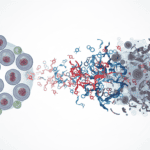
Normally, your cells manage this through antioxidant enzymes like superoxide dismutase and catalase. These proteins patrol retinal cells like molecular security guards, neutralising free radicals before they cause harm. But when smoking floods the retina with external free radicals, this defence system gets overwhelmed. The antioxidants can’t neutralise threats fast enough. Lipids in cell membranes get oxidised. Proteins lose their shape. DNA strands break. This cascade of destruction is oxidative stress.
The retina is particularly vulnerable because it sits in direct contact with blood vessels carrying toxic compounds from smoke, and because photoreceptors (the light-sensing cells) generate free radicals simply by doing their job. Add external oxidative assault on top of that intrinsic burden, and you get a tissue struggling to maintain basic cellular integrity.
What the research shows
Studies comparing retinal tissue from smokers and non-smokers reveal striking differences in oxidative damage markers. Researchers measure levels of malondialdehyde and protein carbonyls in retinal tissue and blood, finding both significantly elevated in smokers. These are the molecular equivalent of burnt wreckage, products created when free radicals attack lipids and proteins.
The damage extends to mitochondria, the power plants of retinal cells. Smoking reduces mitochondrial function in photoreceptors and retinal pigment epithelium cells, the layer that supports photoreceptors. When mitochondria struggle, cells produce even more free radicals, creating a vicious cycle. Research also shows smokers have reduced antioxidant enzyme activity in their retinas compared to non-smokers, meaning their defence systems are simultaneously weaker and facing stronger assault.
One particularly telling observation involves the retinal pigment epithelium, a single layer of cells that essentially babysits photoreceptors. These cells accumulate lipofuscin, a yellowish pigment from oxidative damage, at accelerated rates in smokers. This buildup interferes with the cell’s ability to clear out dead photoreceptors and maintain the retinal environment. In smokers, this process runs decades ahead of schedule.
Why cells need protection from free radicals
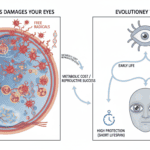
Evolution didn’t waste energy building antioxidant defence systems unless they served a vital function. Free radicals damage the molecular instructions that cells rely on to survive and function. Uncontrolled oxidative stress triggers apoptosis, the programmed cell death pathway. For photoreceptors, which you cannot replace once lost, this is catastrophic and permanent.
The retina invests heavily in antioxidant defences because the cost of failure is blindness. Unlike skin cells that you constantly replace, photoreceptors are lifelong commitments. Your body maintains elaborate enzyme systems to keep oxidative stress below the threshold where cells die. But these systems evolved for the oxidative load of normal living, not for the additional burden of cigarette smoke.
Oxidative stress also drives inflammation. Damaged cells release signalling molecules that recruit immune cells to the retina. While inflammation initially helps clear debris, chronic oxidative stress keeps this inflammatory response switched on, creating tissue damage independent of the original free radical attack. This is why smokers often develop not just isolated cell death but progressive retinal degeneration.
What affects oxidative stress in smokers’ retinas
Smoking quantity matters enormously. Heavy smokers accumulate more retinal oxidative damage than light smokers. But duration of exposure matters just as much. Someone who smoked for 40 years faces greater retinal damage than someone with the same total cigarette count squeezed into 10 years. The retina’s defences never fully recover between exposures.
Age amplifies the problem. Older smokers have retinas already dealing with age-related accumulation of oxidative damage. When you add smoking on top, the combined burden exceeds what antioxidant systems can manage. This is why smokers develop age-related macular degeneration 10 to 15 years earlier than non-smokers on average.
Nutrition influences retinal resilience. Antioxidants from diet, particularly lutein and zeaxanthin (concentrated in leafy greens), deposit in the retina and provide additional defence. Smokers with poor nutrition face compounded risk. Secondhand smoke exposure also contributes, though less dramatically than active smoking, because it delivers the same oxidative compounds but in lower concentrations.
What remains unknown
Researchers still haven’t mapped exactly which free radicals from tobacco smoke cause the most retinal damage. Cigarette smoke contains hundreds of compounds, and their interactions with retinal cells remain incompletely understood. Do some components preferentially attack photoreceptors, while others target supporting cells? The answer would help explain variation in disease progression between individuals.
The timeline of damage is also unclear. How long does oxidative stress need to accumulate before photoreceptors cross the threshold into apoptosis? Do some retinal cells die immediately after smoke exposure, or does damage accumulate silently until cells suddenly fail? Understanding this would help predict who faces highest risk and when vision loss typically becomes noticeable.
Whether antioxidant supplementation in smokers can meaningfully reduce retinal oxidative damage remains contested. Studies show mixed results, partly because supplementation may not achieve sufficient concentrations in retinal tissue, and partly because we don’t fully understand which antioxidants would be most protective against the specific free radicals in tobacco smoke.
Oxidative stress in the retina illustrates a fundamental principle of cellular biology: your tissues are only as durable as their ability to manage the chemical consequences of energy production and external assault. The retina evolved exquisite defences against oxidative damage, but those defences assume a certain operating environment. Smoking fundamentally violates those assumptions, introducing an oxidative burden your cells never developed the capacity to withstand.

Matt Elliott is the editor of Redox News Today, an independent publication covering peer-reviewed research on cellular health, redox signalling, and related biomedical science.