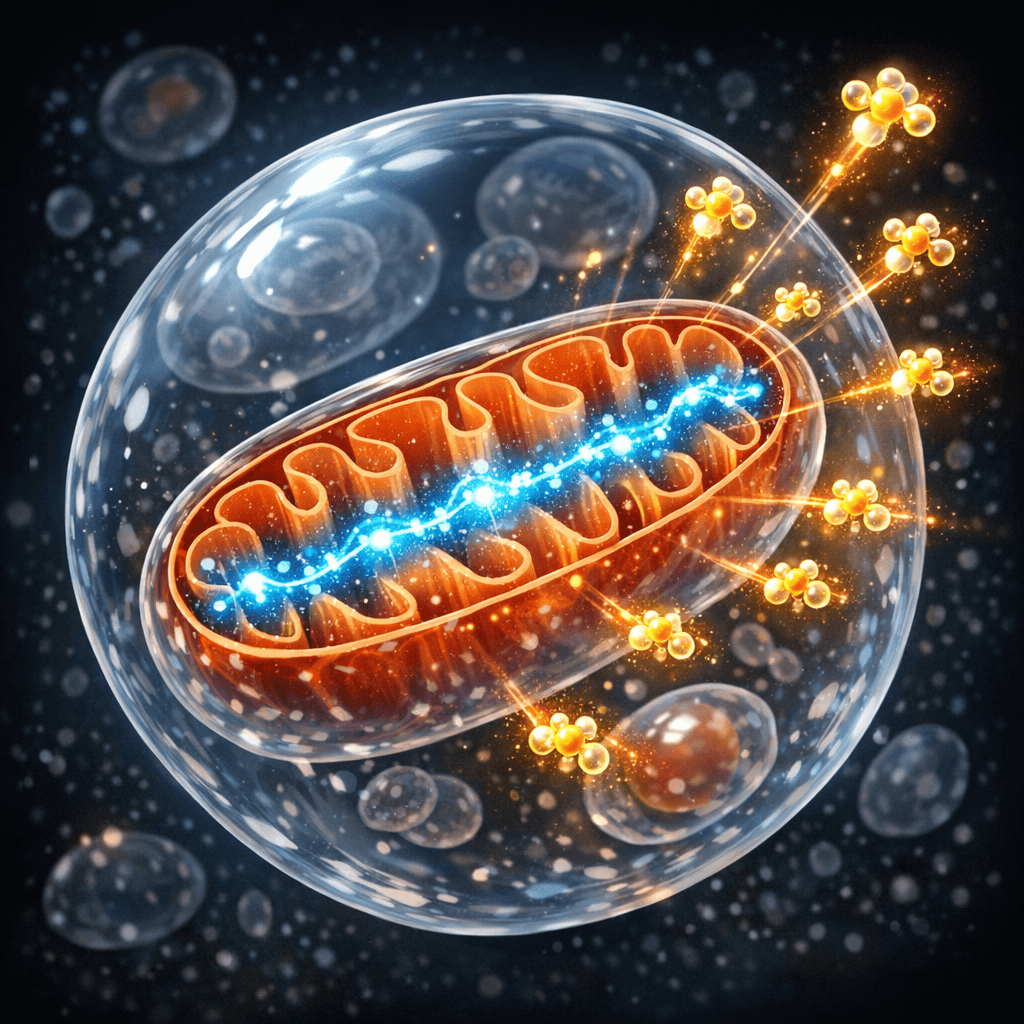
Mitochondria entered biology textbooks as the cell’s powerhouse, a label accurate enough to stick but too narrow to capture what the research has revealed over the past three decades. These double-membraned organelles do produce the ATP that powers cellular life — that part of the textbook is right. What the simplified version misses is that mitochondria also sense the cell’s metabolic state, regulate programmed cell death, generate the reactive signals that activate stress-response pathways, and participate in calcium signalling, thermogenesis, and the immune response to infection. They are less a power station and more a centralised operations hub.
The shift in understanding has practical consequences. If mitochondria are simply energy producers, then declining mitochondrial function in ageing is a problem of reduced ATP output. If they are signalling hubs, then declining function also means degraded communication, slower adaptation, and impaired cellular regulation across systems that don’t look like energy problems at first glance.
How Mitochondria Produce Energy
The ATP production process runs in two connected stages. In the cytoplasm, glycolysis breaks glucose into pyruvate, producing a small net yield of ATP. Pyruvate enters the mitochondria and is converted to acetyl-CoA, which enters the citric acid cycle. The cycle extracts electrons from carbon compounds and transfers them to electron carrier molecules, primarily NADH and FADH2.
These carriers deliver electrons to the inner mitochondrial membrane, where the electron transport chain takes over. Four large protein complexes — Complex I through IV — pass electrons sequentially, each transfer releasing energy used to pump protons across the membrane. The resulting proton gradient drives ATP synthase (Complex V), which uses the proton flow to phosphorylate ADP into ATP. At Complex IV, the final electron acceptor is molecular oxygen, which combines with electrons and protons to form water.
The efficiency of this system is remarkable — each molecule of glucose theoretically yields around 30-32 molecules of ATP through this process, versus 2 from glycolysis alone. In practice, the yield is slightly lower due to membrane proton leakage and the metabolic cost of transporting substrates. But the orders-of-magnitude advantage over anaerobic metabolism is why complex aerobic life depends on mitochondria.
Mitochondria as Signalling Hubs
The electron transport chain is not perfectly sealed. A small fraction of electrons escape their intended path and react with oxygen to form superoxide, the primary mitochondrial reactive oxygen species. At low levels, these reactive species are signals rather than damage. They activate NRF2, stimulate mitochondrial biogenesis, and communicate the cell’s metabolic status to the nucleus through a process called retrograde signalling.
Mitochondria also control apoptosis — programmed cell death — through the release of cytochrome c from the mitochondrial intermembrane space. When a cell accumulates irreparable damage, pro-apoptotic signals cause the outer mitochondrial membrane to permeabilise, releasing cytochrome c into the cytoplasm, where it initiates the caspase cascade that executes cell death. This is a protective mechanism. Orderly elimination of damaged cells prevents their persistence as dysfunctional or potentially malignant tissue. Mitochondria, in this capacity, are part of the cell’s quality control system.
Calcium signalling is another mitochondrial function that connects directly to cellular physiology. Mitochondria take up calcium from the cytoplasm during calcium transients — the pulses of calcium that accompany muscle contraction, neurotransmitter release, and hormone secretion. By buffering cytoplasmic calcium, mitochondria shape the timing and amplitude of these signals. Mitochondrial calcium accumulation also stimulates the citric acid cycle enzymes, coupling energy demand directly to supply.
Mitochondrial DNA and Accumulated Damage
Each mitochondrion contains multiple copies of its own genome — a small circular DNA molecule encoding 13 proteins essential for the electron transport chain, plus the ribosomal and transfer RNAs needed to synthesise them. Mitochondrial DNA sits in close physical proximity to the electron transport chain, exposed to the reactive species generated there. It lacks the histone packaging that protects nuclear DNA, and while it has repair mechanisms, they are less comprehensive than those operating in the nucleus.
Mutations accumulate in mitochondrial DNA over time. Most cells carry a mixture of normal and mutated mitochondrial DNA — a state called heteroplasmy. As the proportion of mutated copies rises past a threshold, mitochondrial function declines. The electron transport chain runs less efficiently, ATP output falls, and reactive species production increases relative to useful energy yield. More reactive species cause further mitochondrial DNA damage, further reducing efficiency. This feedback loop is well-documented in ageing tissue across species.
A quality control process called mitophagy exists to remove damaged mitochondria before they degrade function. The autophagy system identifies dysfunctional mitochondria, encapsulates them, and delivers them for lysosomal degradation. The rate of mitophagy declines with age, allowing damaged mitochondria to accumulate rather than being cleared. Supporting mitophagy — through exercise, intermittent fasting, and adequate sleep — is thought to be one mechanism through which these behaviours preserve mitochondrial quality.
Mitochondrial Biogenesis
New mitochondria can be generated within existing cells through mitochondrial biogenesis, regulated primarily by PGC-1α (peroxisome proliferator-activated receptor gamma coactivator 1-alpha). When energy demand increases, when cells are exposed to cold, or when reactive oxygen species levels rise in a hormetic range, PGC-1α is activated and coordinates the expression of hundreds of genes involved in mitochondrial growth and function.
Exercise is the strongest known stimulus for mitochondrial biogenesis in skeletal muscle. Both endurance and resistance training activate PGC-1α and produce measurable increases in mitochondrial density and respiratory capacity within weeks. This is one of the primary mechanisms through which exercise training improves metabolic health, fatigue resistance, and physical performance.
What Remains Unknown
The causal relationship between mitochondrial decline and systemic ageing is not fully resolved. Correlation between mitochondrial dysfunction and age-related disease is robust and consistent. Whether the dysfunction is a primary driver of the disease or a downstream consequence of other processes — inflammation, DNA damage accumulation, stem cell exhaustion — is harder to establish. Probably the answer varies by tissue and condition.
The therapeutic potential of directly targeting mitochondria is an active research area. Mitochondria-targeted antioxidants, drugs that enhance mitophagy, and approaches aimed at reducing mitochondrial DNA mutation rates are all in early to mid-stage development. None are yet established as standard interventions, and the translation from animal models to humans has proven slow. Whether NAD+ precursors like NMN and NR — currently popular supplements with a mechanistic rationale linking them to mitochondrial function — produce clinically meaningful benefits in healthy humans is still being determined in ongoing trials.
Why Mitochondria Are Central to Cellular Health
Energy, signalling, apoptosis, calcium homeostasis, reactive species generation and clearance — mitochondria participate in all of it. Their functional decline with age is not one problem among many. It is connected to most of the other cellular changes that characterise ageing: accumulating oxidative damage, declining immune function, impaired repair, reduced stress resilience. Supporting mitochondrial health is not a peripheral strategy. It is close to the centre of what supporting cellular health actually means.

Matt Elliott is the editor of Redox News Today, an independent publication covering peer-reviewed research on cellular health, redox signalling, and related biomedical science.