Your brain doesn’t have much time to waste after an injury. Within hours, immune cells flood the damaged area. They release a cascade of inflammatory molecules meant to clean up debris and kill potential invaders. But here’s the problem: if that inflammatory response doesn’t switch off, it becomes the injury itself. Cells die. Neural connections dissolve. The very defence meant to protect the brain causes secondary damage that can persist for months or years. So the brain has evolved a clever solution: specialised signalling molecules that tell immune cells to stand down. One of the most potent is a lipid called resolvin D1, or RvD1, which works through a receptor called FPR2. Understanding how this pathway operates is reshaping how scientists think about recovery after brain trauma.
What is the RvD1/FPR2 pathway
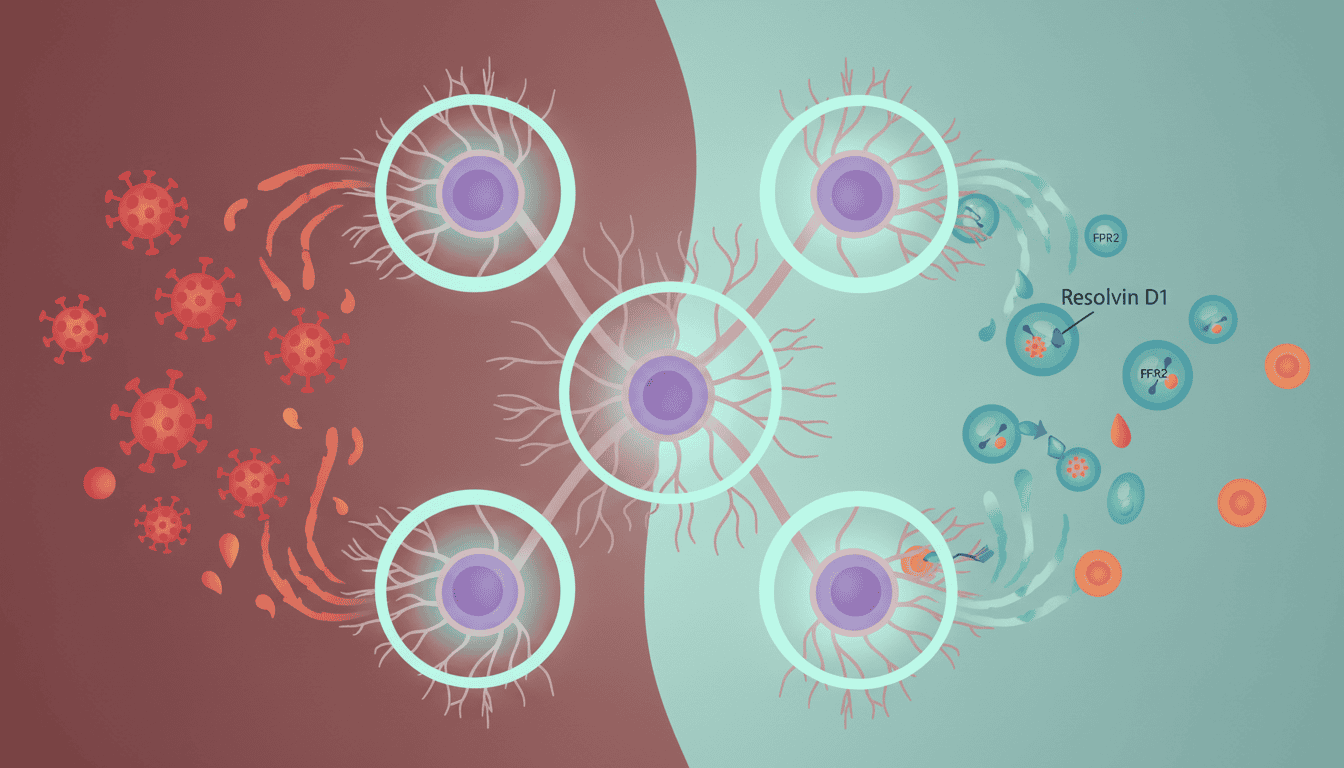
Resolvins are small lipid molecules your body produces from omega-3 fatty acids. Think of them as biological brakes. When inflammation gets rolling, your immune system is designed to produce these molecules as a signal to wind things down. RvD1 is one of the most important resolvins for the central nervous system. It doesn’t just reduce inflammation passively. When RvD1 binds to FPR2, a receptor found on immune cells and brain cells themselves, it triggers a coordinated shift in cellular behaviour. The immune cells that were in attack mode switch to a repair mode instead. They stop pumping out pro-inflammatory chemicals and start clearing away dead cells and debris. Meanwhile, brain cells increase their own antioxidant defences, neutralising free radicals that accumulate during injury. This is an active process, not a simple suppression of the immune system. The body is actively redirecting the inflammatory response toward tissue repair.
What the research shows
Scientists studying brain injury models have observed something consistent: animals that produce sufficient RvD1 and have functional FPR2 signalling recover better than those without it. In laboratory settings, when researchers apply RvD1 to injured brain tissue, they see a measurable reduction in oxidative stress markers, the molecular signatures of cellular damage from free radicals. Immune cells shift their gene expression patterns within hours. They produce less TNF-alpha and IL-6, classical inflammatory mediators, and more of the anti-inflammatory molecules like IL-10. The injured tissue itself shows better preservation of neuronal structure. Researchers have also found that FPR2 signalling ramps up cellular antioxidant systems, particularly the glutathione and SOD (superoxide dismutase) pathways that cells use to neutralise reactive oxygen species. In some studies, blocking the FPR2 receptor actually worsens outcomes after brain injury, suggesting this pathway is essential for natural recovery, not merely beneficial. The effect appears to be most pronounced in the acute phase, the first hours and days after injury, though some benefits persist into the longer recovery window.
Why cells need this
From an evolutionary perspective, this makes complete sense. Your brain is metabolically ravenous. It uses about 20 percent of your body’s energy despite being only 2 percent of your body weight. During normal operation, it generates considerable oxidative stress just from routine metabolism. After injury, that oxidative load skyrockets. Mitochondria spill free radicals. Immune cells deliberately produce reactive oxygen species to kill pathogens and destroy damaged cells. But in the tight quarters of the skull, with limited space and no regenerative capacity like, say, the liver has, uncontrolled oxidative damage is catastrophic. The RvD1/FPR2 pathway represents an elegant biological solution: it harnesses the immune response’s power to clear debris while simultaneously preventing that same response from spiralling into destructive excess. The brain evolved this system because damaged neural networks are a liability. A zebra that survives a lion attack but loses the ability to coordinate movement doesn’t last long. Recovery had to be efficient and proportional. The RvD1/FPR2 pathway is part of the brain’s finely tuned recovery toolkit.
What affects the RvD1/FPR2 pathway
Several factors influence how well this pathway functions. Dietary composition matters. Since resolvins are synthesised from omega-3 fatty acids, people and animals consuming diets low in these precursors produce less RvD1. Ageing also dampens the response. Older brains show reduced resolvin production and diminished FPR2 signalling after injury, which may explain why recovery tends to be slower in older individuals. Chronic stress appears to suppress the pathway. Cortisol and sustained inflammatory states impair the metabolic machinery that manufactures resolvins. Exercise enhances resolvin production, and research suggests this contributes to exercise’s protective effects on brain health. Genetic variation in FPR2 itself affects pathway efficiency. Some individuals carry gene variants that reduce receptor expression or function. Sleep deprivation, which impairs immune regulation broadly, also compromises RvD1/FPR2 signalling. Interestingly, previous infections or immune challenges can prime the pathway, making it more responsive. Sex hormones like oestrogen appear to enhance resolvin production in some contexts, which may contribute to sex differences in injury recovery observed in some studies.
What remains unknown
Scientists still don’t fully understand why the RvD1/FPR2 pathway sometimes fails to activate adequately after injury, even in individuals who produce resolvins normally. Is there a critical window when intervention might work best? Most animal studies show benefits when RvD1 is applied early, but optimal timing in humans remains unclear. Researchers also don’t know whether supplementing resolvins directly or increasing dietary precursors would replicate the benefits seen in controlled laboratory conditions. The brain’s physical isolation from the rest of the body complicates this question. Does RvD1 produced in the periphery reach the brain? Can it be manufactured locally? How do different types of brain injury, from traumatic impact to stroke to repetitive subconcussive events, affect pathway activation? And what role does the blood-brain barrier play in controlling RvD1 signalling? There’s also the question of precision: if the RvD1/FPR2 pathway is so protective, why doesn’t the brain simply ramp it up immediately after injury instead of allowing hours of unchecked inflammation? Is there a cost to constitutively high resolvin signalling that evolution has balanced against its benefits? These questions suggest the next generation of research will focus on timing, dosage, and context specificity rather than simple on-off switches.
The RvD1/FPR2 pathway reveals something fundamental about how brains recover: the process isn’t simply about extinguishing inflammation but choreographing a transition from defence to repair. This pathway and others like it represent billions of years of evolutionary refinement, biology’s solution to a hard problem. Understanding how cells switch between these modes isn’t abstract academic work. It points toward the broader principle that many diseases involve dysregulated transitions, not simply too much or too little of a single process. The brain’s injury response is instructive for the whole field of cellular health.

Matt Elliott is the editor of Redox News Today, an independent publication covering peer-reviewed research on cellular health, redox signalling, and related biomedical science.