You stop training for three months. Then you return to the gym and within two weeks you’re nearly back to where you started. Your muscles somehow remember. That’s not metaphorical. Your cells have actually encoded the experience of previous training into their physical structure, and oxidative stress plays an unexpected starring role in that process.
What is muscle memory
Muscle memory isn’t actually a memory stored in muscle itself, though the name stuck around. It’s a collection of cellular and molecular changes that persist in muscle tissue long after training stops. When you exercise, you create tiny injuries and metabolic demands. Your muscle cells respond by building more contractile proteins, expanding mitochondrial networks, and rewiring their signalling pathways. These adaptations make the muscle stronger and more efficient. Stop training and most of those gains fade. But something stays behind.
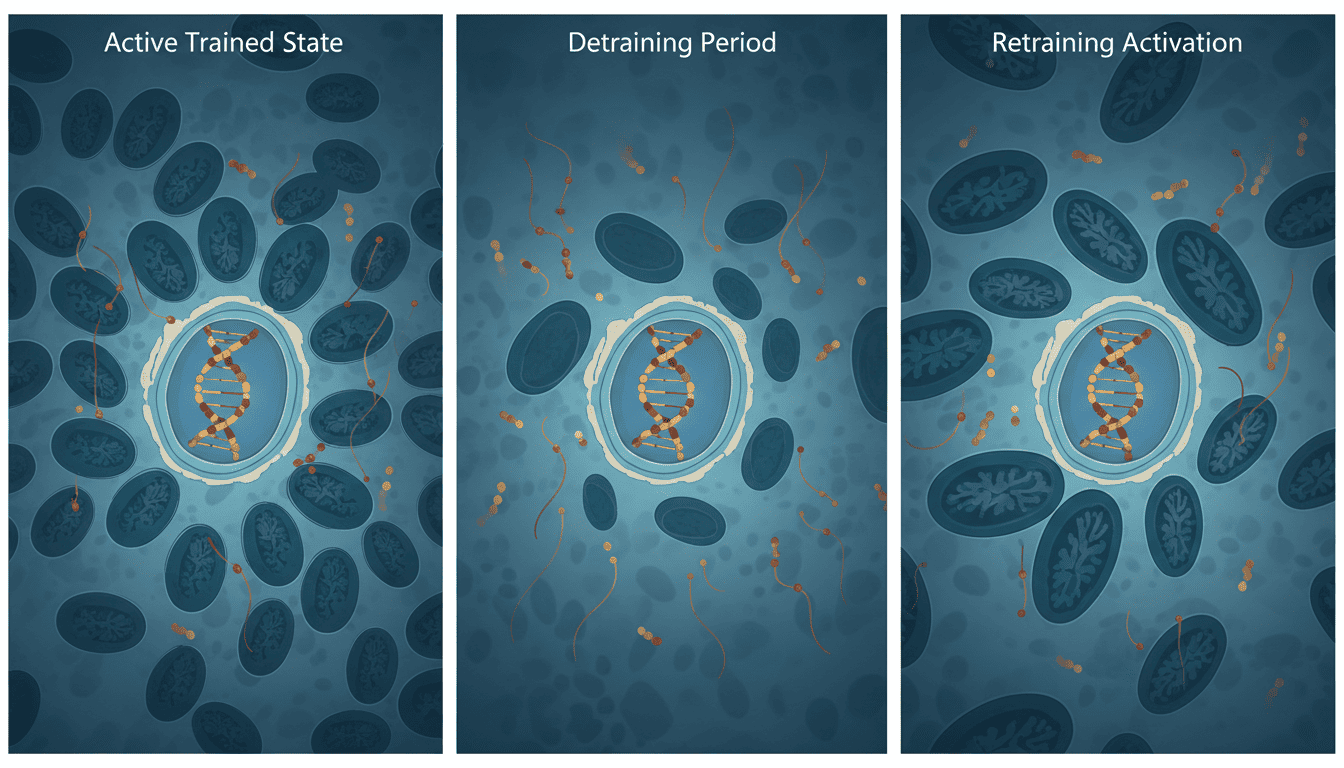
That something includes epigenetic modifications on DNA, altered gene expression patterns, and structural changes in how muscle fibres are organised. Even after months of detraining, when you return to exercise, your cells activate these dormant programmes much faster than if you were starting from scratch. They’re not learning in a conscious sense. They’re responding to a cellular imprint of what happened before.
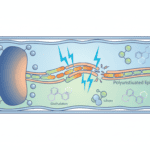
The oxidative stress connection is the interesting bit. Exercise generates reactive oxygen species, ROS, as a byproduct of increased mitochondrial activity. Your cells don’t treat this as purely damage to avoid. Instead, they’ve evolved to read ROS as a signal that something metabolically demanding is happening and respond accordingly.
What the research shows
Studies examining muscle tissue from trained individuals who took extended breaks found that mitochondrial markers remained elevated compared to sedentary controls. Even after weeks of inactivity, the muscle still had more mitochondria and more efficient mitochondrial DNA transcription machinery in place. When training resumed, the muscle quickly reactivated these pre-existing structures rather than building new ones from scratch. That’s why the adaptation phase is so rapid the second time around.
Oxidative stress signalling pathways like PGC-1 alpha, a master regulator of mitochondrial biogenesis, showed persistent epigenetic marks even during the detraining period. These marks act like bookmarks in a library. The genes weren’t actively being read while you weren’t training, but the system remembered where the important chapters were. When exercise stress returned, the cell opened back to those same pages immediately.
Research on ROS levels during exercise showed a dose-response relationship. Moderate elevation in ROS during resistance training triggered adaptive signalling through multiple pathways, while excessive ROS damage from intense eccentric exercise required more extensive cellular repair. The muscle adapted to the specific stress profile it had experienced before. A previously trained muscle recognised the stress signature and responded with practised efficiency.
One striking finding involved satellite cells, the stem cells that help repair and regenerate muscle. Previously trained muscle maintained higher numbers of these cells in an activated state, even during detraining. When training resumed, these cells proliferated faster and differentiated more efficiently into new muscle fibres or contributed to existing fibre repair.
Why cells need this
From an evolutionary perspective, the ability to retain training adaptations made survival sense. If your ancestors went through periods of high physical demand followed by recovery, their muscles benefited from being able to quickly ramp up strength and endurance if that demand returned. The cost of building mitochondria and contractile proteins is significant. Why dismantle that infrastructure completely if you might need it again?
Oxidative stress serves as the cellular currency of this signalling. It’s proportional to metabolic demand. Light activity creates minimal ROS. Intense training creates substantially more. The cell uses this gradient as information. More ROS at a particular intensity level tells the mitochondria “this type of work is happening regularly, upgrade capacity.” The system learns through repeated chemical messaging.
The mitochondrial adaptations are especially logical. Mitochondria are the power plants of muscle. They generate ATP through oxidative phosphorylation. When you train, mitochondria work harder and produce more ROS as a metabolic cost of their activity. But they also produce more energy. This forces the cell to answer a biological question: do we expand capacity to handle this demand more efficiently, or do we try to limit ROS production and stay smaller? Evolution answered: expand and adapt.
What affects muscle memory
Age significantly influences how well muscle retains these adaptations. Younger individuals show faster reactivation of mitochondrial programmes during retraining. Older individuals show slower reactivation but still retain substantially more advantage than starting from complete inactivity. The underlying mechanisms stay intact, just slower.
Nutritional status matters. Antioxidant levels, protein availability, and metabolic state all influence how strongly the oxidative stress signalling gets encoded and how long those marks persist. Someone who maintains reasonable fitness, even at lower intensity, shows better retention than someone who becomes completely sedentary. The signalling pathways need some baseline activation to stay primed.
Training intensity and type shape what the muscle learns. High-intensity resistance training creates a different oxidative stress profile than endurance training. A muscle trained with heavy weights shows better memory for strength capacity. A muscle trained with endurance work shows better memory for aerobic efficiency. The cell appears to encode not just “we got stronger” but “we got stronger this specific way.”
Genetics influence the magnitude of adaptation but not the fundamental mechanism. Some individuals show larger initial gains and correspondingly stronger memory. But the oxidative stress signalling systems that create memory are universal across humans.
What remains unknown
How long these cellular marks actually persist remains incompletely understood. We know they’re stable for months, maybe years, but nobody’s tracked individuals for decades to know if the marks are truly permanent or just extremely durable. The half-life of epigenetic modifications in muscle is still being mapped out.
The precise threshold where ROS transitions from beneficial signalling to damaging stress isn’t neatly defined. We know both extremes exist. We don’t fully understand the individual variation in that threshold or how training history shifts it. Some of this variation likely comes down to how efficiently each person’s antioxidant defence systems can handle elevated ROS.
Whether muscle memory involves changes to the neuromuscular junction itself, the point where nerves meet muscle, is an active area of investigation. We know neural efficiency improves with training and persists partially after training stops. But whether oxidative stress signalling in the neuromuscular junction contributes to long-term adaptation, or whether that’s purely a neural phenomenon, remains unclear.
We also don’t understand which specific epigenetic marks are essential for memory and which are incidental. Multiple marks accumulate during training. Not all of them probably matter for the memory effect itself.
The oxidative stress pathways that create muscle memory illustrate a broader principle: your cells don’t just react to stress, they interpret it. They read ROS concentrations as metabolic information and adjust their structure based on that signal. Understanding this reading and interpretation process might eventually explain not just muscle adaptation but how cells throughout the body detect and respond to physical demands.

Matt Elliott is the editor of Redox News Today, an independent publication covering peer-reviewed research on cellular health, redox signalling, and related biomedical science.