Your cells are making copies of their own DNA right now. Not the DNA in your nucleus, but the DNA inside mitochondria, those tiny powerhouses floating around inside nearly every cell. And here’s the thing: mitochondria are sloppy copiers. They make mistakes constantly. Most don’t matter much, but over decades, some of those mistakes accumulate in ways that fundamentally change how your cells age.
What is mitochondrial DNA mutation
Mitochondria are semi-autonomous structures, a remnant of when they were actually bacteria billions of years ago. They still carry their own circular genome, about 16,500 base pairs long, separate from the nuclear genome. This mtDNA encodes 13 proteins essential for energy production, plus the RNA machinery to make them.
Here’s where the vulnerability comes in: mitochondria live in a hostile chemical environment. They sit right where electrons are being stripped from molecules to generate energy, creating reactive oxygen species as a byproduct. These reactive molecules constantly bombard mtDNA, damaging it. Unlike nuclear DNA, which has multiple copies and elaborate repair mechanisms, mtDNA usually exists in just a few copies per mitochondrion, with less sophisticated proofreading.
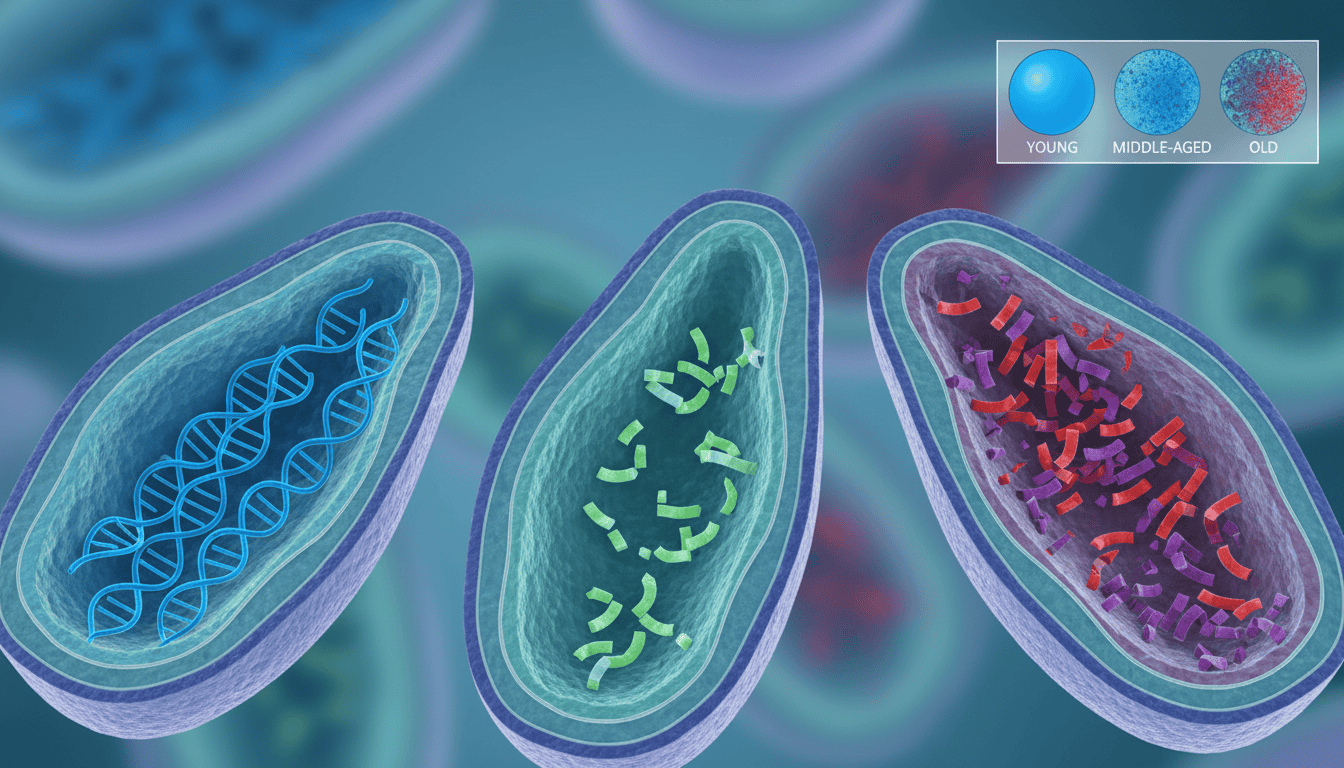
When the copying machinery makes an error and doesn’t catch it, that mutation gets copied again and again. Eventually some cells end up with a mixed population: some normal mtDNA, some mutant. This is called heteroplasmy. Other cells lose the plot entirely, accumulating mostly mutant copies. And because mitochondria are inherited maternally, any mutation that arose in your mother’s egg gets passed down to every single cell in your body.
What the research shows
Scientists tracking mtDNA changes over the human lifespan see a clear pattern. Mutations accumulate steadily from birth onwards. By the time you reach 80, some of your cells contain mtDNA so mutated it barely functions. Researchers studying post-mortem tissue have found that in aged brains, certain neurones can be almost entirely filled with a single mtDNA mutation, sometimes accounting for 90 per cent or more of total mtDNA in that cell.
What’s revealing is that different tissues age differently. Heart muscle, which has enormous energy demands, shows higher mutation loads in older people compared to skin cells. Liver cells accumulate mutations faster than muscle cells. This suggests that tissues with higher energy consumption experience greater selective pressure. Cells with badly mutated mtDNA simply can’t keep up and get outcompeted or die, leaving behind a population skewed toward the least-broken versions.
The functional consequences are real. When researchers examine mitochondria from aged organisms, they find reduced ATP production, increased oxidative stress, and impaired calcium signalling. In one striking observation, mitochondria from older animals required higher voltage across their inner membrane to produce the same amount of energy compared to young animals. The machinery was working harder to achieve less output.
Why cells need this problem
That sounds backwards, but consider the evolutionary logic. Mitochondrial DNA is exposed to damage constantly because mitochondria must sit where the chemistry is. Energy production generates reactive byproducts by necessity. The cell could evolve perfect error-correction, but that costs energy. Instead, evolution settled on a pragmatic compromise: good enough proofreading for the short term, accept that mutations will accumulate, and rely on cellular selection to purge the worst offenders.
This works fine when you’re young and cells divide regularly, clearing out damaged mitochondria through autophagy and inheritance. Dividing cells also tend to use oxidative phosphorylation less intensively, so they’re less vulnerable to mtDNA damage. But cells that stop dividing, like many neurones and cardiac myocytes, hold onto their mitochondria for decades. A neurone born when you were born might still be using the same mitochondrial DNA at 70.
The accumulation of mutations represents a kind of biological mortgage: short-term energy efficiency traded for long-term cellular decline. It’s a sensible strategy for an organism that evolved to reproduce in your twenties, less sensible for one trying to remain healthy at 80.
What affects mitochondrial DNA mutations
Not everyone ages the same way at the cellular level. Some people accumulate mtDNA mutations faster than others, and research points to several influences.
Environmental stress clearly matters. Chronic heat exposure accelerates mtDNA mutation rates in organisms, presumably by increasing reactive oxygen species production. Heavy exercise does too, though the relationship is complex. Intense training generates metabolic stress that damages mtDNA, but it also triggers mitochondrial quality control mechanisms that remove the worst copies. The net effect depends on intensity and recovery.
Infection and inflammation appear to speed mutation accumulation. When immune cells are activated, their mitochondria work harder and produce more reactive species. Some viral infections are known to damage mitochondrial genomes directly. Chronic inflammatory states, like those seen in obesity or some autoimmune conditions, correlate with higher mutation loads in circulating immune cells.
Genetic background matters too. People carry inherited variations in mitochondrial DNA, and some of these variants make cells more or less vulnerable to additional mutations. Certain populations carry mtDNA lineages associated with lower mutation rates over the lifespan. Nuclear genes that control mitochondrial maintenance, like those involved in autophagy or antioxidant defence, also influence how quickly mutations accumulate.
What remains unknown
Despite decades of research, some fundamental questions remain unresolved. Scientists still don’t fully understand why certain cells tolerate high mutation loads while others seem to degrade rapidly at much lower levels. Is it differences in energy demand? Differences in antioxidant capacity? Differences in how stringently cells police their mitochondria?
The causal direction isn’t always clear either. Do mtDNA mutations cause cellular ageing, or do ageing cells simply accumulate mutations as a consequence of declining maintenance? Both probably happen, but the balance remains debated. Some researchers argue mtDNA mutations are a symptom rather than a driver of ageing. Others point to rare genetic syndromes where specific mtDNA mutations cause premature ageing, suggesting they can be directly causal.
There’s also the question of reversibility. Can cells clear mutant mtDNA once it’s accumulated? Recent work suggests some organisms can preferentially eliminate cells with high mutation loads, essentially rebooting the population. Whether humans retain this capacity, and whether it could be therapeutically enhanced, remains an active research area.
The broader picture emerging from decades of mitochondrial research is that cellular ageing isn’t a single mechanism but a constellation of problems, each amplifying the others. mtDNA mutations are one thread in that tapestry, and understanding exactly how they interact with other aspects of cellular decline will likely reshape how we think about ageing at the fundamental level.

Matt Elliott is the editor of Redox News Today, an independent publication covering peer-reviewed research on cellular health, redox signalling, and related biomedical science.