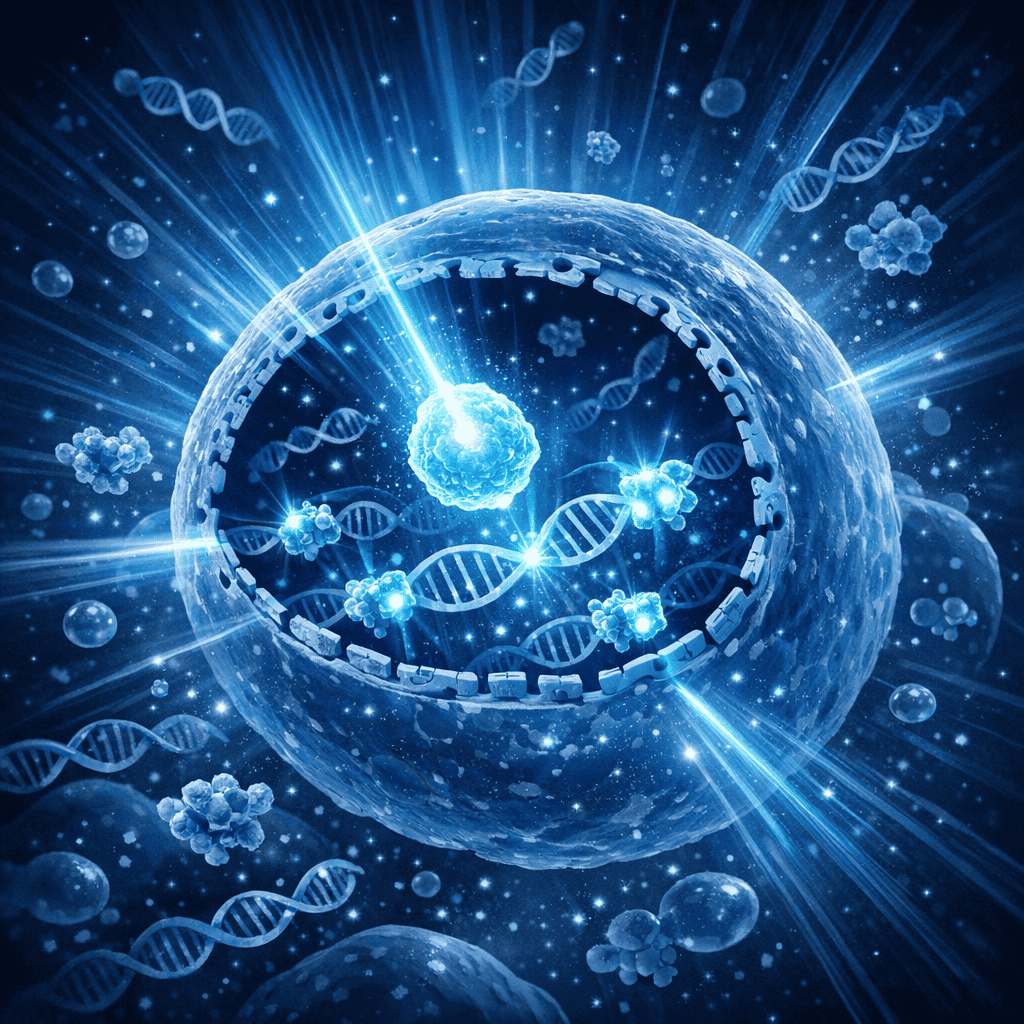

Bone breaks in older adults often heal slower than in younger people, and conventional explanations focus on reduced growth hormone or calcium absorption. But researchers have discovered something happening at a much deeper level: variations in the DNA inside mitochondria, the power plants of our cells, appear to influence how effectively bone cells mount a repair response. The mitochondrial genome is small, just 16,569 base pairs compared to the three billion in the nuclear genome, yet mutations here ripple outward in unexpected ways.
What is mitochondrial DNA and how does it affect bone cells?
Every cell in your body contains hundreds or thousands of mitochondria, and each mitochondrion carries its own circular piece of DNA. Unlike nuclear DNA, which you inherit equally from both parents, mitochondrial DNA comes almost entirely from your mother. This maternal inheritance means variations accumulate through family lineages in distinctive patterns.
Bone cells are metabolically demanding. Osteoblasts, the cells that build new bone matrix, and osteoclasts, the cells that resorb old bone, both burn enormous amounts of ATP (the energy currency mitochondria produce). When mitochondrial DNA carries variations that reduce energy production efficiency, bone cells struggle to perform these energy intensive tasks. Some mutations compromise the electron transport chain, the molecular machinery that generates ATP. Others affect the proteins that repair mtDNA itself, allowing damage to accumulate over time.
The mitochondrial genome encodes 13 proteins essential for oxidative phosphorylation, plus 22 transfer RNAs and 2 ribosomal RNAs needed to translate those proteins. A single mutation in a gene encoding one of these core components can handicap the entire energy-generating system.
What the research shows
Studies examining bone healing in individuals carrying different mitochondrial DNA haplogroups (evolutionary lineages defined by specific mutation patterns) reveal measurable differences in repair rates. Researchers analysed bone tissue samples from people with different mtDNA backgrounds and found variations in the expression of genes controlling osteoblast differentiation and mineralisation. Some haplogroups showed reduced expression of alkaline phosphatase and osteocalcin, two critical markers of bone forming activity.
Laboratory studies using bone cells derived from donors with distinct mtDNA variations showed that cells carrying certain mutations produced less ATP during osteogenic differentiation. When researchers imposed energy stress on these cells, the difference became stark. Cells with efficient mitochondria adapted quickly and maintained their bone forming programme. Cells with mtDNA variations that reduced ATP output showed signs of cellular stress and delayed progression toward mature osteoblasts.
Animal models with specific mtDNA mutations exhibited slower fracture healing timelines and reduced callus formation (the soft tissue bridge that forms between broken bone ends). Imaging studies showed incomplete mineralisation in the healing region, suggesting that energy limitation prevented osteoblasts from fully completing their matrix deposition work.
Why cells need this
Evolution preserved mitochondrial DNA as a distinct genetic system, separate from nuclear DNA, for reasons still being untangled. One leading explanation involves rapid adaptation. The mitochondrial genome mutates at a higher rate than nuclear DNA, allowing populations to fine tune energy production to local environmental conditions. Over thousands of years, human populations adapted to different climates and food sources, accumulating distinct mtDNA variations that influence metabolic efficiency.
Bone repair is one context where metabolic efficiency matters acutely. A bone fracture triggers a biological emergency. Within hours, immune cells flood the site, haematoma forms, and then the slower process of new bone deposition begins. This phase demands sustained energy production over weeks or months. Individuals whose mitochondria operate at peak efficiency can support prolonged osteoblast activity without cellular exhaustion.
The system also involves signalling between mitochondria and the nucleus. Reactive oxygen species (ROS) produced in mitochondria act as messengers that regulate bone cell differentiation. mtDNA variations affect ROS production, which in turn modulates the activity of genes like RUNX2 and Osterix, master transcription factors that drive osteoblast maturation. This is not a simple energy story. It is a communication story where the mitochondrial genome influences how bone cells interpret signals to build or resorb tissue.
What affects mitochondrial DNA function in bone
Age is the most obvious factor. mtDNA mutations accumulate through life as mitochondrial replication introduces copying errors. By age 60 or 70, many cells harbour populations of mtDNA with various mutations, some benign and some reducing energy production capacity. This age related accumulation partly explains why fracture healing slows in older people.
Physical activity influences mitochondrial health through mechanisms independent of mtDNA sequence. Exercise drives mitochondrial biogenesis, the formation of new mitochondria, which partially compensates for any inherited mtDNA inefficiency. Sedentary individuals with unfavourable mtDNA variants may experience compounded disadvantage.
Nutritional factors, particularly calcium and vitamin D, interact with mitochondrial function. Vitamin D regulates genes controlling calcium handling in mitochondria, and calcium signalling inside mitochondria influences energy production. A person with mtDNA variations reducing ATP output faces a steeper nutritional requirement to support bone repair. Environmental temperature also plays a subtle role, since mitochondria from populations adapted to cold climates often show different ATP production characteristics than those from warm climates, reflecting ancestral metabolic pressures.
What remains unknown
Researchers still cannot predict with confidence how any individual’s particular mtDNA variants will affect their bone healing capacity. The relationship is not deterministic. Some people with mtDNA variants associated with reduced ATP production still heal normally, suggesting nuclear genetic background, lifestyle, or epigenetic factors provide substantial buffering.
The precise mechanisms linking specific mtDNA mutations to osteoblast dysfunction remain incompletely mapped. Does reduced ATP production directly limit bone matrix secretion, or does it primarily affect ROS signalling? Both may operate simultaneously. Scientists are still characterising how different mtDNA haplogroups influence mineral homeostasis and calcium sensing in osteoblasts and osteocytes.
Little research has examined whether therapeutic approaches targeting mitochondrial function could enhance bone repair in people with unfavourable mtDNA backgrounds. Could mitochondrial targeted antioxidants improve outcomes? What about compounds enhancing mitochondrial biogenesis? These questions sit largely unanswered.
The emerging picture suggests that bone repair capacity is not solely determined by age, hormones, or nutrition. Mitochondrial DNA variations, inherited from your mother, create a metabolic baseline that influences how effectively your bone cells can respond to injury. This discovery redirects attention toward the ancient cellular machinery that powers everything else.

Matt Elliott is the editor of Redox News Today, an independent publication covering peer-reviewed research on cellular health, redox signalling, and related biomedical science.