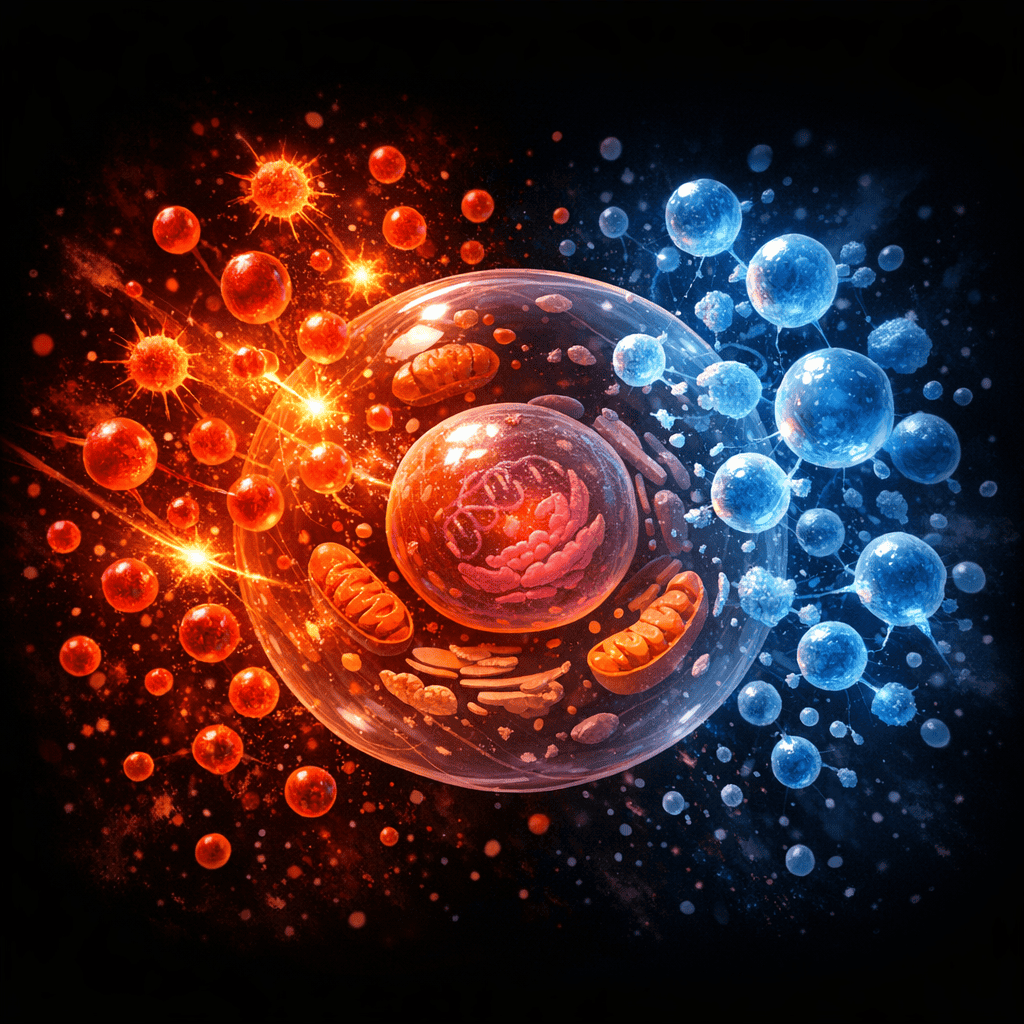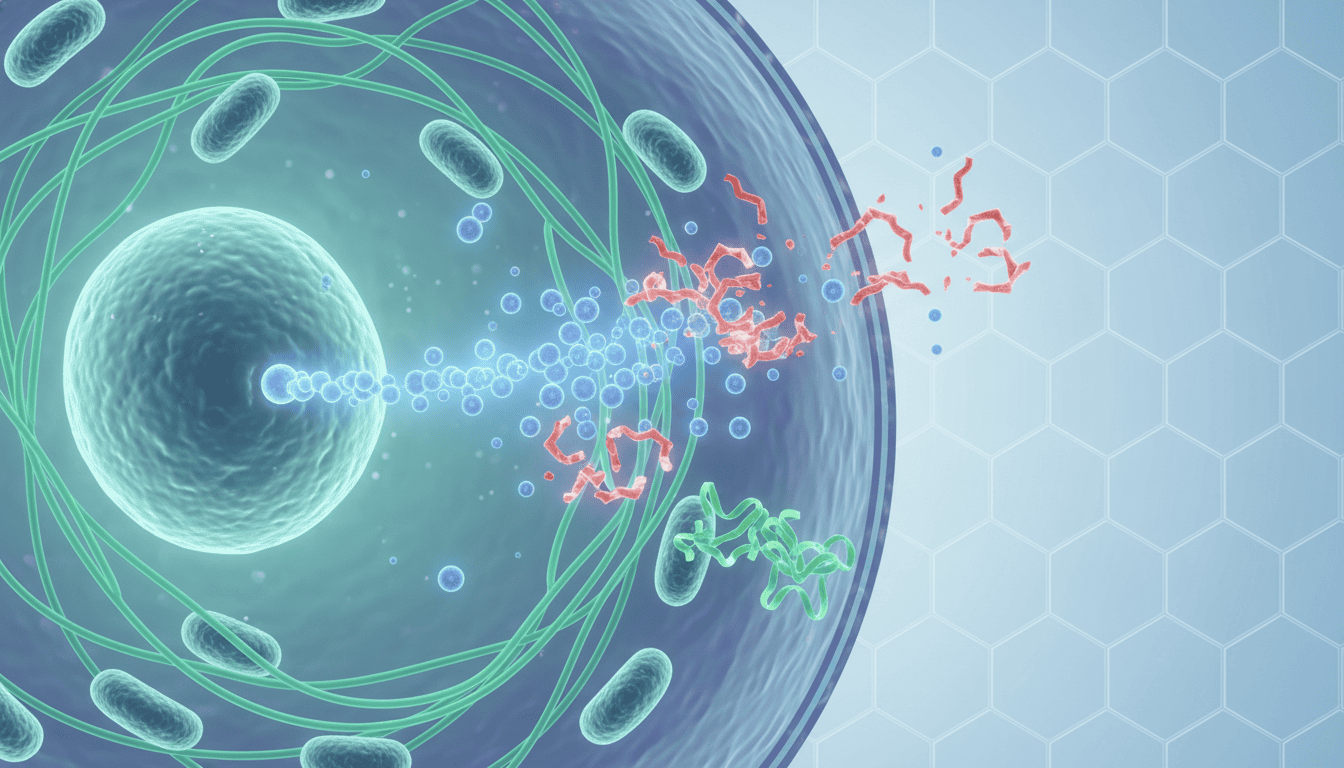

Your cells spend billions of dollars worth of energy every day folding proteins the right way. Get it wrong and those misfolded proteins clump together, jam up the cellular machinery, and trigger the cascade of damage we recognise as ageing. Glutathione, a tiny three-amino-acid molecule your cells make constantly, is one of the main reasons this system doesn’t immediately fall apart. It’s not the flashy antioxidant story you’ve heard before. This is about glutathione as a molecular quality controller, standing at the crossroads between protein stability and cellular lifespan.
What is glutathione
Glutathione is a tripeptide, a short chain of three amino acids strung together: glutamate, cysteine, and glycine. Your cells synthesise it on demand, and they do this constantly. What makes it special is that reactive cysteine residue in the middle. That sulphur atom can form disulphide bonds with other molecules, which sounds boring until you understand what that means in practice.
In its reduced form (GSH), glutathione acts like a molecular handshake coordinator. It binds to misfolded proteins and prevents them from sticking to other damaged proteins. In its oxidised form (GSSG), it participates in signalling cascades that tell cells when things have gone wrong. Your cells maintain a precise ratio of reduced to oxidised glutathione, and this ratio is one of the most sensitive indicators of cellular stress scientists have found.
The redox state matters enormously. When reduced glutathione drops relative to oxidised glutathione, cells shift into protective mode. Genes for heat shock proteins flip on. Autophagy machinery activates to clear out the trash. It’s not mystical. It’s a chemical sensor system.
What the research shows
When researchers isolate cells and deplete their glutathione, protein aggregation happens fast. Misfolded proteins that should be fleeting become stable problems. The cells then trigger apoptosis, a controlled death sequence that prevents those damaged cells from lingering and causing problems elsewhere.
In longer-lived organisms and in tissues that seem resistant to ageing, glutathione levels stay elevated. Young cells have higher GSH/GSSG ratios than old ones. This isn’t correlation happening by accident. When researchers boost glutathione in aged cells, protein folding stress markers decline and cells show improved stress resilience.
Work on protein disulphide isomerases, enzymes that help proteins fold correctly, reveals they operate in partnership with glutathione. The enzyme does the heavy lifting of reorganising disulphide bonds, but glutathione provides the chemical environment where this can happen efficiently. Without adequate glutathione, even capable enzymes work poorly. Some studies suggest glutathione directly regulates the activity of key proteostasis factors, the cellular systems responsible for maintaining protein balance. The mechanism isn’t fully mapped, but the functional relationship is clear.
Why cells need this
Protein misfolding is inevitable. Thermal fluctuations cause proteins to unfold. Oxidative damage breaks chemical bonds. Copy errors during protein synthesis happen. Evolution couldn’t prevent misfolding, so it built quality control systems to manage it. Glutathione is one pillar of that defence.
The system works because glutathione is abundant and renewable. Your cells make roughly 100 to 150 grams of it daily. That’s a tremendous amount of molecular labour. They recycle it constantly, converting it between reduced and oxidised forms. This built-in redundancy means the system can handle acute stress without collapsing.
From an evolutionary perspective, glutathione’s central role in protein maintenance explains why its synthesis machinery appears across every organism from bacteria to humans. The genes for making glutathione are ancient and conserved. Organisms that couldn’t maintain adequate glutathione would accumulate damaged proteins and die young. Natural selection preserved the mechanisms to make it reliably.
What affects glutathione
Synthesis capacity declines with age. The genes that code for glutathione synthesis enzymes show lower expression in older cells. This isn’t mysterious. Cells prioritise immediate energy use over long-term maintenance as they age, and glutathione production demands metabolic resources.
Exercise increases glutathione levels. Moderate physical activity triggers mild oxidative stress, which cells respond to by upregulating glutathione synthesis. Chronic overtraining has the opposite effect, depleting glutathione faster than cells can replace it.
Dietary precursors matter. Cysteine availability can limit glutathione synthesis. Glycine becomes harder to obtain in restrictive diets. Glutamate your body makes easily from many sources, but the other two building blocks can become bottlenecks. This is why some research has looked at whether supplementing individual precursors might help, though the evidence for this affecting systemic glutathione remains unsettled.
Chronic inflammation and ongoing infection deplete glutathione stores. Oxidative stress, whether from environmental pollutants or metabolic dysfunction, drives glutathione consumption faster than synthesis can keep pace. Persistent illness shifts the GSH/GSSG ratio unfavourably, which then impairs protein folding and accelerates damage accumulation.
What remains unknown
The precise molecular signals that link glutathione redox state to gene expression aren’t fully catalogued. Researchers know the GSH/GSSG ratio acts as a sensor, but which proteins directly detect that ratio in which cell compartments? The map is still incomplete.
Whether boosting glutathione in intact organisms actually extends lifespan remains uncertain. Cell studies show compelling effects. Whole-organism results are mixed. Mice with enhanced glutathione synthesis don’t reliably live longer, which suggests other factors matter. The relationship between glutathione and ageing is real, but it’s not simple cause and effect.
The tissue-specific behaviour of glutathione metabolism puzzles researchers. The brain maintains extremely high glutathione levels. The liver synthesises most of the body’s glutathione but can’t distribute it well across cell membranes. Muscle tissue has different requirements than nerve tissue. Why evolution shaped glutathione systems so differently across tissues isn’t understood.
Whether glutathione deficiency is a cause or consequence of protein aggregation diseases remains genuinely open. In neurological conditions where protein misfolding drives pathology, glutathione is often depleted. But is that because the disease caused depletion, or because low glutathione enabled the disease? Separating cause from effect requires research that hasn’t been done conclusively.
Glutathione sits at a crossroads in cellular biology where protein quality control meets metabolic signalling meets ageing. The cells that maintain robust glutathione systems cope better with stress, fold proteins more reliably, and seem to resist some aspects of ageing. That’s not the whole story of why we age, but it’s clearly part of it. Understanding how cells manage protein stability through glutathione and related systems points toward the deeper question of how cells maintain themselves over time and what breaks down when they can’t.

Matt Elliott is the editor of Redox News Today, an independent publication covering peer-reviewed research on cellular health, redox signalling, and related biomedical science.