
Imagine being able to take a healthy mitochondrion from one cell and slip it into another that’s struggling. For decades, this sounded like science fiction. Mitochondria are finicky organelles, and moving them between cells without destroying them has been nearly impossible. Now researchers are using an unexpected technique borrowed from cell biology: they’re exploiting the way liquids naturally separate into distinct phases, much like oil and water, to isolate and transfer active mitochondria between cells. This opens a door to understanding what happens when mitochondrial function fails and how we might one day restore it.
What is liquid-liquid phase separation
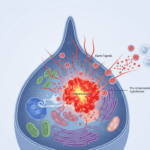
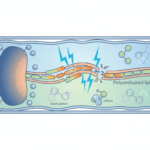
Cells aren’t bags of uniform soup. Inside them, molecules cluster into distinct regions that behave almost like separate liquids within the same space. This is liquid-liquid phase separation, and it’s everywhere in cells: in the nucleus where genes are regulated, in signalling complexes that detect threats, in the granules that store proteins. Think of it like how vinegar and oil spontaneously form separate droplets even when mixed together. The molecules organise themselves based on chemical affinity. Some molecules prefer to cluster with similar ones and exclude others. Researchers have realised you can harness this natural tendency to isolate and concentrate specific cellular components, including mitochondria themselves. By creating the right chemical conditions, they can prompt mitochondria to gather in a distinct phase, making them easier to extract and transfer intact.
What the research shows
Recent work demonstrates that liquid-liquid phase separation can isolate metabolically active mitochondria from cell homogenates and successfully transplant them into recipient cells. Scientists have observed that mitochondria separated this way retain their membrane integrity and continue producing ATP, the cellular energy currency. The transplanted mitochondria integrate into the recipient cells and appear to function normally, at least in the timeframes tested. What’s striking is the specificity: this approach allows researchers to separate active, healthy mitochondria from damaged or inactive ones in a population. Previously, extracting mitochondria meant getting a mixed bag of functional and dysfunctional organelles. The phase separation method acts as a filter, enriching for the ones that actually work. In experiments, cells receiving transplanted mitochondria show measurable increases in energy production compared to controls.
Why cells need this
Mitochondria are the cell’s power plants, but they’re also sensors, signalers, and buffers against cellular stress. A single cell contains hundreds to thousands of them, and they’re constantly being made and broken down. When this renewal system fails, problems cascade quickly. Neurons are particularly vulnerable because they demand enormous amounts of energy and can’t divide to dilute away damaged mitochondria. In conditions like Parkinson’s disease, mutations affect mitochondrial function and cells struggle. Muscle cells face similar pressures during intense activity. Evolution preserved the ability to replace mitochondria because cells that couldn’t would simply die. But you can’t always replace them fast enough when damage accumulates. Being able to supplement a cell’s mitochondrial population with healthy organelles addresses this fundamental constraint. It’s not about creating new power plants from scratch but restocking them when the cell’s own repair mechanisms fall behind.
What affects mitochondrial transplantation success
Several factors influence whether transplanted mitochondria survive and function. The health of donor mitochondria matters tremendously: organelles isolated from aged tissue or from cells exposed to stress perform worse than those from young, healthy cells. Temperature during isolation and transfer is critical; mitochondria are sensitive to cold, and the transplantation window is narrow. The recipient cell’s own metabolic state plays a role too. Cells already under oxidative stress may be less able to integrate foreign organelles. Recent research shows that the composition of the phase separation medium itself affects outcomes. Too much salt or the wrong pH and mitochondria lose function during isolation. The type of recipient cell also influences success rates. Some cell types appear more receptive to mitochondrial transplantation than others, possibly because they have different import machinery or different metabolic demands. Interestingly, cells from younger organisms generally show better integration of transplanted mitochondria than aged cells, suggesting that ageing affects not just mitochondrial quality but the cell’s ability to accept new ones.
What remains unknown
We still don’t fully understand whether transplanted mitochondria can sustain recipient cells over weeks or months rather than hours. Most studies look at short timeframes. Will the immune system recognise foreign mitochondria as threats and target them? In whole organisms, this could be a major obstacle. We also don’t know whether mitochondrial function declines over time in new hosts or whether they integrate permanently. The mechanism by which recipient cells recognise and import transplanted mitochondria remains unclear. Are there specific signals that tell a cell to accept them? Can we enhance this signalling to improve transplant success? There are also practical questions: how do you scale this to therapeutic use? Phase separation requires specific conditions maintained in test tubes, not in living tissue. Moving from cell culture to animal models to humans involves solving engineering problems that haven’t been addressed yet. And perhaps most fundamentally, we don’t know whether restoring mitochondrial function in disease models will actually reverse pathology or just slow its progression.
What’s happening here is a demonstration of how understanding fundamental cell biology opens unexpected practical doors. Liquid-liquid phase separation wasn’t discovered with mitochondrial transplantation in mind. Instead, scientists recognised that a natural cellular organising principle could solve a technical problem. This is how biological research often proceeds: not through direct assault on a question, but by building tools and understanding from seemingly unrelated corners of the field. Whether mitochondrial transplantation becomes a real therapeutic approach depends on answering many hard questions. But the technique itself represents a shift in what’s experimentally possible when working with these ancient, vital organelles.

Matt Elliott is the editor of Redox News Today, an independent publication covering peer-reviewed research on cellular health, redox signalling, and related biomedical science.