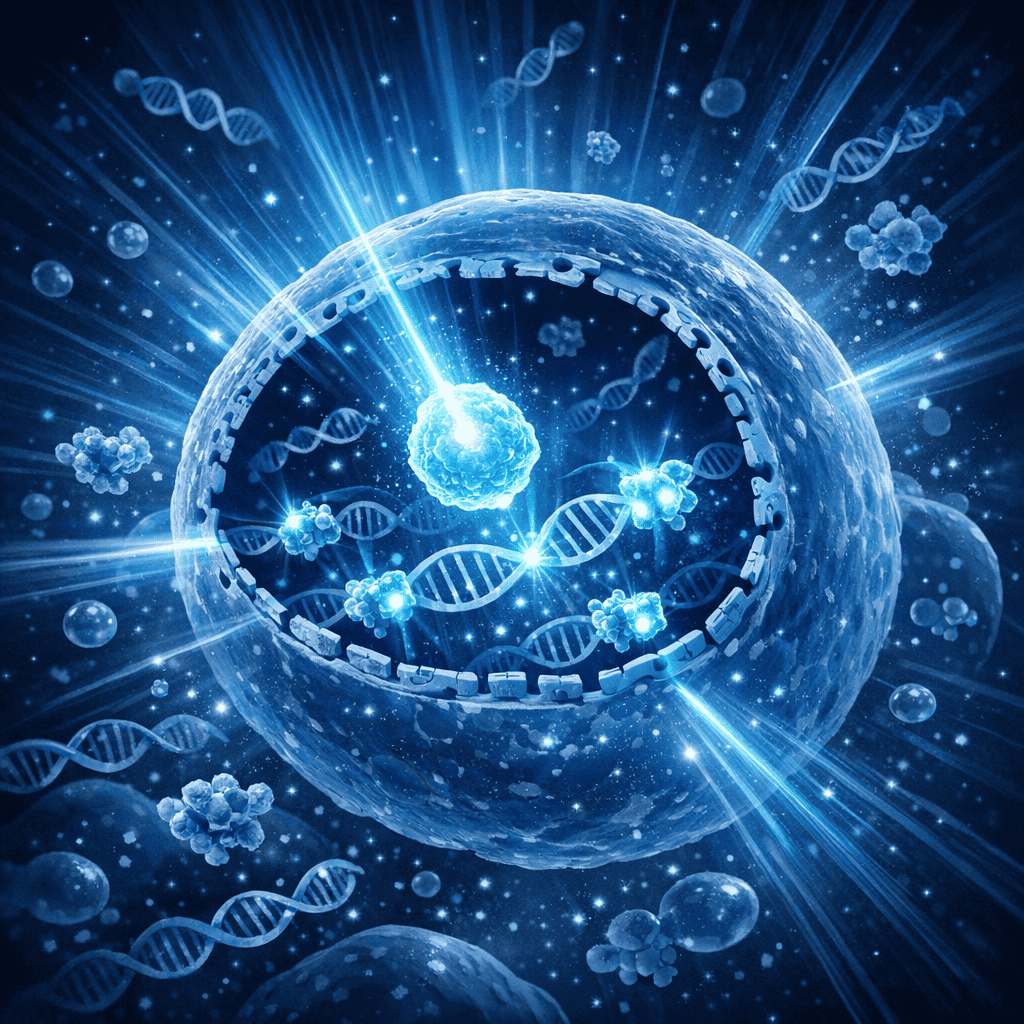

Your cells are constantly monitoring oxygen levels. When oxygen drops, they activate a coordinated survival response. But here’s what’s less obvious: the molecules that signal low oxygen can themselves become damaged during recovery, triggering a completely different set of protective responses. That’s where hydrogen peroxide enters the picture, redirecting cellular signalling pathways in ways researchers are only beginning to understand.
What is oxygen sensing signalling?
Cells detect oxygen availability through a family of proteins called hypoxia-inducible factors, or HIFs. When oxygen is scarce, these proteins accumulate and act like emergency broadcasters, telling the nucleus to switch on survival genes. The system is elegant in its simplicity: high oxygen normally keeps HIF levels low through a continuous cycle of modification and destruction. Low oxygen disrupts this cycle, allowing HIF to accumulate and trigger adaptation.
This mechanism evolved because oxygen availability shifts constantly. In developing embryos, many tissues operate in low-oxygen environments. During intense exercise, muscles temporarily become hypoxic. Even in healthy tissue, microenvironments can have surprisingly low oxygen levels. The ability to sense and respond to these fluctuations is fundamental to survival.
But the story doesn’t end when oxygen returns. As cells recover from hypoxia, metabolic activity ramps up rapidly. This acceleration generates reactive oxygen species, including hydrogen peroxide, as byproducts. These molecules don’t simply dissipate. Instead, they actively participate in reprogramming how cells interpret their oxygen status during the recovery phase.
What the research shows
When researchers expose cells to hypoxic conditions then restore oxygen, hydrogen peroxide levels spike noticeably. This elevation correlates with changes in how key signalling proteins function. Specifically, hydrogen peroxide appears to modify critical proteins involved in the HIF pathway itself, altering their activity in ways that differ from the initial hypoxic response.
In cell culture studies, blocking hydrogen peroxide production during reoxygenation prevents certain adaptive responses from fully activating. The cells can sense that oxygen has returned, but their downstream signalling becomes incomplete. Conversely, increasing hydrogen peroxide production under controlled conditions can partially mimic the reoxygenation response even when oxygen levels remain constant. This suggests hydrogen peroxide isn’t just a toxic byproduct but an active messenger.
The mechanism appears to involve hydrogen peroxide modifying specific amino acids on signalling proteins. These chemical modifications act like switches, changing whether proteins can bind to DNA or interact with other cellular machinery. During the hypoxic phase, one set of genes activates. During reoxygenation, when hydrogen peroxide levels peak, a partially different set of genes receives activation signals. The cell isn’t simply reversing the hypoxic response; it’s engaging a distinct recovery program.
Why cells need this
The oxygen sensing system faces a genuine problem during recovery. If cells simply reversed all hypoxic adaptations at once, they’d waste energy maintaining proteins that were useful under stress but become liabilities when oxygen is abundant. Yet complete erasure of the hypoxic response could leave cells vulnerable if oxygen levels fluctuate again within hours or days.
Hydrogen peroxide signalling provides a middle path. It allows cells to gradually transition between states rather than flipping a binary switch. The elevated hydrogen peroxide during reoxygenation acts as evidence that metabolism has ramped up successfully. This signal triggers genes involved in defending against oxidative stress specifically, priming the cell for the metabolic reality of oxygen abundance.
From an evolutionary perspective, this makes sense. Organisms that could fine-tune their recovery from hypoxic stress would have metabolic advantages. They wouldn’t waste resources, but they’d also maintain resilience. A cell that responds thoughtfully to reoxygenation can handle subsequent fluctuations more efficiently than one that makes abrupt transitions.
What affects oxygen sensing during recovery
The intensity and duration of the initial hypoxic stress shapes how hydrogen peroxide signalling unfolds during recovery. Brief, mild hypoxia triggers different reoxygenation responses than prolonged severe hypoxia. The longer cells spend in low oxygen, the more extensive their metabolic reprogramming, and consequently, the larger the hydrogen peroxide surge when oxygen returns.
The cell type matters considerably. Cells with high metabolic demands, like cardiac muscle cells or neurons, generate more hydrogen peroxide during reoxygenation than quiescent fibroblasts. This likely reflects their greater mitochondrial activity. The signalling machinery itself also varies between cell types, so the same hydrogen peroxide concentration might trigger different responses in different tissues.
Nutritional status influences antioxidant defences, which affect how much hydrogen peroxide actually accumulates during recovery. Cells with robust catalase or peroxidase activity will neutralise hydrogen peroxide more rapidly, shortening the window for signalling. This is why nutritional factors and the activity of antioxidant enzymes appear relevant to how efficiently cells recover from hypoxic stress.
Age also plays a role. Ageing cells often show diminished ability to generate appropriate hydrogen peroxide responses during reoxygenation, correlating with slower metabolic recovery and potentially reduced ability to mount protective responses.
What remains unknown
Scientists still don’t fully understand which specific proteins hydrogen peroxide modifies during reoxygenation or how many different modifications occur simultaneously. The breadth of the chemical changes is likely larger than currently characterised. Identifying all the targets would clarify which aspects of the reoxygenation response depend directly on hydrogen peroxide signalling versus which happen independently.
The physiological consequences remain murky too. Does enhanced hydrogen peroxide signalling during recovery make cells more resilient to subsequent hypoxic episodes? Or does repeated activation of these pathways eventually lead to maladaptation? Animal studies suggest nuanced effects, but the mechanisms aren’t clear. Tissues might benefit or suffer depending on how frequently they experience hypoxic cycles.
The relationship between hydrogen peroxide signalling and other stress response pathways needs mapping. Cells activate multiple defence systems during reoxygenation: heat shock responses, ER stress pathways, autophagy. How these systems coordinate with hydrogen peroxide-driven signalling remains largely uncharted territory.
What happens in intact tissues versus isolated cells also warrants investigation. Cell culture strips away the complexity of neighbouring cells, tissue architecture, and systemic signals. A hypoxic episode in living organisms involves inflammation, immune activation, and vascular changes that don’t exist in culture dishes.
Ultimately, cells possess an intricate system for distinguishing between different types of stress and mounting appropriately tailored responses. The discovery that hydrogen peroxide actively redirects signalling pathways during recovery from hypoxia reveals another layer of this sophistication. Rather than treating reactive oxygen species simply as metabolic waste, cells have evolved to use them as information carriers. Understanding how this works opens windows into how cells maintain themselves through constant environmental fluctuation. That capacity for flexible adaptation underpins the resilience of living systems.

Matt Elliott is the editor of Redox News Today, an independent publication covering peer-reviewed research on cellular health, redox signalling, and related biomedical science.