
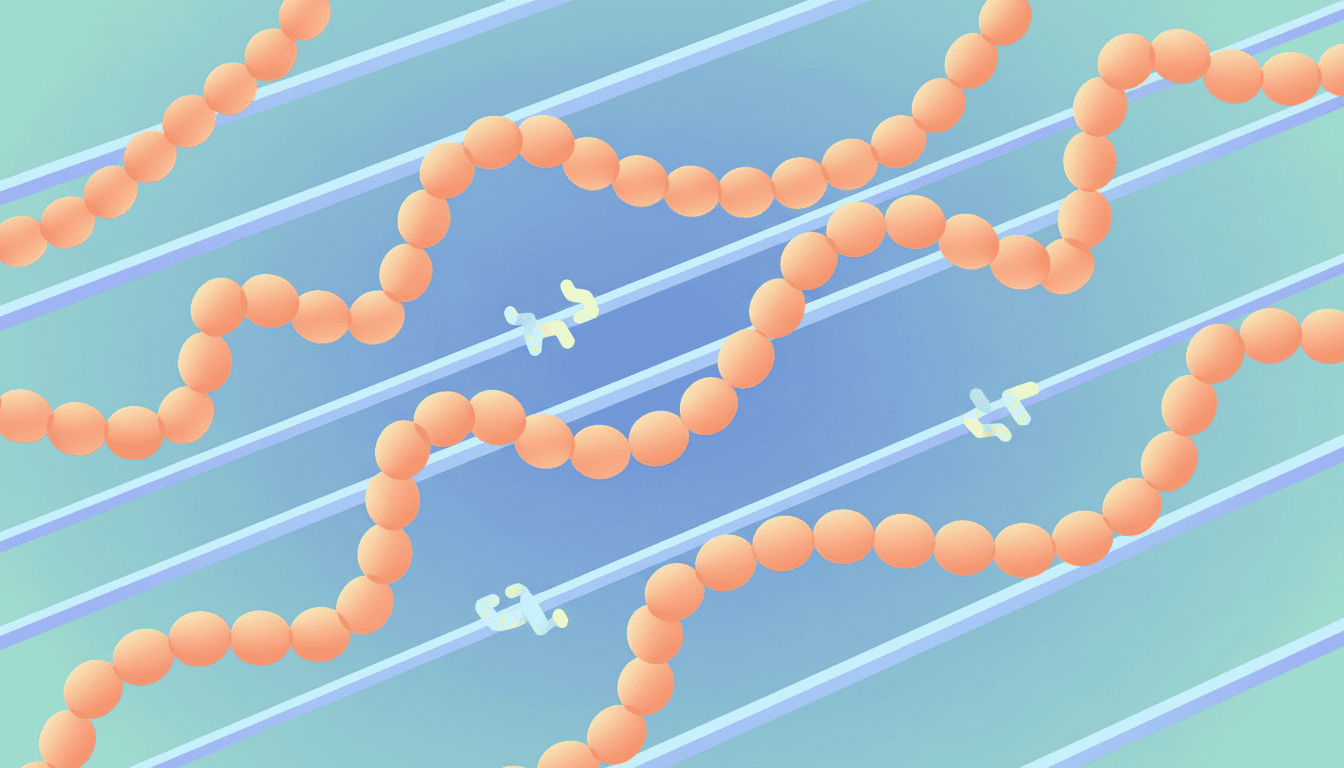
Your mitochondria are moving right now. Not just drifting randomly through your cells, but sliding along tracks in a coordinated motion that looks remarkably like pearls moving along a string. This behaviour, which scientists call pearling, appears to do something far more sophisticated than simply delivering energy where it’s needed.
What is mitochondrial pearling
Mitochondrial pearling describes the way these cellular powerhouses move in single file along the cell’s internal highway system. Think of it like beads on a wire, except the wire is made of proteins called microtubules and the beads are constantly changing shape as they travel.
The mitochondria don’t just slide passively. They actively grip and release the microtubule tracks using motor proteins, particularly one called kinesin. As they move, individual mitochondria can split apart or fuse together, creating a dynamic network that’s constantly reshaping itself.
This pearling motion happens in most of your cells, but it’s especially dramatic in neurons. A single nerve cell might stretch from your spinal cord to your toe, and mitochondria need to travel the entire length. Without this organised transport system, distant parts of the cell would run out of the energy and materials they need to function.
What the research shows
Recent studies using advanced microscopy have revealed that pearling does much more than transport energy. Researchers tracked individual mitochondria as they moved through living cells and discovered something unexpected. The moving mitochondria were actively communicating with other cellular structures along their path.
When mitochondria encounter the endoplasmic reticulum during their journey, they pause and form temporary contact points. These meetings allow the two organelles to exchange calcium ions and lipids. The mitochondria essentially act as mobile messengers, carrying information and materials between different parts of the cell.
Scientists also found that the pearling pattern changes dramatically when cells are stressed. Under normal conditions, mitochondria move in a fairly regular, predictable fashion. But when cells face challenges like oxidative stress or nutrient shortage, the pearling becomes more frequent and the mitochondria cluster in specific locations where they’re most needed.
Perhaps most intriguingly, mitochondria appear to influence where other organelles position themselves. As they move through the cell, they leave behind chemical signals that help organise the entire cellular interior. It’s like they’re city planners, determining the optimal layout for cellular neighbourhoods.
Why cells need this
Evolution rarely preserves energy-expensive processes without good reason. Pearling requires substantial cellular resources. Motor proteins consume ATP, and maintaining the microtubule tracks demands constant investment.
The payoff appears to be organisation. Cells are incredibly crowded places, packed with thousands of different proteins and organelles all trying to do their jobs simultaneously. Without some kind of coordination system, this would be chaos. Mitochondrial pearling provides a solution by creating a mobile information network.
Think of it like a postal service for cells. Instead of every organelle trying to communicate directly with every other organelle, mitochondria act as intermediaries. They pick up signals and materials from one part of the cell and deliver them elsewhere, creating order from potential pandemonium.
This system becomes particularly critical during cell division. When a cell prepares to split, it needs to ensure both daughter cells receive appropriate numbers of mitochondria in the right locations. Pearling helps coordinate this distribution, essentially ensuring the cellular inheritance is properly divided.
What affects mitochondrial pearling
Age significantly impacts pearling patterns. In older cells, mitochondria move more slowly and less frequently. The microtubule tracks themselves become less stable, and motor proteins don’t work as efficiently. This might explain why cellular organisation becomes less precise as organisms age.
Physical activity appears to influence pearling in muscle cells. Exercise increases the demand for mitochondrial movement, and cells respond by building more robust transport networks. Sedentary lifestyles show the opposite effect, with less organised mitochondrial traffic patterns.
Environmental toxins can disrupt pearling by damaging either the mitochondria themselves or the cellular tracks they travel on. Heavy metals, certain pesticides, and some medications interfere with motor proteins, essentially creating traffic jams in the cellular transport system.
Nutritional status also matters. Cells running low on key nutrients may alter their pearling patterns to conserve energy or redistribute resources more efficiently. Conversely, periods of nutrient abundance can trigger increased mitochondrial movement as cells expand their activities.
What remains unknown
Scientists still don’t fully understand how mitochondria decide where to go. Something must be directing their movement, but the navigation system remains largely mysterious. Do chemical gradients guide them? Are there cellular GPS signals? The mechanism behind their apparent purposefulness is unclear.
The relationship between pearling and disease is another major question. Researchers know that disrupted mitochondrial movement occurs in neurodegenerative conditions, but they don’t know whether this is a cause or consequence of cellular dysfunction. Understanding this could reveal new therapeutic targets.
There’s also the puzzle of tissue specificity. Different cell types show distinct pearling patterns, but why? What determines whether mitochondria in liver cells move differently from those in brain cells? The signals that create these differences haven’t been identified.
Perhaps most intriguingly, some research suggests mitochondria might be capable of learning or memory-like behaviours. They seem to remember previous routes and respond to repeated stimuli in increasingly efficient ways. If true, this would represent a form of cellular intelligence that’s barely been explored.
Mitochondrial pearling reveals something profound about cellular life. These organelles aren’t just energy factories floating passively in cellular soup. They’re active participants in cellular organisation, mobile coordinators ensuring that complex cellular societies function smoothly. Every time your cells need to coordinate their activities, adapt to challenges, or simply maintain order, mitochondria are likely sliding along their protein highways, carrying the messages that keep life organised.

Matt Elliott is the editor of Redox News Today, an independent publication covering peer-reviewed research on cellular health, redox signalling, and related biomedical science.