Every cell in your body has a molecular panic button. When things go wrong – when oxygen gets too reactive, when toxins sneak past cellular defences, when inflammation starts spiralling – this switch flips on and coordinates an emergency response involving hundreds of protective proteins. That switch is called NRF2, and pharmaceutical companies are spending hundreds of millions trying to figure out how to control it.
What is NRF2
NRF2 stands for nuclear factor erythroid 2-related factor 2, but the name tells you almost nothing useful. Think of it as your cellular fire chief instead.
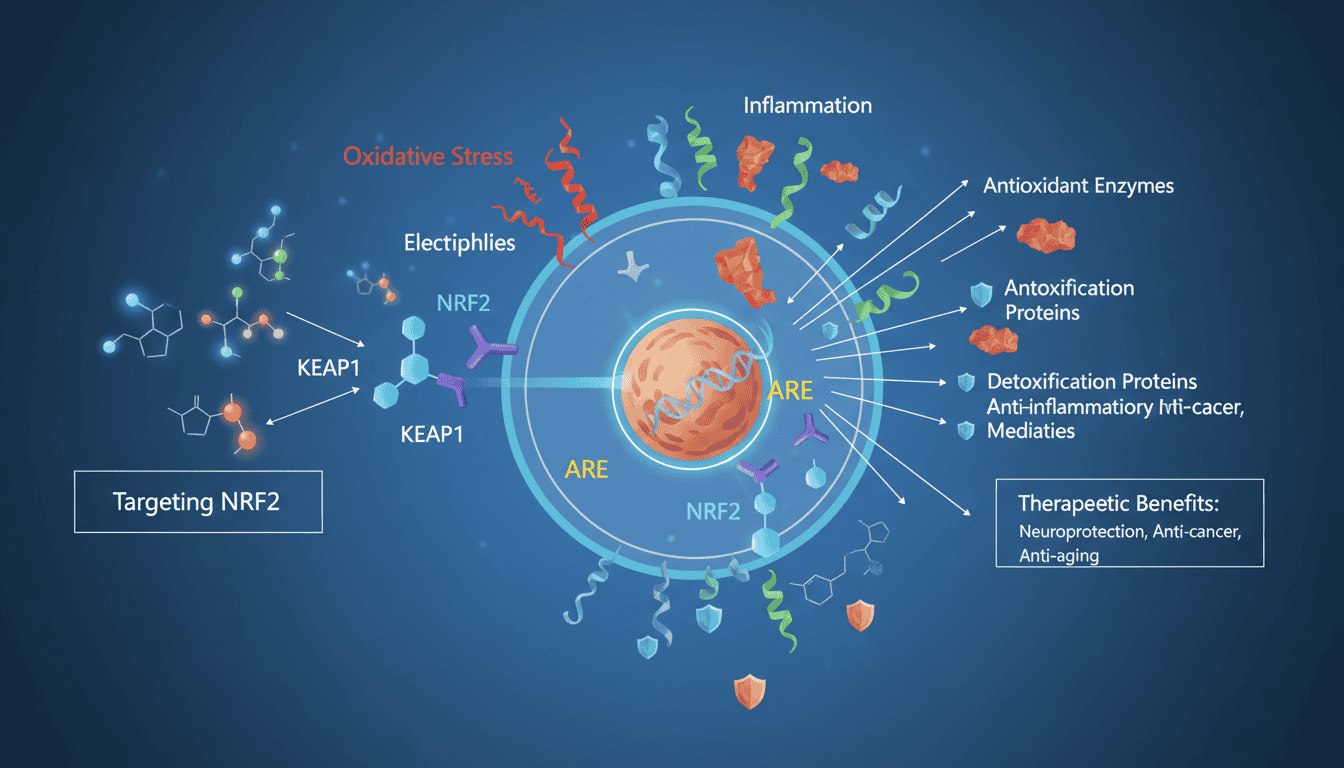
Under normal conditions, NRF2 sits quietly in the cytoplasm, bound to a protein called KEAP1 that keeps it inactive. KEAP1 acts like a molecular bouncer, constantly tagging NRF2 for destruction. But when cells detect trouble – oxidative stress, toxic compounds, or inflammatory signals – something remarkable happens.
The stress damages specific amino acids on KEAP1. This breaks its grip on NRF2. Freed from its molecular prison, NRF2 rushes into the nucleus and binds to DNA sequences called antioxidant response elements. Within minutes, it switches on genes that produce glutathione, the cell’s most powerful antioxidant. It activates enzymes that neutralise toxins. It ramps up production of proteins that repair cellular damage and reduce inflammation.
One master switch controls this entire protective network. When NRF2 activates, cells don’t just defend themselves – they become significantly more resilient to future attacks.
What the research shows
Scientists have been studying NRF2 for over two decades, and the results consistently point in one direction: this pathway matters for almost every disease researchers have examined.
In laboratory studies, animals engineered to lack NRF2 develop more severe symptoms when exposed to toxins, radiation, or inflammatory triggers. Their cells produce less glutathione and other protective compounds. They show accelerated signs of cellular ageing. Conversely, when researchers boost NRF2 activity, cells become remarkably resistant to damage.
Human studies reveal similar patterns. People with genetic variants that reduce NRF2 function show higher rates of cellular damage markers in their blood. Their cells produce less glutathione when challenged. Population studies have found associations between reduced NRF2 activity and various health outcomes, though the relationships are complex.
Drug companies have taken notice because NRF2 dysfunction appears in so many different disease contexts. Researchers have documented reduced NRF2 activity in liver disease, kidney problems, neurodegenerative conditions, cardiovascular issues, and metabolic disorders. The pathway seems to be a common thread connecting cellular stress to disease progression.
Why cells need this
From an evolutionary perspective, NRF2 makes perfect sense. Life emerged in a world full of chemical threats and energy challenges.
Early cells needed ways to handle reactive oxygen species – the inevitable byproducts of using oxygen for energy. They needed defences against environmental toxins. They needed rapid response systems for surviving sudden changes in their chemical environment. NRF2 provided all of this in one integrated system.
The pathway is ancient. Scientists have found NRF2-like systems in organisms ranging from fruit flies to humans, suggesting it evolved early and proved so useful that natural selection preserved it across hundreds of millions of years.
But NRF2 does more than just respond to immediate threats. It helps cells maintain what researchers call hormetic responses – the principle that mild stressors can actually strengthen biological systems. Exercise stresses your muscles and heart, but this stress triggers adaptations that make you stronger. NRF2 works similarly at the cellular level, turning manageable stress into enhanced resilience.
What affects NRF2
Multiple factors influence how well your NRF2 system functions, and researchers have mapped many of these relationships.
Age consistently emerges as a major factor. NRF2 activity declines as people get older, which may explain why cellular stress resistance decreases with ageing. Studies show that older adults produce less glutathione and show reduced activation of NRF2-controlled genes compared to younger people.
Diet plays a significant role. Compounds called isothiocyanates, found in cruciferous vegetables like broccoli and kale, directly activate NRF2. So do sulforaphane from broccoli sprouts, curcumin from turmeric, and various polyphenols from berries and green tea. These compounds work by mildly stressing KEAP1, which releases its hold on NRF2.
Exercise activates NRF2 through controlled oxidative stress. Physical activity generates reactive oxygen species, but in manageable amounts that trigger protective responses rather than cause damage. Regular exercisers show higher baseline NRF2 activity.
Sleep, stress levels, and environmental exposures all influence the system. Chronic psychological stress can dysregulate NRF2, while adequate sleep supports its function. Exposure to air pollution, cigarette smoke, or excessive alcohol can overwhelm the pathway.
What remains unknown
Despite decades of research, scientists still grapple with fundamental questions about NRF2 that complicate drug development efforts.
The biggest puzzle involves timing and context. Sometimes boosting NRF2 activity helps cells resist damage. But in certain cancer contexts, tumour cells hijack NRF2 to resist chemotherapy. This creates a therapeutic dilemma – the same pathway that protects healthy cells might also protect cancer cells you’re trying to eliminate.
Researchers are still working out optimal dosing strategies. How much NRF2 activation is beneficial versus excessive? The answer likely varies by person, age, health status, and specific condition. What constitutes the right amount of pathway stimulation remains unclear.
Individual genetic variation adds another layer of complexity. People carry different versions of genes controlling NRF2 function, KEAP1 activity, and downstream target proteins. These differences might explain why some individuals respond better to NRF2-activating compounds than others, but personalised approaches are still in early stages.
The pharmaceutical industry also faces technical challenges in developing NRF2-targeted drugs. The pathway involves multiple protein interactions and feedback loops. Creating compounds that modulate it precisely, without unwanted side effects, requires sophisticated molecular engineering that researchers are still perfecting.
NRF2 research illustrates both the promise and complexity of targeting fundamental cellular processes. This ancient stress response system touches nearly every aspect of cellular health, making it an attractive therapeutic target. But its very importance means that manipulating it requires exceptional precision and understanding. As drug companies invest heavily in NRF2-based therapies, they’re betting that science can unlock the secrets of one of biology’s most essential survival mechanisms.
Further reading: for a full, sourced explanation of how NRF2 works, what switches it on and where it has reached medicine, see our guide to the NRF2 pathway.

Matt Elliott is the editor of Redox News Today, an independent publication covering peer-reviewed research on cellular health, redox signalling, and related biomedical science.