Your arteries face a constant chemical assault. Every breath you take pulls oxygen into your bloodstream, and every calorie you burn generates reactive molecules that can damage the delicate cells lining your blood vessels. This is oxidative stress, and it’s one of the main drivers of arterial ageing. But inside those cells sits a molecular alarm system that can dramatically dial down the damage. When you eat certain plant compounds called polyphenols, they trigger this system to spring into action.
What is NRF2 signalling
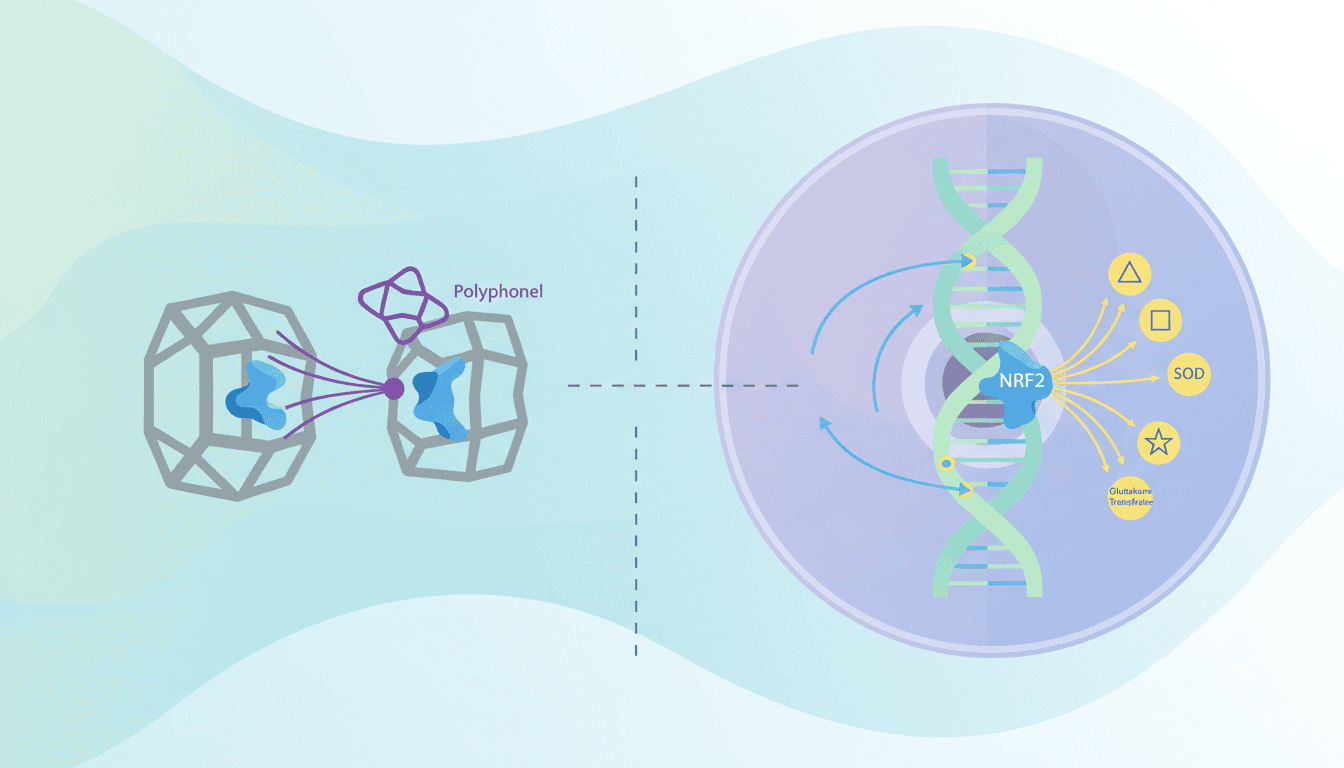
NRF2 is a protein that acts like a master switch for cellular defence. Under normal conditions, it sits dormant in the cytoplasm, held in place by another protein called KEAP1. Think of KEAP1 as a security guard keeping NRF2 locked in a waiting room. When oxidative stress builds up or when certain compounds bump into KEAP1, that guard releases NRF2. The freed protein rushes into the nucleus and binds to DNA sequences called antioxidant response elements (AREs). Once attached, NRF2 acts like a conductor, orchestrating the expression of dozens of protective genes at once.
These genes produce antioxidant enzymes and other defence molecules. Glutathione S-transferases mop up harmful compounds. NAD(P)H quinone oxidoreductase neutralises dangerous molecules. Superoxide dismutase and catalase disarm reactive oxygen species before they can damage lipids, proteins, or DNA. The whole system is elegant and efficient. A single activation signal can trigger a coordinated wave of cellular protection.
What the research shows
When researchers expose arterial cells to polyphenols like quercetin, kaempferol, or resveratrol, something specific happens. These compounds don’t work like blunt-force antioxidants that directly neutralise free radicals. Instead, they interact with KEAP1 in ways that trick the protein into releasing NRF2. In cell culture studies, this releases a surge of antioxidant enzyme production within hours. Oxidative stress markers drop. The cells’ ability to handle incoming reactive oxygen species improves dramatically.
In animal models with arterial inflammation or oxidative stress, polyphenol-rich interventions consistently activate this pathway. Researchers measure this by tracking NRF2 accumulation in the nucleus and monitoring downstream gene expression. The effect is dose-dependent and time-dependent. You need enough of the compound, and you need to sustain exposure. Single doses show transient activation. Regular consumption appears to provide more durable benefits.
What’s particularly interesting is that different polyphenols trigger this response through slightly different mechanisms. Some interact directly with cysteine residues on KEAP1. Others work indirectly by increasing reactive oxygen species in a controlled way that signals the need for defence. The endpoint is the same, but the molecular path varies. This suggests the NRF2 system evolved as a flexible responder to multiple types of cellular stress.
Why cells need this
Arterial cells live in a hostile environment. They sit at the interface between flowing blood and the vessel wall, constantly exposed to shear stress, fluctuating oxygen levels, and metabolic byproducts. Evolution didn’t leave this to chance. The NRF2 pathway represents a core defence strategy that appears across most animal species and cell types.
Without this system, oxidative damage accumulates. Cellular lipids oxidise, creating harmful compounds. Proteins cross-link and stop functioning properly. DNA acquires mutations. The cell either repairs itself, adapts, or dies. When oxidative stress chronically exceeds the cell’s natural repair capacity, the tissue starts to malfunction. In arteries, this contributes to stiffness, inflammation, and eventually structural disease. The NRF2 system essentially buys the cell time to handle damage faster than it accumulates.
Polyphenols appear to work because they mimic or amplify what the body is already trying to do. They don’t introduce foreign defences. They enhance existing ones. This is why the effect varies between individuals. If someone already has robust NRF2 signalling, polyphenols might add less benefit. If their system is sluggish or suppressed, the response can be more dramatic.
What affects polyphenol activation of NRF2
Age matters. NRF2 signalling declines with time. Older animals show weaker NRF2 activation in response to the same polyphenol dose compared to younger ones. This may explain why oxidative damage accumulates in ageing arteries despite the cell’s ability to activate defences.
Genetic variation plays a role too. Polymorphisms in genes encoding KEAP1, NRF2 itself, and downstream antioxidant enzymes all influence how effectively someone can mount an antioxidant response. Some people’s cells respond robustly to polyphenols. Others show minimal activation from the same dietary source.
Existing disease state influences responsiveness. In conditions like diabetes or chronic inflammation, baseline oxidative stress runs higher and NRF2 can become chronically activated or paradoxically suppressed. Adding more polyphenol activation in these states produces unpredictable effects. Environmental exposures matter as well. Pollution, smoking, and acute stress all shift how responsive the system is.
Gut microbiota affects polyphenol bioavailability. Your bacteria metabolise dietary polyphenols into smaller compounds your intestinal cells can actually absorb. Someone with a depleted microbiome won’t extract as much benefit from polyphenol-rich foods. The compound reaches your arterial cells only if it successfully makes the journey from your plate through your gut into your circulation.
What remains unknown
Researchers still can’t precisely predict who will respond to polyphenol interventions and who won’t. The interplay between genetics, age, existing disease, and microbiota is complex enough that individual variation is substantial. Personalised approaches might work better than population-level recommendations, but we’re not there yet.
The long-term consequences of chronic NRF2 activation remain incompletely mapped. Acutely, the system protects cells. But sustained hyperactivation of any pathway can have unintended consequences. Does chronically elevated antioxidant enzyme production eventually desensitise cells to mild oxidative stress that might otherwise trigger beneficial adaptations? Research suggests this is possible but remains speculative.
We also don’t know the optimal polyphenol dose, duration, or timing for arterial protection in humans. Most research uses cell culture or animal models where dose and exposure are tightly controlled. Translating this to human diet involves huge unknowns about absorption, metabolism, and tissue distribution. A polyphenol that activates NRF2 powerfully in a test tube might reach your arteries in negligible amounts.
The broader question of whether NRF2 activation is the main mechanism through which polyphenols benefit vascular health remains open. These compounds have multiple cellular targets. Some work through signalling pathways entirely separate from NRF2. Teasing apart which effects come from which mechanism requires more refined research tools.
Understanding how polyphenols activate NRF2 reveals something fundamental about how cells adapt to stress. Your arterial cells don’t passively suffer oxidative damage. They sense threats and mount coordinated defences using ancient, conserved machinery. Plant compounds can enhance these defences, but the effect depends on genetics, age, disease state, and the microbial ecosystem in your gut. This is the reality of cellular biology: elegant systems interact with messy, variable biology. It’s more complicated than a single nutrient conferring a single benefit, but also more interesting because it points to how individualised cellular health actually works.

Matt Elliott is the editor of Redox News Today, an independent publication covering peer-reviewed research on cellular health, redox signalling, and related biomedical science.