
Your cells are opportunists. When nutrients become scarce, they don’t just downshift and suffer through. Instead, they rebuild their mitochondria from the ground up, restructuring these cellular power plants in ways that prioritise survival over comfort. This remodelling happens fast, often within hours, and it reveals something essential about how life adapts to scarcity.
What is mitochondrial remodelling under nutrient stress
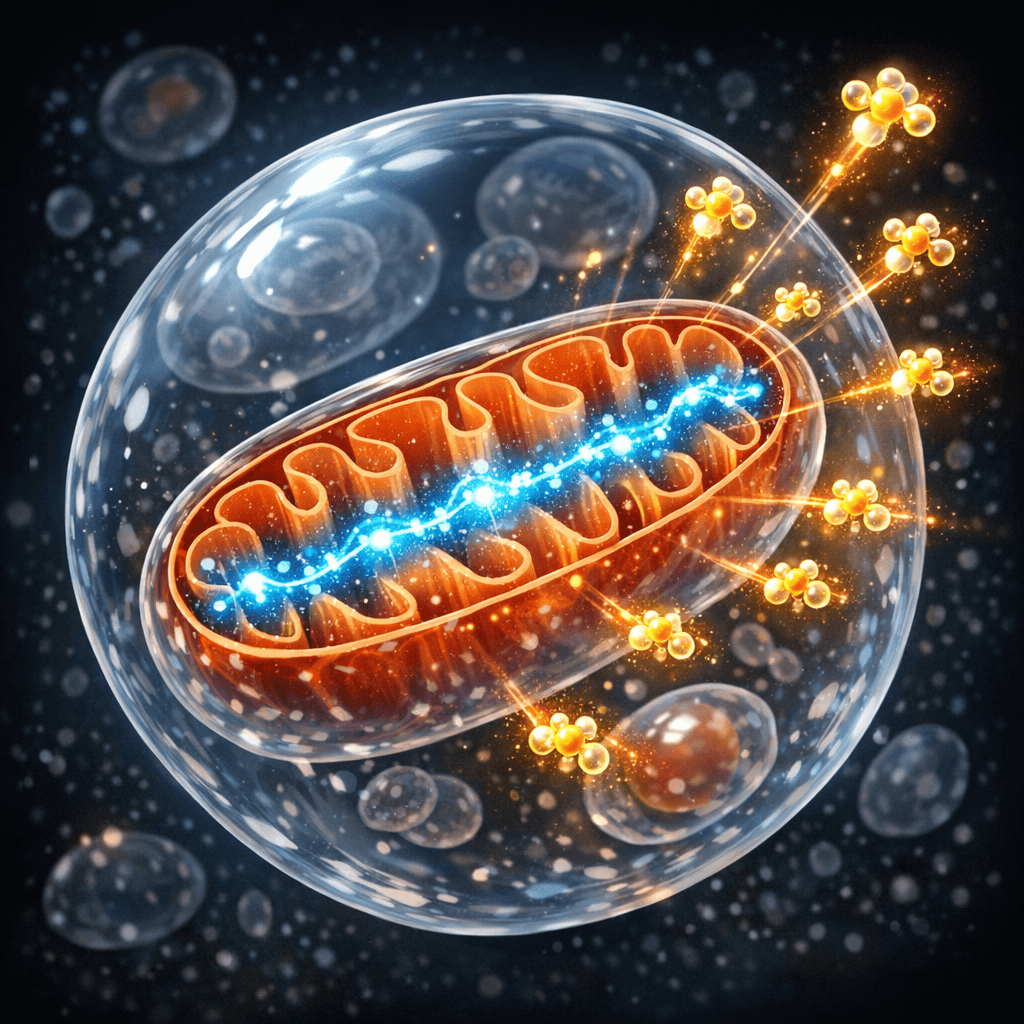
Mitochondria exist as a dynamic network inside your cells, constantly fusing together and splitting apart. Under normal conditions, this balance keeps them healthy and efficient. But when nutrients run low, cells trigger a cascade of signalling events that shifts this balance dramatically toward fragmentation. The mitochondria break into smaller pieces, and their internal structure changes too.
This isn’t random damage. The outer membranes of mitochondria flatten and compress. The inner membranes lose some of their characteristic folds, called cristae. The network becomes sparse and scattered. What emerges is a fundamentally different architecture, one built for a different purpose. Instead of maximising energy production, these restructured organelles prioritise nutrient sensing and the initiation of cellular survival pathways.
Think of it like a factory switching from production mode to maintenance mode. The machinery looks different because it’s doing different work.
What the research shows
When researchers subject cells to nutrient deprivation or restrict amino acids and glucose, they observe predictable structural changes within 4 to 24 hours. The mitochondrial network fragments. Individual mitochondria become shorter and rounder. Electron microscopy reveals that the cristae simplify, sometimes almost disappearing entirely in severely starved cells.
Simultaneously, cells activate autophagy, a cellular recycling programme that breaks down damaged or unnecessary components to harvest amino acids and other nutrients. This process is intimately connected to mitochondrial remodelling. Cells preferentially target fragmented mitochondria for autophagy, suggesting that fragmentation marks them for recycling. It’s a sorting system where structure signals fate.
The remodelling also correlates with shifts in energy metabolism. Cells switch away from aerobic respiration, which depends on intact cristae and demands abundant nutrients. Instead, they rely more heavily on glycolysis and fat oxidation, pathways that are less structurally demanding. ATP production drops, but the cells survive by spending less energy on growth and proliferation.
Genetic studies show that proteins controlling mitochondrial fusion and fission are central to this process. Manipulating these proteins alters how cells respond to nutrient stress, which confirms that remodelling is an active, regulated response rather than passive deterioration.
Why cells need this
Mitochondrial remodelling under nutrient stress solves a real survival problem. Intact, networked mitochondria with full cristae are expensive to maintain. They require constant protein synthesis, lipid trafficking, and proteostasis. When nutrients disappear, maintaining that infrastructure becomes wasteful.
Fragmentation allows cells to quickly degrade some mitochondria through autophagy while preserving others. This selective recycling extracts amino acids and other building blocks from the damaged organelles and redirects them toward critical functions. A cell that can’t eat doesn’t have the luxury of maintaining perfect organelles.
The structural changes also enhance nutrient sensing. Fragmented mitochondria have higher surface-area-to-volume ratios. Their membranes interact differently with cytoplasmic signalling molecules. This altered geometry helps cells detect starvation signals more acutely and triggers appropriate responses faster. It’s a feedback loop where the physical structure amplifies the chemical signals.
From an evolutionary perspective, this makes sense. Cells that could sense and respond to nutrient scarcity had better survival odds. Natural selection would favour mechanisms that linked nutrient availability to mitochondrial architecture. We see the result in modern cells.
What affects mitochondrial remodelling
The degree of nutrient restriction matters enormously. Mild shortages trigger modest remodelling. Severe starvation produces dramatic fragmentation and cristae loss. The type of nutrient restricted also matters: amino acid deprivation produces different kinetics than glucose restriction, partly because different signalling pathways sense these different shortages.
Age appears to influence the response. Mitochondria in older cells sometimes struggle to complete remodelling efficiently, and their fragmentation persists longer. This may contribute to impaired cellular adaptation in ageing organisms.
Metabolic state before the stressor matters too. Cells that are already engaged in active protein synthesis or rapid division undergo more dramatic remodelling when nutrients disappear. Resting cells in energy conservation mode show subtler changes.
Genetic background influences the speed and extent of remodelling. Some cell types fragment mitochondria readily in response to starvation. Others resist fragmentation longer, relying instead on other adaptation mechanisms. These differences likely reflect specialisation for different metabolic demands.
Temperature and oxidative stress can modify the remodelling response as well. Cold temperatures slow the process. Elevated reactive oxygen species production during starvation sometimes triggers more aggressive fragmentation.
What remains unknown
Scientists still don’t fully understand how cells decide which mitochondria to preserve and which to recycle when fragmentation occurs. The sorting appears selective, but the precise recognition signals remain unclear. Do cells mark certain mitochondria based on age, function, or redox state? The answer probably involves multiple overlapping cues, but the weighting of each factor is still being worked out.
The reversibility of these changes also deserves more attention. When nutrients return, do mitochondria refuse and restore their networks to original architecture? Or do they remain partially remodelled, carrying metabolic memories of the starvation episode? Early evidence suggests cells can recover their mitochondrial networks, but the completeness and timing vary.
The connection between mitochondrial remodelling and specific disease states remains incompletely mapped. Metabolic conditions involving chronic nutrient scarcity might rely on these mechanisms. Cancer cells, which often operate under glucose restriction, may remodel their mitochondria differently than normal cells. Understanding these distinctions could illuminate disease-specific biology.
Researchers also want to know how mitochondrial remodelling coordinates with other cellular stress responses. Nutrient starvation triggers dozens of signalling cascades simultaneously. How do these pathways communicate with the proteins controlling mitochondrial fusion and fission? Systems-level understanding remains sparse.
What this teaches us
Mitochondrial remodelling under nutrient stress demonstrates a principle that runs through cellular biology: structure and function are inseparable. These organelles don’t just respond chemically to starvation. They physically rebuild themselves to match new metabolic demands. This coupling of architecture to function suggests that understanding any cellular process requires thinking in three dimensions, not just two.
The research also highlights how cellular adaptation operates on timescales much faster than we often assume. Organisms don’t wait for slow genetic changes to respond to environmental shifts. Individual cells can restructure their mitochondria in hours, retuning their energy production and survival signalling within a day. This responsiveness is a feature of life itself, built into the machinery we’ve inherited from billions of years of evolution in an unpredictable world.

Matt Elliott is the editor of Redox News Today, an independent publication covering peer-reviewed research on cellular health, redox signalling, and related biomedical science.