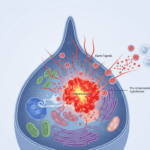

What happens inside a cell when it suddenly starts making a foreign protein?
Your cells have spent millions of years perfecting their routines. They know which proteins to make, when to make them, and exactly how much. Then an mRNA vaccine arrives and tells them to manufacture spike protein. For most people, this is fine. But in rare cases, cells seem to experience something like stress in their power plants. Mitochondria, the organelles responsible for generating energy, show signs of heightened activity and altered function. Understanding why this happens in some people and not others is becoming a serious research question.
What is mitochondrial stress response
Mitochondria are the cell’s energy factories, but they’re also surveillance systems. They monitor what’s happening inside the cell and decide whether conditions are safe or dangerous. When they detect a threat, they activate a cascade of protective mechanisms called the mitochondrial stress response. This includes turning up production of antioxidants, temporarily changing metabolic pathways, and signalling to the nucleus that something’s wrong.
Think of it like a factory manager noticing unusual activity on the floor. The manager doesn’t shut everything down. Instead, they increase safety measures, redirect resources, and alert supervisors. The stress response isn’t inherently bad. It’s actually protective. But sustained or excessive activation can drain the cell’s resources and sometimes trigger inflammation.
mRNA vaccines work by instructing cells to produce spike protein, which trains the immune system to recognise SARS-CoV-2. The mRNA itself is relatively harmless and degrades quickly. But the act of rapidly manufacturing large amounts of foreign protein puts unusual metabolic demands on the cell. Some research suggests this demand can activate mitochondrial stress responses in certain contexts.
What the research shows
Scientists have documented that mRNA vaccine injection can trigger increased mitochondrial activity in some immune cells, particularly dendritic cells and macrophages that process the vaccine. This appears as increased oxygen consumption, elevated reactive oxygen species (ROS) production, and activation of mitochondrial quality control pathways. These responses are generally temporary and resolve within hours to days.
What matters is that these observations are real and measurable. In cell cultures and animal models, researchers can directly observe mitochondrial behaviour changing in response to mRNA. The heat shock protein response activates. Mitochondrial membrane potential shifts. Energy production ramps up. These are documented cellular events, not theoretical possibilities.
However, the connection between these cellular observations and actual clinical symptoms in people remains unclear. Myocarditis cases, inflammation of the heart muscle reported in rare instances after mRNA vaccination, do show some evidence of mitochondrial involvement. But scientists haven’t established a clear causal chain. The mitochondrial activity observed in laboratory settings doesn’t necessarily cause the specific tissue damage seen in these rare cases.
Why cells need this response
Mitochondrial stress responses evolved to handle cellular emergencies. When a cell detects viral proteins, sudden energy demands, or accumulation of damaged molecules, activating these protective systems makes biological sense. They buy time while the cell mobilises its defence mechanisms.
For immune cells specifically, this becomes even more relevant. Dendritic cells and T cells need enormous energy bursts when they’re activated. They shift into high-metabolic overdrive, manufacturing proteins rapidly and moving around the body. A robust mitochondrial stress response helps these cells survive intense activity without self-destructing.
The reason this matters for mRNA vaccines is that they’re specifically designed to activate immune cells. They’re supposed to create a strong immune response. Some degree of mitochondrial activation is actually expected. The question isn’t whether it happens, but whether it ever becomes excessive or prolonged in ways that cause tissue damage.
What affects mitochondrial stress responses
Age matters significantly. Older people have mitochondria that are already running less efficiently. Their cellular stress responses are often slower to activate and slower to resolve. This might explain why vaccine side effects, though still rare, are slightly more common in older populations. The same immune activation that’s manageable in younger people could push older mitochondria past their limits.
Pre-existing mitochondrial conditions make a difference too. People with genetic mitochondrial disorders or those taking medications that affect mitochondrial function may have less capacity to handle additional metabolic stress. This includes some commonly used drugs that impair mitochondrial function as a side effect.
Viral infections themselves, including COVID-19, damage mitochondria extensively. Someone recovering from acute COVID might have compromised mitochondrial function when they receive a vaccine. The timing matters. So does overall metabolic health, nutritional status, and even sleep. A sleep-deprived person with poor nutrition will have less metabolic reserve than someone well-rested and well-fed.
Recent research has also examined genetic variation in mitochondrial genes and nuclear genes that regulate mitochondrial function. Some people appear to have variants that make their mitochondria more reactive to stress. This genetic component could explain why mRNA vaccine side effects cluster in particular individuals.
What remains unknown
Scientists still don’t have a clear picture of why mitochondrial stress responses occasionally progress to clinical inflammation in rare cases. Millions of people receive mRNA vaccines and show no observable symptoms. Millions more show temporary, mild symptoms that resolve quickly. But some people develop inflammation, and the path from mitochondrial stress to tissue damage isn’t well mapped.
We also don’t know whether certain vaccine formulations or storage conditions might amplify mitochondrial stress. We don’t understand whether some people’s mitochondria recover poorly from the initial stress, creating a prolonged problem. We can’t yet predict who will experience problems based on their genetics or health status, which limits our ability to identify at-risk individuals before vaccination.
Another major gap is understanding the role of the innate immune response itself. The mitochondrial stress response doesn’t operate in isolation. It’s intertwined with inflammatory signalling, interferon production, and other immune activation. Separating out what’s caused by mitochondrial stress versus what’s caused by immune activation generally remains technically challenging.
The bigger picture
This line of research reveals something important about how we think about vaccine safety. Side effects aren’t usually random mysteries. They’re cellular events with biological explanations. By studying the rare cases where problems occur, we learn about normal mitochondrial function and how much stress a typical cell can handle before things go wrong.
Understanding mitochondrial responses to mRNA vaccines also illuminates broader questions about how our cells manage intense metabolic demands. The same mechanisms that activate in response to vaccination also activate during infection, exercise, and fasting. Studying one system teaches us about all of them. The work remains genuinely open and active. Scientists are building the maps that explain why some cells tolerate massive protein synthesis easily while others struggle.

Matt Elliott is the editor of Redox News Today, an independent publication covering peer-reviewed research on cellular health, redox signalling, and related biomedical science.