Your cells have a fuel gauge, and most of the time it’s broken. That’s the problem LKB1 solves. This enzyme acts like a master alarm system that detects when energy is running low and mobilises the cellular machinery to fix it. But LKB1 doesn’t activate itself. It needs a trigger. Recent research has identified one hiding in garlic: a compound called S1PC that appears to directly activate this critical energy sensor.
What is LKB1 and why cells depend on it
LKB1 is a kinase, which means it phosphorylates other proteins to change what they do. Think of it as a molecular key that unlocks energy-conservation pathways when cells detect they’re running on empty. The enzyme activates AMPK, another kinase sometimes called the “metabolic master switch” because it controls so many downstream processes. When AMPK is switched on, cells stop building new proteins and fats. They start breaking down existing stores for energy instead.
This is an ancient system. LKB1 shows up in yeast, worms, flies, and humans. Evolution has kept it largely unchanged for over a billion years, which tells you it works. The enzyme also acts as a tumour suppressor in mammals. Defects in LKB1 increase cancer risk, probably because cells lose their ability to sense when they should stop dividing.
What makes LKB1 interesting isn’t what it does in isolation. It’s that activating it changes everything downstream: metabolic rate, mitochondrial function, cellular stress responses, even lifespan in some organisms.
What the research shows
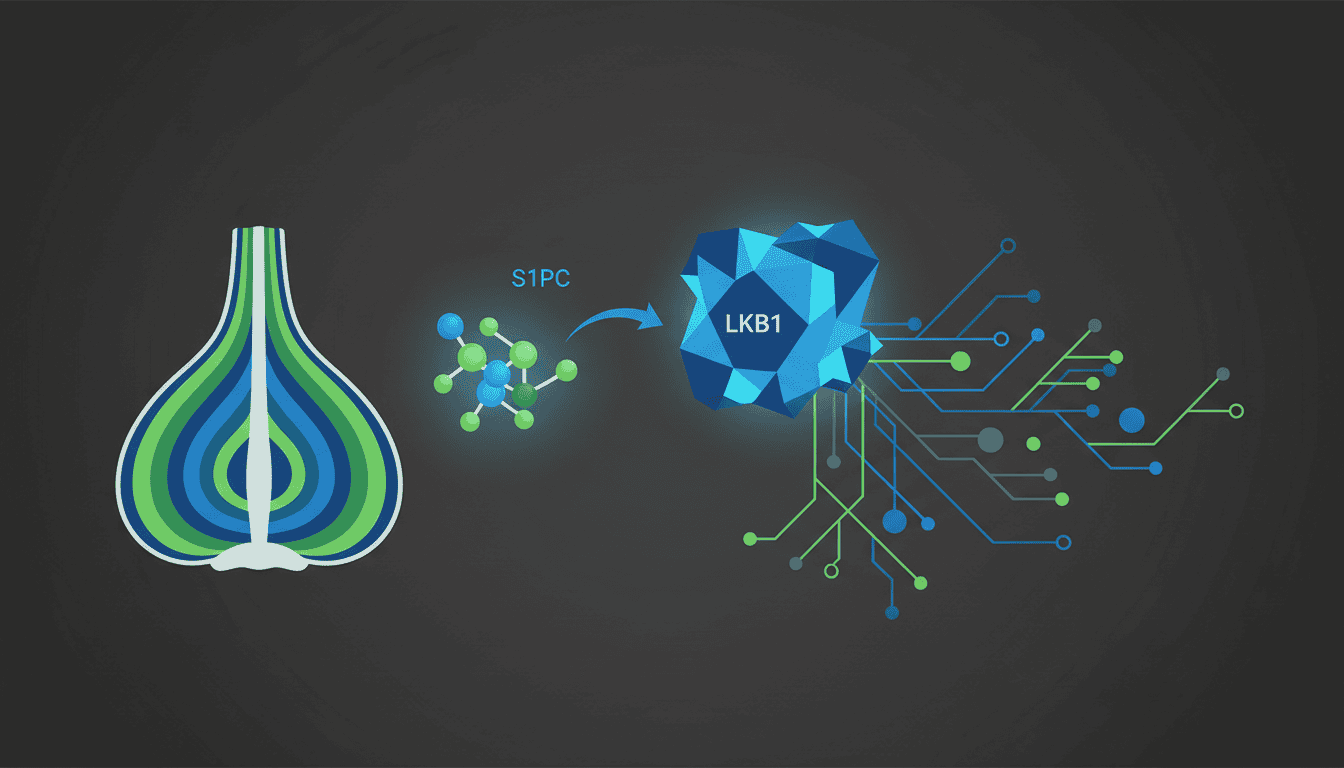
Scientists discovered that S1PC, a compound derived from garlic that forms when cells are damaged, directly binds to LKB1 and activates it. This isn’t a vague interaction. The binding is specific and measurable. Cells treated with S1PC show increased AMPK phosphorylation, which is the downstream readout that LKB1 is actually working.
The research demonstrates that S1PC activates LKB1 independently of the major pathway that usually triggers it. Typically, LKB1 wakes up when AMP levels rise inside cells. S1PC appears to offer an alternative route to the same outcome. This matters because it suggests cells can be prompted to activate their energy-sensing machinery through dietary exposure to garlic compounds.
What’s particularly interesting is that this happens in cultured cells at concentrations that are biologically plausible. This isn’t a pharmacology experiment where researchers blast cells with 1,000 times the normal dose. The concentrations tested are in ranges that real organisms might encounter from actual food consumption.
When researchers tracked downstream effects, they observed the classic AMPK signature: decreased protein synthesis, altered glucose metabolism, and activation of mitochondrial biogenesis pathways. The cells responded as if their energy stores were depleted, even though they weren’t.
Why cells need this system
Energy sensing isn’t a luxury. It’s existential. Cells that can’t detect low energy die quickly. They keep burning fuel they don’t have, and the machinery grinds to a halt. Cells that sense energy accurately have options. They can slow their growth, recycle damaged components, or trigger their stress defences.
LKB1 acts as the gatekeeper for this entire decision-making process. Without it, cells lose the ability to tell the difference between feast and famine. This is why LKB1 mutations cause such severe problems in humans. Peutz-Jeghers syndrome, caused by LKB1 defects, leads to uncontrolled tissue growth and high cancer risk.
The broader biological logic is clear: activating this pathway triggers the same cascade of events that happens during caloric restriction or exercise. Mitochondria become more efficient. Cellular garbage disposal systems activate. Proteins that cause inflammation and oxidative damage get cleared away.
What affects LKB1 activation
LKB1 activity varies based on several factors. Exercise is one of the most powerful. Physical activity raises AMP levels and activates the LKB1-AMPK axis within minutes. This is part of why exercise triggers so many beneficial changes throughout the body. Caloric restriction has the same effect through a different mechanism.
Temperature also matters. Cold exposure activates energy-sensing pathways because maintaining body temperature requires burning fuel. Sleep quality influences it too. Poor sleep disrupts the metabolic sensing systems that depend on LKB1.
Dietary compounds appear to modulate it as well. Polyphenols from plants, compounds related to S1PC from allium vegetables, and various other phytochemicals can activate or support LKB1 signalling. Age is another factor. LKB1 activity tends to decline with ageing, which may partly explain why metabolic flexibility decreases with time.
Disease states affect it profoundly. Obesity reduces LKB1 activation in metabolically active tissues. Type 2 diabetes involves progressive loss of metabolic sensing, which correlates with reduced AMPK activity. This creates a vicious cycle where cells lose their ability to respond appropriately to energy depletion.
What remains unknown
The big question is whether activating LKB1 through S1PC in living organisms produces meaningful health effects. Cell culture experiments are clean and controlled, but organisms are messier. We don’t know how much S1PC reaches target tissues after you eat garlic. We don’t know whether other compounds in garlic interfere with or enhance the effect. We don’t know if chronic S1PC exposure maintains LKB1 activation or whether cells adapt and become less responsive over time.
There’s also the question of specificity. S1PC activates LKB1, but does it trigger any off-target effects? Does it interact with other proteins in the cell? The research so far suggests specificity, but that’s still being mapped out.
We don’t fully understand why evolution preserved S1PC production in garlic. It forms when cells are crushed or damaged, which suggests it might have a role in plant defence. Whether that same mechanism has anything to do with human cells remains speculative. The compound was probably never selected for its effect on human LKB1 because humans didn’t encounter garlic regularly until relatively recent agricultural history.
What this reveals about cellular regulation
The discovery that a plant compound can directly activate a mammalian energy-sensing enzyme illustrates something fundamental about biology. Our cellular systems evolved in an environment full of plant chemistry. We’ve spent millions of years eating plants that produce bioactive compounds. Our cells recognise and respond to many of these molecules because they’ve been part of our dietary landscape.
This doesn’t mean eating garlic will recalibrate your metabolism or extend your lifespan. But it does point to something real about how the body interfaces with food. The distinction between nutrition and pharmacology starts to blur when you’re talking about specific molecular interactions at the cellular level. Understanding which dietary compounds activate which cellular pathways is one of the most underexplored areas of biomedical science.

Matt Elliott is the editor of Redox News Today, an independent publication covering peer-reviewed research on cellular health, redox signalling, and related biomedical science.