Your muscle cells contain hundreds of mitochondria, each one a microscopic power plant generating the energy needed for every contraction. But these cellular engines don’t last forever. They accumulate damage, lose efficiency, and eventually need replacement. Enter ATF5, a transcription factor that acts like a quality control foreman, deciding when mitochondria need repair and when they should be scrapped entirely.
What is ATF5
ATF5 belongs to a family of proteins called transcription factors. These molecules bind to DNA and control which genes get switched on or off. Think of them as molecular switches that determine what proteins a cell makes at any given moment.
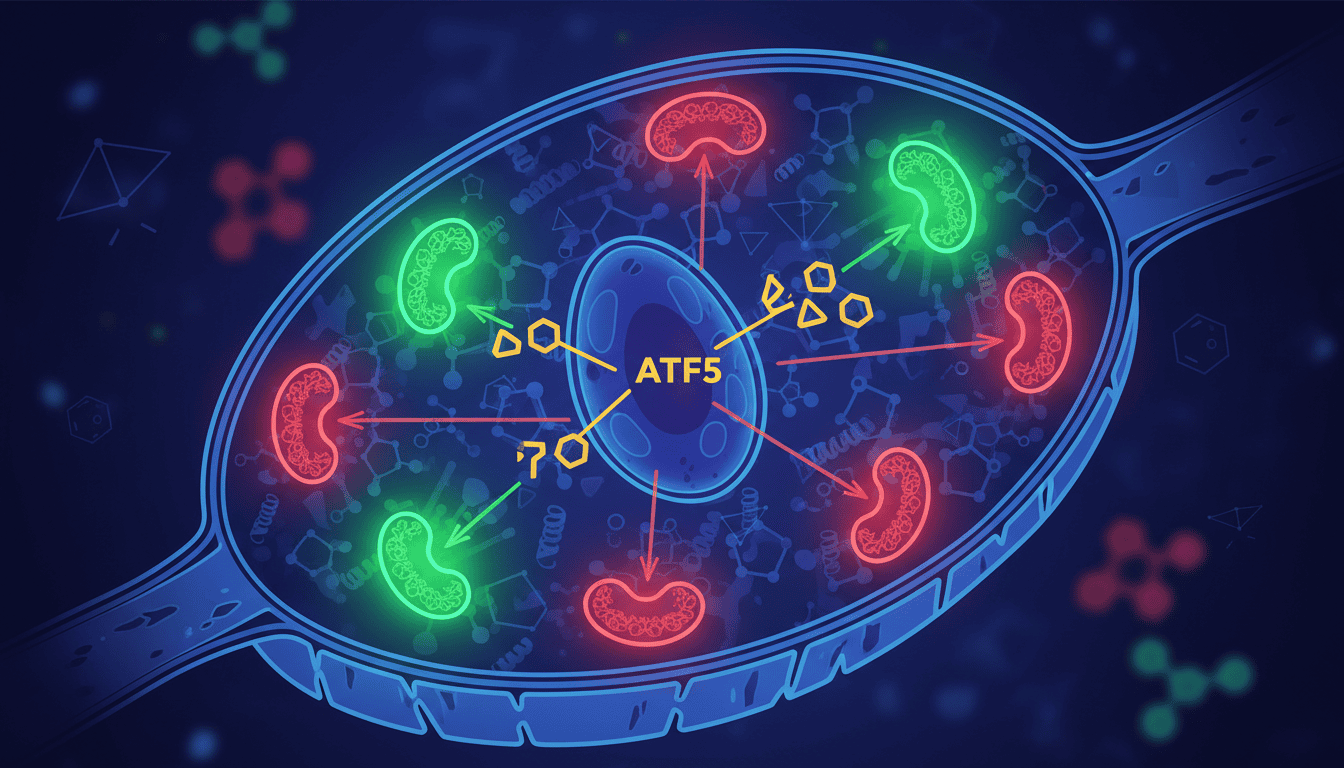
What makes ATF5 special is its dual citizenship. Unlike most transcription factors that work exclusively in the cell nucleus, ATF5 shuttles between the nucleus and the mitochondria themselves. This unique location allows it to monitor mitochondrial health firsthand and coordinate the cellular response when things go wrong.
In skeletal muscle, where energy demands can spike dramatically during exercise, ATF5 plays a particularly crucial role. Muscle fibres rely almost entirely on mitochondrial energy production. When these powerhouses start failing, muscle function suffers quickly.
What the research shows
Scientists have discovered that ATF5 operates like a sophisticated monitoring system. When mitochondria start showing signs of damage or stress, ATF5 levels increase inside the affected organelles. This isn’t random. The protein actively senses mitochondrial dysfunction.
Research reveals that ATF5 controls genes involved in both mitochondrial repair mechanisms and mitochondrial removal. When mitochondria can still be salvaged, ATF5 activates genes that produce protective proteins and repair machinery. But when damage is too severe, it triggers a completely different program.
Studies using muscle cells show that ATF5 coordinates with a process called mitophagy. This is cellular housekeeping at its most efficient. Damaged mitochondria get tagged for destruction, wrapped in membrane bubbles, and fed to cellular recycling centres called lysosomes. The raw materials get reused to build fresh mitochondria.
Researchers have also found that ATF5 responds to exercise stress. When muscles work hard, mitochondria experience increased oxidative stress. ATF5 levels rise, activating quality control programs that either strengthen existing mitochondria or clear out the damaged ones to make room for new, more efficient versions.
Why cells need this
Mitochondria face a constant barrage of damage. They generate reactive oxygen species as a byproduct of energy production, essentially poisoning themselves in the process of keeping cells alive. Without quality control, these damaged mitochondria would accumulate like broken machinery in a factory.
Muscle cells face this challenge more acutely than most other cell types. During intense exercise, energy demands can increase fifty-fold or more. Mitochondria work overtime, generating more oxidative stress and accumulating damage faster. A robust quality control system becomes essential for maintaining performance.
Evolution preserved ATF5 because it solves a fundamental problem: how to maintain a fleet of cellular power plants that are constantly wearing themselves out. The protein provides both surveillance and response capability in one package. It can detect problems early and coordinate appropriate responses before small issues become catastrophic failures.
This system also allows muscles to adapt to changing energy demands. Regular exercise damages some mitochondria but also signals for the production of new, more efficient ones. ATF5 helps orchestrate this turnover, ensuring that muscle cells maintain optimal energy production capacity.
What affects ATF5
Age significantly impacts ATF5 function. Research shows that older muscle tissue often has reduced ATF5 activity, which correlates with the accumulation of damaged mitochondria. This may partly explain why muscle function declines with ageing.
Exercise has the opposite effect. Both endurance and resistance training appear to enhance ATF5 signalling pathways. This creates a beneficial cycle where exercise stress temporarily damages some mitochondria, ATF5 clears them out, and the muscle rebuilds with more efficient energy production machinery.
Nutritional status also plays a role. Caloric restriction and certain nutrients can influence ATF5 activity. Some research suggests that compounds found in foods like green tea and berries may support the pathways that ATF5 controls, though the mechanisms remain under investigation.
Oxidative stress from various sources affects ATF5 function. Environmental toxins, chronic inflammation, and metabolic dysfunction can overwhelm the quality control systems that ATF5 coordinates. When this happens, damaged mitochondria accumulate faster than they can be cleared.
What remains unknown
Scientists still don’t fully understand how ATF5 decides between repair and removal. What signals tell this protein that a mitochondrion can be saved versus when it should be destroyed? The decision-making process involves multiple molecular signals, but researchers are still mapping these complex interactions.
The relationship between ATF5 and other quality control systems needs more research. Cells have multiple overlapping mechanisms for maintaining mitochondrial health. How these systems coordinate with each other, and what happens when they conflict, remains unclear.
Researchers are also investigating whether ATF5 function differs between muscle fibre types. Slow-twitch endurance fibres have different mitochondrial profiles than fast-twitch power fibres. Whether they use different quality control strategies is still being determined.
The timing of ATF5 responses presents another puzzle. How quickly does this system respond to mitochondrial damage? Can it predict problems before they become severe? Understanding these temporal aspects could reveal new insights into muscle adaptation and resilience.
ATF5 represents just one piece of the intricate machinery that keeps our cellular powerhouses running efficiently. As research continues to unravel how cells maintain their energy production systems, we’re discovering that quality control mechanisms like those coordinated by ATF5 are fundamental to cellular health. This isn’t just about muscle function, it’s about understanding how life maintains itself at the most basic level, one mitochondrion at a time.

Matt Elliott is the editor of Redox News Today, an independent publication covering peer-reviewed research on cellular health, redox signalling, and related biomedical science.