Your cells are oxidising right now. Oxygen molecules are splitting into reactive fragments, colliding with DNA, proteins, and fats in a process that sounds apocalyptic but is actually normal. The trouble starts when oxidation happens faster than your cells can repair the damage. This imbalance, called oxidative stress, is where compounds like anthocyanins from blueberries and polyphenols from olive oil enter the picture. These aren’t mystical superfoods. They’re molecules with specific chemical structures that cells appear to recognise and use as defensive tools.
What is oxidative stress
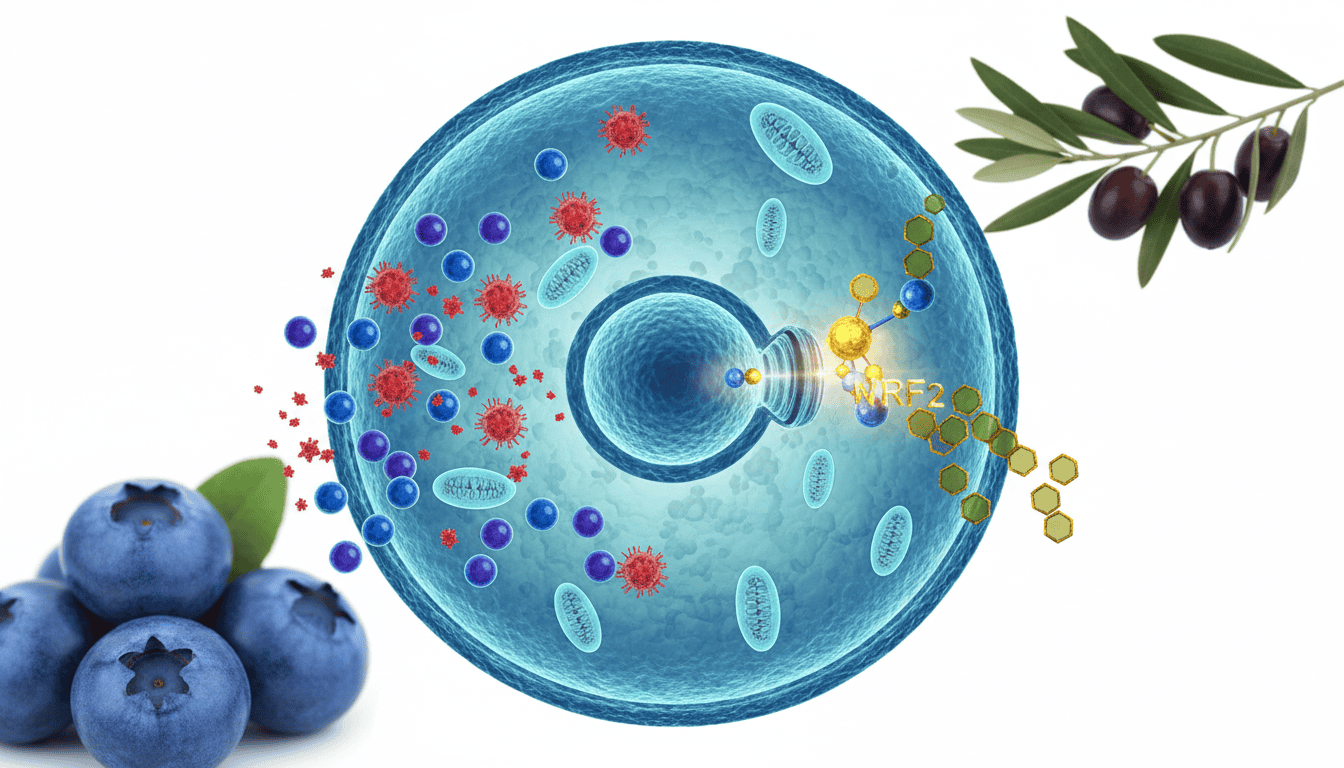
Oxidative stress happens when reactive oxygen species (ROS) accumulate faster than cells can neutralise them. Think of ROS as free radicals, charged particles that careen through cells seeking electrons to steal. When they grab electrons from other molecules, they damage those molecules and create more free radicals in the process. It’s a cascade. Your cells have evolved multiple enzymatic systems to stop this cascade: superoxide dismutase converts one type of free radical into hydrogen peroxide, catalase breaks down hydrogen peroxide into water and oxygen, and glutathione peroxidase mops up lipid peroxides. These defences are elegant and efficient when they work. When oxidative stress overwhelms these systems, damage accumulates in mitochondria, the nucleus, and cell membranes.
Anthocyanins are water-soluble pigments responsible for blue, purple, and red colours in plants. Polyphenols are a broader class of compounds with multiple phenol groups in their structure. Both have a chemical property in common: they donate electrons readily. This makes them antioxidants in the chemical sense. They can react with free radicals and neutralise them without becoming dangerous themselves.
What the research shows
Studies examining blueberry anthocyanins have found that these compounds accumulate in cells and tissues after consumption. Researchers tracked how specific anthocyanins, particularly cyanidin-3-glucoside and malvidin-3-glucoside, appear in blood and tissues within hours of eating blueberries. In cell culture experiments, anthocyanins reduce markers of oxidative damage like protein carbonylation and DNA strand breaks when cells are exposed to oxidative stress triggers. The effect is dose-dependent: more anthocyanins generally means more protection, at least in controlled laboratory conditions.
Olive oil polyphenols work through overlapping but distinct mechanisms. Oleocanthal and oleuropein, two major compounds in extra-virgin olive oil, interact with cellular signalling pathways rather than just acting as passive free radical sponges. They activate nuclear factor erythroid 2-related factor 2, commonly abbreviated NRF2, which is a transcription factor that switches on dozens of protective genes. When cells detect oxidative stress, NRF2 normally moves from the cytoplasm into the nucleus and binds to DNA regions called antioxidant response elements. This triggers production of more superoxide dismutase, more catalase, and other defence proteins. Polyphenols accelerate this process.
The two compound classes also differ in persistence. Anthocyanins are metabolised relatively quickly, appearing in tissues within hours and clearing within days. Polyphenols from olive oil show longer residence times in some tissues, particularly in the liver and adipose tissue. Neither compound replaces the cell’s own enzymatic defences. Instead, they appear to augment them.
Why cells need this
Oxidative stress isn’t a disease invented by modern marketing. It’s a fundamental consequence of aerobic metabolism and of living in an oxygen-containing environment. Every cell that uses oxygen to produce energy in its mitochondria generates free radicals as a byproduct. This is physics, not a bug. Evolution solved this problem by building redundant antioxidant systems into every cell. But these systems require energy to maintain and their efficiency declines with age. They also get overwhelmed by environmental stressors like UV radiation, pollution, and certain drugs.
From an evolutionary perspective, compounds like anthocyanins and polyphenols offered ancestral humans an additional layer of defence. Plants produce these compounds as their own protection against oxidative stress from sunlight and metabolism. When we consume plants, we gain access to compounds our cells recognise and can utilise. The cell doesn’t treat anthocyanins as foreign toxins because they fit into existing signalling pathways. NRF2 recognises polyphenols because the structural features that allow polyphenols to activate NRF2 were already part of the cell’s detection system.
What affects anthocyanins and polyphenols
Concentration matters. Ripe blueberries contain more anthocyanins than unripe ones. The timing and method of harvest, storage temperature, and even the specific cultivar determine final anthocyanin content. Frozen blueberries retain most anthocyanins, but processing into juice or supplements concentrates them in different ways than whole fruit. With olive oil, the extraction method determines polyphenol content dramatically. Cold-pressed extra-virgin oils contain roughly ten times more polyphenols than refined oils. Oils left sitting in clear bottles exposed to light lose polyphenols over weeks.
Individual variation matters too. Genetic differences affect how quickly people metabolise these compounds. Someone with a particular variant of UDP-glucuronosyltransferase, an enzyme involved in breaking down anthocyanins, will process them faster than someone without that variant. Age influences the response: older adults may have reduced NRF2 signalling, which means polyphenols might be less effective at activating protective genes. The existing oxidative stress burden in someone’s tissues affects how much additional protection these compounds can provide.
What remains unknown
The practical question that researchers still can’t answer with certainty is how much anthocyanins or polyphenols someone would need to consume to meaningfully shift oxidative stress in living tissues over the long term. Cell culture studies use concentrations that don’t necessarily reflect real-world exposure. Animal studies suggest benefits, but animal physiology doesn’t always translate to humans. Long-term human studies tracking oxidative stress markers alongside anthocyanin or polyphenol intake are sparse and complicated by the fact that people who eat more blueberries or olive oil also tend to exercise more, sleep better, and maintain other healthy habits.
Researchers also don’t fully understand which metabolites of these compounds are actually active. Anthocyanins break down into smaller molecules in the gut and liver. Some of these breakdown products might be more protective than the original anthocyanins. The same applies to polyphenols. Identifying which metabolites do what is technically challenging and still ongoing. Finally, it remains unclear whether benefits from anthocyanins and polyphenols differ meaningfully between people with normal oxidative stress and those with pathologically elevated oxidative stress.
These plant compounds reveal something fundamental about cellular defence: cells have evolved to recognise and cooperate with molecules from their environment. Anthocyanins and polyphenols aren’t magic. They’re tools that fit into existing cellular mechanisms. Understanding how they work teaches us more about the systems our cells already possess and the surprising ways that food chemistry and cellular biology intersect.

Matt Elliott is the editor of Redox News Today, an independent publication covering peer-reviewed research on cellular health, redox signalling, and related biomedical science.