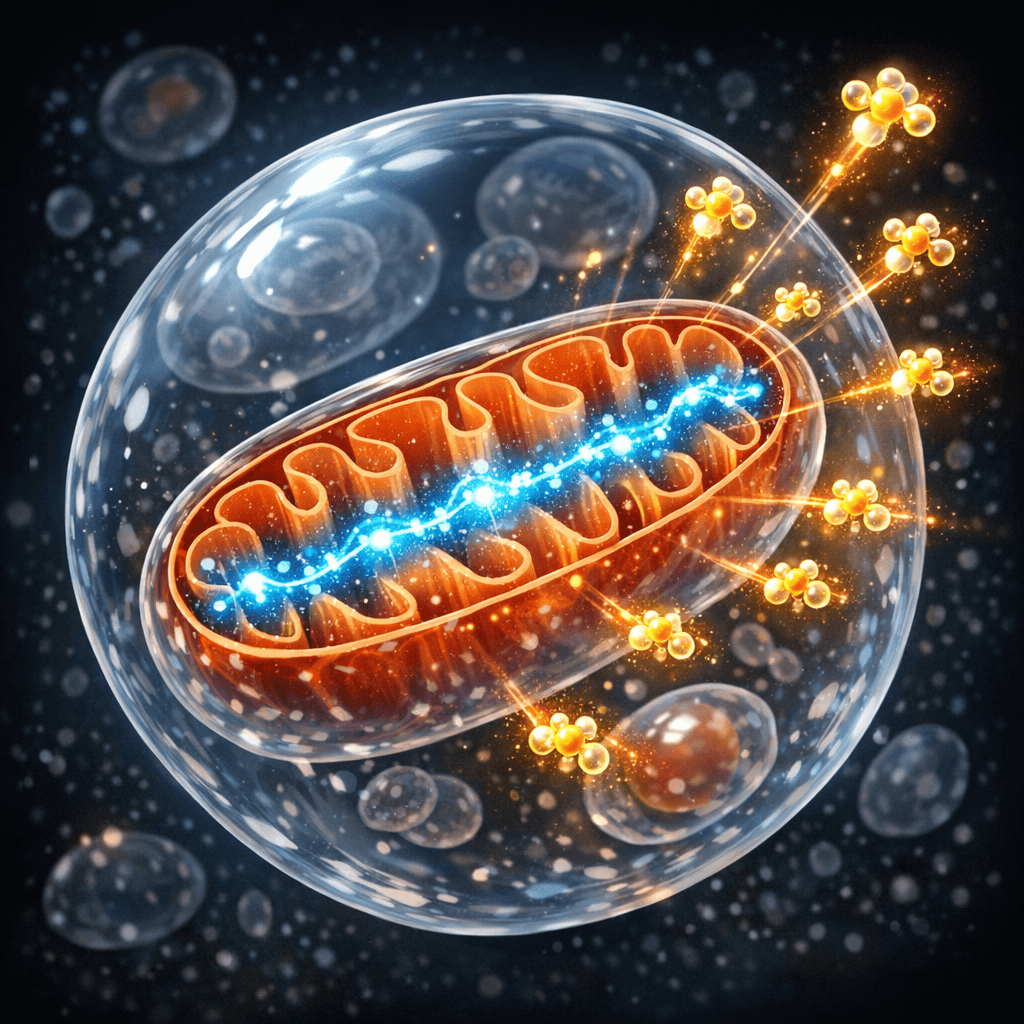

Your mitochondria are shape-shifters. Right now, inside each of your cells, these cellular powerhouses are stretching into long tubes, breaking apart into fragments, and reconnecting like some microscopic game of cellular Tetris. But this isn’t random. The way mitochondria reshape themselves directly controls where their DNA ends up throughout the cell.
What is mitochondrial shape regulation
Mitochondria don’t just sit in cells like static beans. They form dynamic networks that constantly fuse together and split apart through processes called fusion and fission.
When mitochondria fuse, they join their membranes to create longer, interconnected structures. Think of it like railway carriages linking up to form a train. When they undergo fission, they pinch apart at specific points, creating separate mitochondrial units.
These shape changes matter because mitochondria carry their own DNA. Unlike nuclear DNA that stays locked in the cell’s control centre, mitochondrial DNA needs to spread throughout the cell to where it’s needed most. The shape of the mitochondrial network determines exactly how this genetic material gets distributed.
Specialised proteins orchestrate these transformations. Dynamin-related protein 1 acts like molecular scissors, cutting mitochondria apart. Meanwhile, proteins called mitofusins help mitochondria stick together and merge their outer membranes.
What the research shows
Scientists have observed that when mitochondria form long, interconnected networks through fusion, their DNA spreads more evenly throughout the cell. The connected structure acts like a highway system, allowing genetic material to travel from one end of the cell to the other.
In contrast, when mitochondria fragment into smaller pieces, their DNA becomes clustered in specific cellular regions. This isn’t necessarily bad. Sometimes cells need concentrated mitochondrial activity in particular areas.
Researchers have tracked mitochondrial DNA movement using fluorescent markers. They found that cells actively adjust their mitochondrial network shape based on their energy demands. Muscle cells, which need energy throughout their length, maintain highly connected mitochondrial networks. This keeps their mitochondrial DNA well distributed.
The timing of these changes follows predictable patterns. During cell division, mitochondria fragment to ensure each daughter cell receives roughly equal amounts of mitochondrial DNA. As cells mature and specialise, they develop characteristic mitochondrial shapes that match their function.
Why cells need this mechanism
Mitochondrial DNA codes for essential proteins involved in energy production. Unlike nuclear genes, these mitochondrial genes need to be expressed close to where the proteins will be used. There’s no point having all your mitochondrial DNA clustered at one end of a long cell if you need energy-producing proteins at the other end.
The shape-shifting ability solves a fundamental logistics problem. Cells can redistribute their mitochondrial genetic material without having to move individual DNA molecules across long distances. Instead, they reshape the entire network to put DNA where it’s needed.
This system also provides redundancy. If one part of the mitochondrial network gets damaged, the remaining sections still contain copies of the essential genetic information. It’s like having backup generators distributed throughout a building rather than one central power source.
Evolution has preserved this mechanism across many species because it allows cells to match their energy production capacity to local demand. Brain cells can concentrate mitochondrial DNA near synapses where energy needs spike during neural signalling.
What affects mitochondrial shape changes
Age significantly impacts how well mitochondria maintain their shape-changing abilities. As cells get older, their mitochondria tend to become more fragmented and less capable of forming the long networks that distribute DNA effectively.
Exercise influences mitochondrial network structure. Physical activity triggers signals that promote mitochondrial fusion, creating more interconnected networks. This helps explain why exercise improves cellular energy metabolism.
Cellular stress pushes mitochondria toward fragmentation. When cells face oxidative damage or energy shortages, they increase mitochondrial fission. This allows damaged mitochondria to be identified and removed more easily, but it also disrupts DNA distribution.
Metabolic state affects the balance between fusion and fission. Well-fed cells tend to have more connected mitochondrial networks, while cells experiencing nutrient stress fragment their mitochondria. This reflects the cell’s assessment of whether it’s worth maintaining expensive, extended networks.
Calcium levels within cells also influence mitochondrial shape. High calcium concentrations can trigger mitochondrial fragmentation, which affects where mitochondrial DNA ends up within the cell.
What remains unknown
Scientists still don’t fully understand how cells decide where to position mitochondrial DNA within their networks. There appear to be specific signals that guide DNA to certain locations, but the molecular mechanisms remain unclear.
The relationship between mitochondrial DNA distribution and gene expression is another active area of investigation. Researchers know that DNA location affects protein production, but they’re still mapping out these relationships in different cell types.
How mitochondrial networks coordinate their shape changes across an entire cell presents another puzzle. Individual mitochondria somehow communicate to create organised, cell-wide changes in network structure. The signalling mechanisms behind this coordination aren’t well understood.
Questions also remain about how diseases affect mitochondrial shape regulation. Many conditions involve disrupted mitochondrial networks, but it’s often unclear whether the shape changes cause problems or represent the cell’s attempt to cope with existing damage.
This intricate dance between mitochondrial form and genetic function reveals how cellular architecture shapes biology at the molecular level. Cells don’t just contain their components randomly. They organise their internal structures, including their DNA distribution, with remarkable precision. Understanding how mitochondria reshape themselves to control genetic positioning adds another layer to our picture of cellular organisation. These shape-shifting organelles demonstrate that even at the microscopic scale, location determines everything.

Matt Elliott is the editor of Redox News Today, an independent publication covering peer-reviewed research on cellular health, redox signalling, and related biomedical science.