Right now, as you read this, every cell in your body is performing an invisible balancing act. While your blood pH hovers around 7.4, your stomach churns at a highly acidic 1.5, and your small intestine maintains an alkaline 8.5. Yet somehow, each cell maintains its internal pH within a razor-thin range that keeps you alive.
What is cellular pH regulation
pH measures how acidic or alkaline something is, on a scale from 0 to 14. Pure water sits at neutral 7, while lemon juice hits around 2 and household bleach reaches 12. For your cells, pH isn’t just a number. It determines whether proteins fold correctly, whether enzymes work, and whether cellular machinery functions at all.
Most cells maintain their internal pH between 7.0 and 7.4, but this varies by cell type and location. Your muscle cells during intense exercise might drop to 6.8. Kidney cells handle much wider swings. The mitochondria inside your cells operate at different pH levels in different compartments, creating the very gradients that power ATP production.
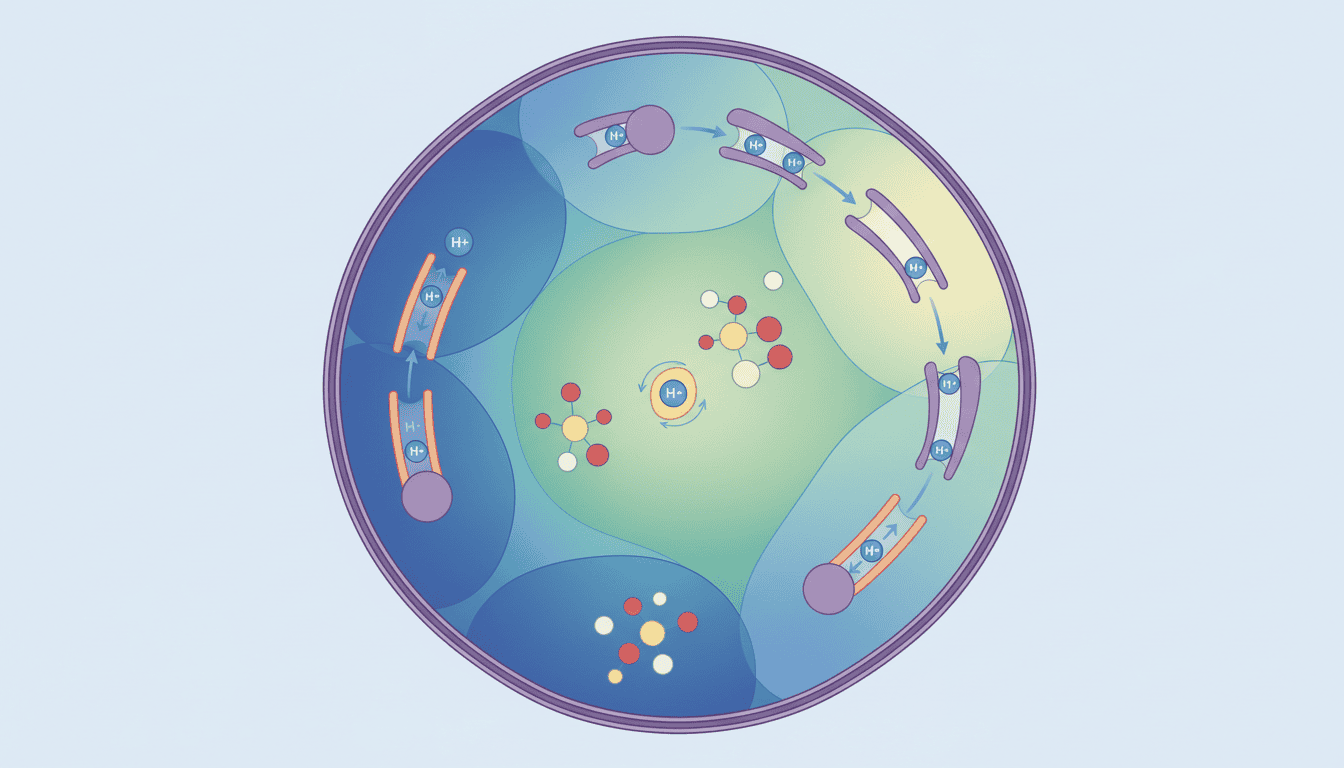
Cells achieve this control through multiple overlapping systems. Membrane transporters actively pump hydrogen ions in and out. Buffer systems neutralise sudden pH changes. Specialised proteins detect pH shifts and trigger corrective responses faster than you can blink.
What the research shows
Scientists have identified dozens of proteins that cells use to manage pH. The sodium-hydrogen exchanger, found in virtually every human cell, swaps internal hydrogen ions for external sodium ions. When cells become too acidic, this protein works overtime to restore balance.
Researchers have also discovered that cells don’t just react to pH changes, they anticipate them. During exercise, muscle cells ramp up their pH-regulating machinery before they actually become acidic. Cancer cells exploit these same systems, using enhanced pH regulation to survive in the harsh, oxygen-poor environments of tumours.
Perhaps most intriguingly, scientists have found that pH regulation isn’t just about survival. It’s about communication. Cells release different chemical signals depending on their internal pH. Immune cells change their behaviour based on the pH of their surroundings. Even stem cells use pH as a cue to decide when to divide or differentiate.
Studies using fluorescent pH indicators show that cellular pH fluctuates constantly, sometimes changing by 0.1 units in seconds. These aren’t random fluctuations. They’re purposeful adjustments that help cells coordinate their activities with their neighbours and respond to changing conditions.
Why cells need this precision
Proteins are exquisitely sensitive to pH changes. Drop the pH by just 0.2 units, and enzymes that were working perfectly start to malfunction. Their shapes change subtly but critically, like a key that no longer quite fits its lock.
Evolution has shaped cells to exploit these pH sensitivities. The electron transport chain in mitochondria depends on maintaining different pH levels on either side of the inner membrane. This pH gradient stores energy like water behind a dam. Disrupt it, and energy production collapses.
DNA itself becomes unstable in the wrong pH environment. The chemical bonds that hold genetic information together are pH-dependent. Too acidic, and DNA strands can break. Too alkaline, and the bases that encode genetic information can spontaneously change, creating mutations.
Cellular membranes also depend on proper pH. The lipids that form these barriers change their properties as pH shifts. At the wrong pH, membranes become either too rigid or too fluid, compromising the cell’s ability to control what enters and exits.
What affects cellular pH
Physical activity immediately challenges cellular pH control. Exercising muscles produce lactic acid faster than they can clear it, forcing pH-regulating systems into overdrive. Well-trained athletes develop more efficient pH-buffering systems, one reason why they can sustain intense efforts longer.
Age affects these systems too. Older cells often struggle to maintain tight pH control, partly because their membranes become leakier and their transport proteins work less efficiently. This contributes to the general decline in cellular function that comes with ageing.
Diet influences cellular pH through multiple pathways. Not through direct acidification or alkalinisation, as some popular theories suggest, but through the metabolic byproducts that different foods create. High-protein diets increase acid production. High-potassium foods provide substrates for pH-buffering systems.
Inflammation disrupts cellular pH regulation. Inflammatory signals cause cells to alter their metabolism in ways that challenge pH homeostasis. Chronic inflammation creates a persistent burden on these regulatory systems.
Environmental toxins can interfere with pH control by damaging transport proteins or disrupting membrane integrity. Even seemingly minor exposures can have outsized effects because pH regulation has so little margin for error.
What remains unknown
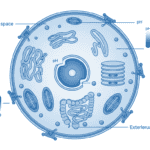
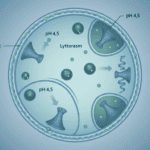
Scientists are still working out how cells coordinate pH regulation across different compartments. A single cell might maintain different pH levels in its nucleus, cytoplasm, mitochondria, and various organelles simultaneously. How these systems communicate and avoid interfering with each other remains partially mysterious.
The relationship between cellular pH and disease is another active area of investigation. Researchers know that many diseases involve disrupted pH regulation, but they’re still determining whether pH changes cause disease or result from it. The answer likely varies by condition.
How cells pass on information about pH regulation to their offspring during cell division is also unclear. Some pH-regulating proteins seem to be inherited directly, while others must be rebuilt from scratch in daughter cells.
Perhaps most intriguingly, researchers are discovering that pH might play a role in cellular memory and adaptation. Cells that have experienced pH stress sometimes respond differently to future challenges, but the mechanisms behind this cellular learning remain largely unknown.
Cellular pH regulation reveals something profound about life itself. Every cell is simultaneously an island and part of a larger community, maintaining its internal environment while responding to external demands. This balance between autonomy and cooperation, played out in the invisible realm of hydrogen ions and membrane proteins, underlies every biological process from muscle contraction to memory formation. Understanding how cells achieve this balance brings us closer to understanding how life maintains its improbable existence in a world of constant change.

Matt Elliott is the editor of Redox News Today, an independent publication covering peer-reviewed research on cellular health, redox signalling, and related biomedical science.