Your cells walk a chemical tightrope every second of every day. If their internal pH shifts by just 0.2 units in either direction, proteins start to unfold, enzymes stop working, and the cell dies. Yet somehow, despite constant acid production from metabolism and fluctuating conditions in your blood, your cells maintain their pH within margins so narrow that laboratory instruments struggle to measure the difference.
What is cellular pH balance
pH measures how acidic or alkaline something is, on a scale where 7 is neutral, lower numbers are acidic, and higher numbers are alkaline. Most of your cells maintain an internal pH around 7.2, just slightly alkaline. This might sound simple, but it represents one of biology’s most sophisticated balancing acts.
Every chemical reaction in your cells either produces or consumes hydrogen ions, which directly affect pH. When your mitochondria burn glucose for energy, they pump out acids. When your cells break down proteins, more acids. When they synthesise DNA, the process releases hydrogen ions that would turn the cell acidic if left unchecked.
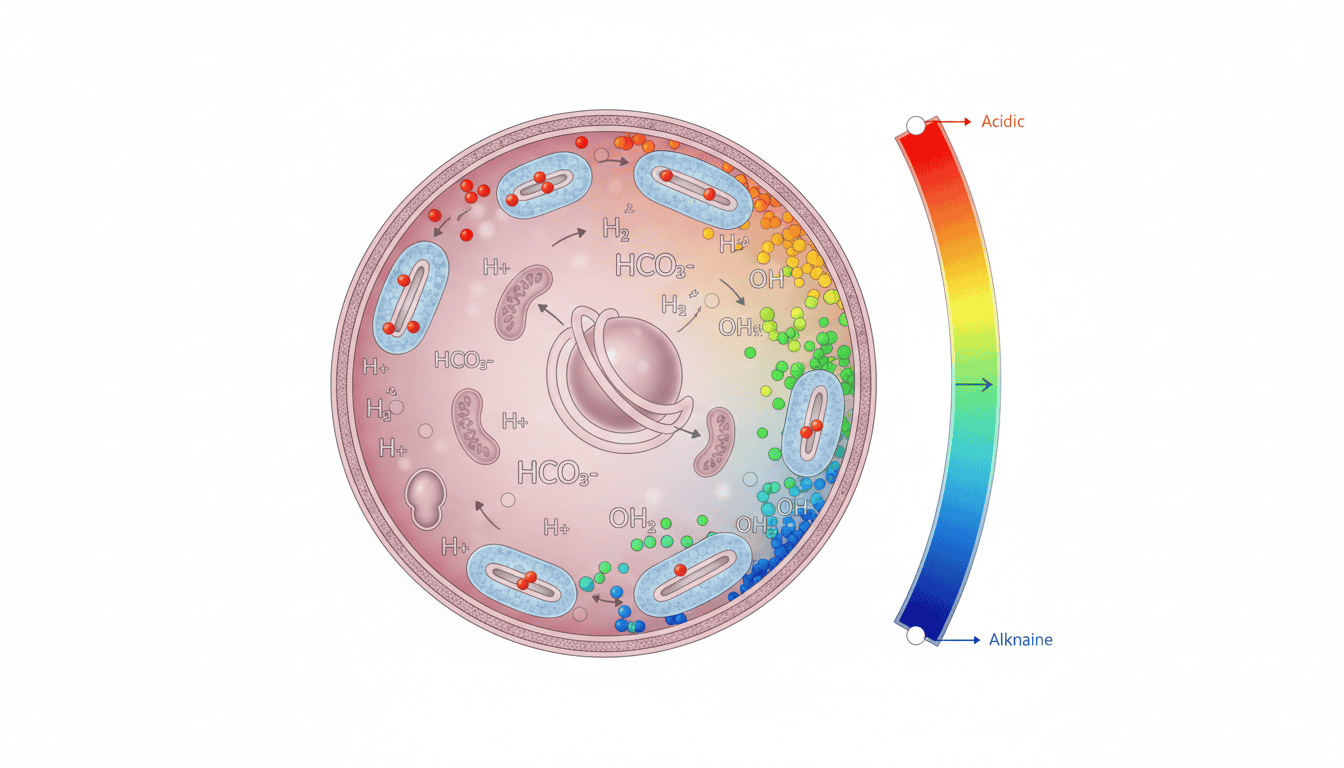
To counter this constant acid assault, cells deploy multiple buffering systems. Phosphate groups mop up excess hydrogen ions. Bicarbonate acts like a chemical sponge, absorbing acids when pH drops and releasing them when it rises. Proteins themselves can grab or release hydrogen ions as needed, though this only works within tight limits before the proteins lose their shape and function.
What the research shows
Scientists have discovered that cells don’t just passively maintain pH through chemical buffers. They actively manage it with dedicated transport proteins that work like molecular pumps and exchangers.
The sodium-hydrogen exchanger sits in cell membranes and swaps internal hydrogen ions for external sodium ions. When a cell becomes too acidic, this exchanger kicks into high gear, literally pumping acid out of the cell. Meanwhile, the sodium-potassium pump works alongside it, maintaining the electrical gradients that power these pH-regulating systems.
Researchers have observed that different cell types maintain slightly different pH levels based on their function. Muscle cells during intense exercise can temporarily tolerate more acidic conditions than brain cells, which require extremely stable pH for proper electrical signalling. Cancer cells often run more alkaline than normal cells, possibly giving them survival advantages that scientists are still unravelling.
Studies using fluorescent pH indicators have revealed that pH can vary within different parts of the same cell. The cytoplasm might be 7.2 while organelles like lysosomes intentionally maintain much more acidic environments around pH 4.5 to help them digest cellular waste.
Why cells need this
The reason cells guard their pH so jealously comes down to protein structure. Proteins fold into precise three-dimensional shapes that depend on electrical charges along their amino acid chains. Change the pH, and you change how these charges interact.
Enzymes are particularly pH-sensitive because their active sites depend on exact positioning of amino acids. Shift the pH by half a unit, and an enzyme that was efficiently catalysing reactions suddenly becomes useless. Some enzymes have evolved to work in specific pH ranges, which is why your stomach produces such strong acid and why your pancreas secretes alkaline juice to neutralise it.
DNA and RNA also depend on stable pH. These molecules carry negative charges that affect how they interact with proteins and each other. Too acidic, and the genetic material can become unstable. Too alkaline, and it may not fold properly for replication or transcription.
Cell membranes face their own pH challenges. The phospholipids that form these barriers can change their electrical properties with pH shifts, potentially affecting how molecules move in and out of cells. Evolution has preserved tight pH regulation because cells that couldn’t maintain it simply died.
What affects cellular pH
Exercise creates one of the strongest challenges to cellular pH balance. When muscles work harder than oxygen supply allows, they switch to anaerobic metabolism, producing lactic acid faster than buffers can neutralise it. This is partly why intense exercise becomes difficult to sustain.
Diet influences pH regulation through multiple pathways. Protein metabolism produces acids that cells must handle, while certain minerals like potassium and magnesium support the buffering systems. However, the relationship isn’t as direct as some health claims suggest because your lungs and kidneys work overtime to maintain blood pH regardless of what you eat.
Age appears to gradually reduce the efficiency of cellular pH regulation. Older cells show less responsive pH buffering systems and may struggle more with acid loads. This could contribute to age-related decline in cellular function, though researchers are still mapping these connections.
Disease states can severely disrupt pH balance. Diabetes can lead to acidosis when cells can’t use glucose properly and switch to burning fats, producing acidic ketones. Kidney disease impairs the body’s ability to excrete acids through urine, forcing cells to work harder to maintain their internal environment.
What remains unknown
Scientists still don’t fully understand how cells coordinate pH regulation across different compartments. How does a cell sense that its mitochondria are producing more acid and respond by ramping up buffering in the cytoplasm? The signalling pathways remain partly mysterious.
The relationship between cellular pH and ageing presents another puzzle. Do pH regulatory systems fail because cells get old, or do cells age partly because pH regulation becomes less efficient? Research suggests both directions of causation might be true, but untangling them requires more work.
Individual variation in pH regulation also needs more investigation. Some people seem better at handling acid loads during exercise or maintaining stable cellular pH under stress. Whether this comes down to genetics, training, or other factors could inform our understanding of human performance and resilience.
The role of pH in cancer development remains an active research area. Cancer cells often create more acidic environments around tumours, but whether this drives cancer progression or simply results from altered metabolism isn’t fully clear.
This intricate pH balancing act reveals something profound about life itself. Every cell in your body constantly fine-tunes its chemical environment with precision that makes industrial process control look crude by comparison. Understanding these mechanisms doesn’t just satisfy scientific curiosity. It illuminates the remarkable engineering that evolution has embedded in every living thing, reminding us that the most sophisticated technology on Earth might be happening right inside us, one hydrogen ion at a time.

Matt Elliott is the editor of Redox News Today, an independent publication covering peer-reviewed research on cellular health, redox signalling, and related biomedical science.