Your muscles feel heavy. Climbing stairs leaves you breathless. You blame getting older, but the real culprit might be happening at the cellular level, where vitamin B12 has stopped showing up to work. Without this single vitamin, the tiny power plants inside your muscle cells begin to falter, unable to produce the energy you need to move.
What is vitamin B12 and mitochondrial energy production
Vitamin B12 is a cobalamin, a molecule your body cannot manufacture. You must get it from food, mainly from animal products like meat, dairy, and eggs. Once absorbed, B12 travels to your cells where it becomes a cofactor for two critical enzymes. Think of it as the missing piece that lets these enzymes actually function.
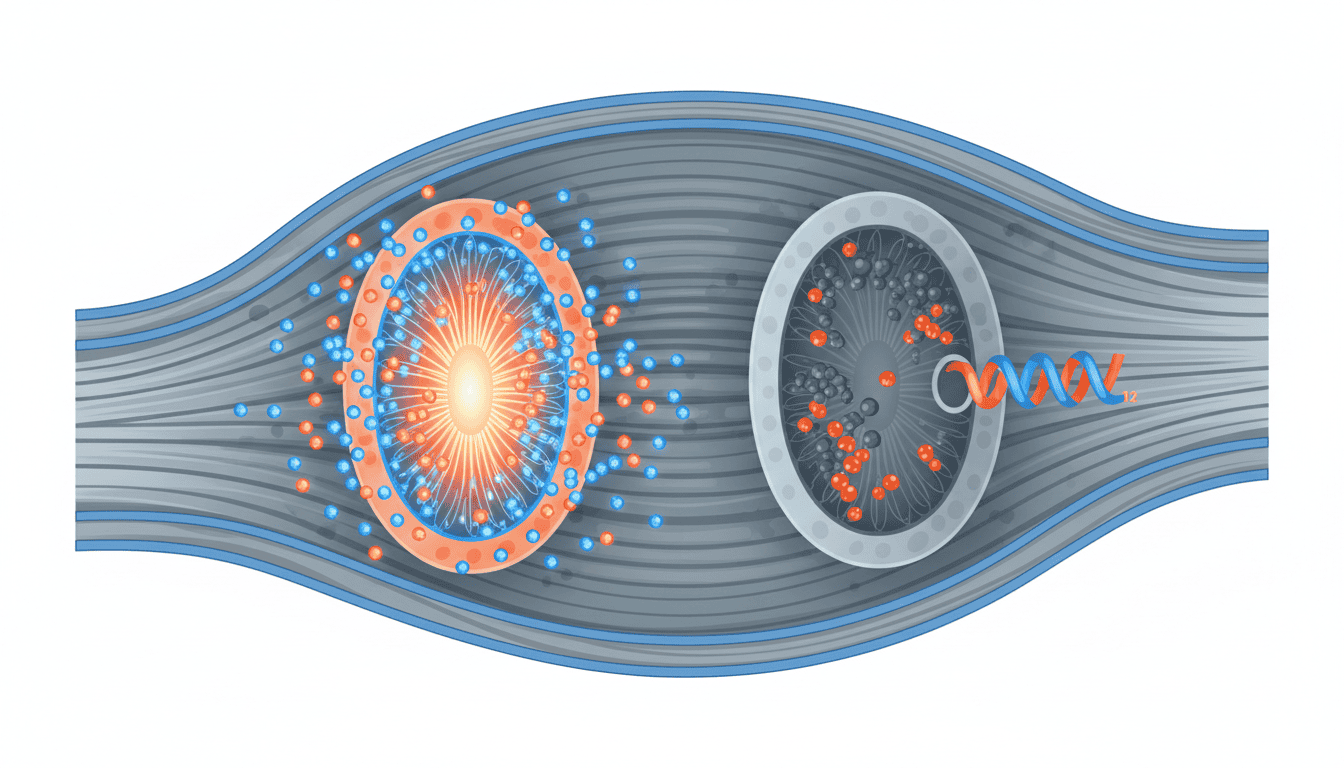
Mitochondria are the power plants of muscle cells. They take nutrients like glucose and fatty acids and strip away electrons through a series of chemical reactions, capturing that energy to build molecules of ATP (adenosine triphosphate). ATP is the currency your cells spend to do literally everything: contract, repair, maintain ion balance. Without ATP, muscles cannot function. B12 plays a supporting role in this chain. Specifically, B12 helps convert a compound called methylmalonic acid into succinyl-CoA, a molecule that feeds directly into the mitochondrial energy production pathway known as the citric acid cycle. This is not a minor sideline role.
Without adequate B12, methylmalonic acid accumulates instead. Your mitochondria never receive that crucial fuel. The energy production line slows or stalls entirely.
What the research shows
When scientists measure mitochondrial function in people with B12 deficiency, they find reduced ATP production in muscle tissue. The citric acid cycle does not shut down entirely, but it runs less efficiently, like an engine missing a cylinder. Some studies have shown that ATP levels can drop by 20 to 30 percent in cells starved of B12.
Researchers also observe increased accumulation of lactate in muscles during exercise among B12-deficient individuals. This happens because muscle cells, desperate for energy, shift toward anaerobic metabolism (the less efficient pathway that does not require oxygen). They produce lactate as a byproduct, which leads to faster fatigue and muscle soreness.
The effect compounds over time. As mitochondria produce less ATP, the cell cannot maintain normal membrane potential. Calcium regulation falls apart. Protein synthesis slows. In severe B12 deficiency, muscle biopsy samples show signs of mitochondrial damage and degeneration. The organelles themselves begin to look abnormal under electron microscopy.
What makes this particularly interesting is that B12 deficiency can progress silently. Early deficiency may cause only subtle reductions in energy production. You might feel slightly more tired after exercise or recover more slowly. By the time symptoms become obvious, mitochondrial dysfunction is already well established.
Why cells need this mechanism
The reason evolution preserved this B12-dependent pathway is straightforward: efficiency. Muscle cells demand extraordinary amounts of ATP. During intense exercise, your muscles can burn through their ATP stores in seconds. The citric acid cycle is the most efficient way to extract energy from food. Any disruption to this cycle has immediate, noticeable consequences.
B12’s role in this system is ancient. Nearly all organisms use cobalamin-dependent enzymes. The requirement suggests that this vitamin has been essential since early evolution. Your body cannot store B12 indefinitely. Most people store enough to last 3 to 5 years, but only if absorption is working normally. This is why B12 deficiency is more common than people realise.
Muscle cells are particularly vulnerable because they are metabolically demanding. A neuron uses a lot of energy too, which is why B12 deficiency often causes neurological symptoms alongside muscle weakness. But muscle tissue experiences the energy shortage first and most obviously.
What affects B12 status and mitochondrial function
Absorption is the key factor. You could eat B12-rich food and still become deficient if your stomach or small intestine cannot absorb it properly. People who take metformin or proton pump inhibitors chronically have reduced B12 absorption. Vegetarians and vegans face obvious dietary gaps because B12 comes almost exclusively from animal sources. Those with pernicious anaemia produce antibodies against intrinsic factor, a protein your stomach secretes to bind B12 for absorption. They cannot fix this through diet alone.
Age matters too. Older adults produce less stomach acid and intrinsic factor, so B12 absorption declines naturally. Studies show that B12 deficiency rates in people over 60 reach 10 to 15 percent, even among those eating normally.
Gut health influences everything. Inflammatory bowel disease, coeliac disease, and bacterial overgrowth all disrupt B12 absorption in the terminal ileum, where this vitamin is normally taken up. Some medications and high-dose supplements of other B vitamins can interfere with B12 absorption as well.
Interestingly, mitochondrial dysfunction from B12 deficiency accelerates as cells age. Ageing mitochondria are already running less efficiently, so B12 deficiency has a larger impact in older people than younger ones.
What remains unknown
Scientists still do not fully understand why some people with subclinical B12 deficiency (low levels but no anaemia) experience muscle symptoms while others do not. Genetic variation in B12 metabolism likely plays a role, but this has not been mapped thoroughly.
The threshold for mitochondrial dysfunction is also unclear. How much B12 is actually needed to maintain normal ATP production in muscle? Does this vary by age, activity level, or muscle fibre type? These seem like basic questions, but proper longitudinal studies are lacking.
Researchers are still working out how B12 deficiency interacts with other metabolic stressors. What happens when someone is B12-deficient and also losing mitochondrial function due to ageing, or due to high oxidative stress from exercise? These combinations probably matter clinically, but the data is sparse.
There is also genuine uncertainty about optimal B12 levels. The standard reference ranges were set decades ago based on anaemia risk. Whether these ranges reflect optimal mitochondrial function in muscle is a separate question nobody has definitively answered.
Vitamin B12 deficiency exposes something fundamental about how cells work: the whole system depends on small molecular pieces working in concert. Take away one cofactor, and the entire energy production pipeline sputters. This is not a story about a single nutrient fixing a disease. It is a window into why cellular function is so fragile, and why understanding the basic machinery matters so much when something goes wrong.

Matt Elliott is the editor of Redox News Today, an independent publication covering peer-reviewed research on cellular health, redox signalling, and related biomedical science.