Drop a few tablespoons of lemon juice into a glass of milk and watch what happens. The proteins clump, the mixture curdles, and you end up with something that looks nothing like what you started with. This same chemical chaos would unfold inside your cells if their pH shifted by even a few tenths of a point. Yet somehow, your trillions of cells maintain their internal acidity within an incredibly narrow range, day after day, despite the constant chemical storms happening around them.
What is cellular pH balance
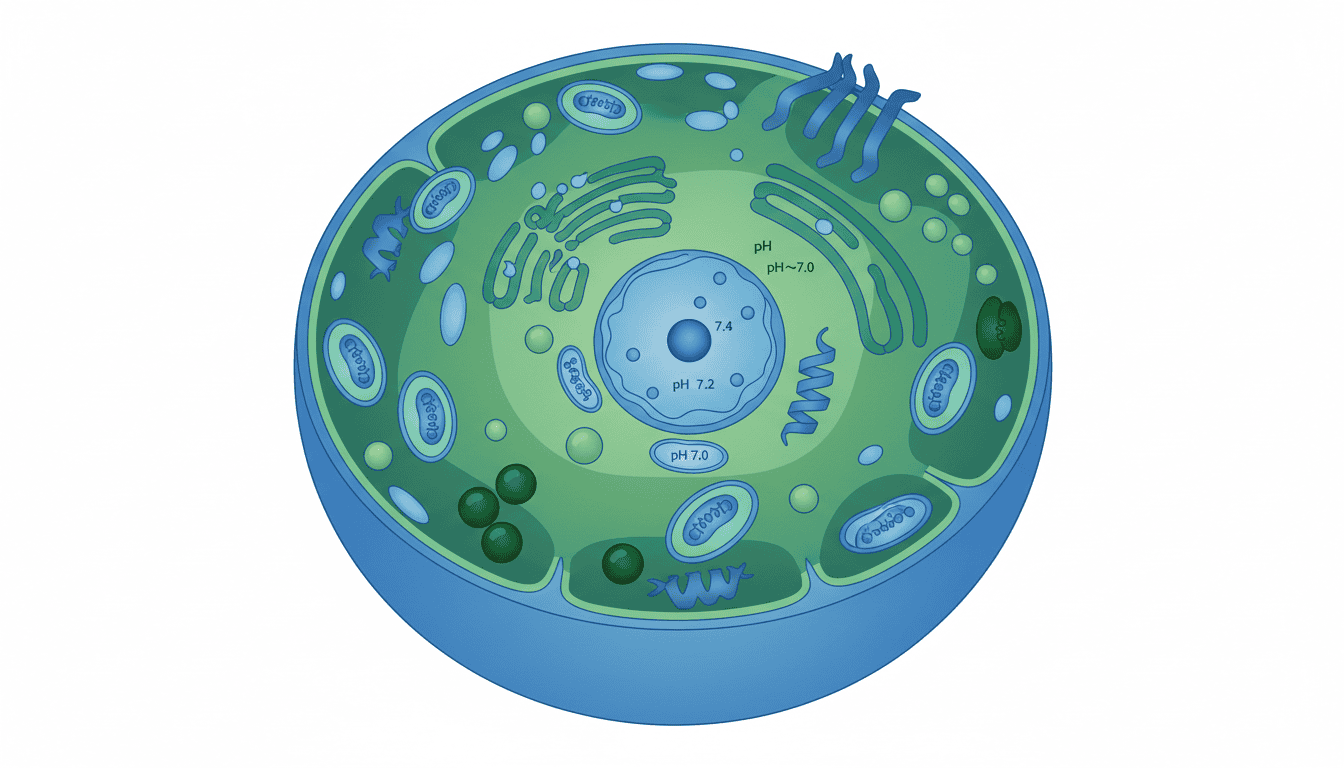
Think of pH as a measure of how acidic or basic something is, running from 0 (battery acid) to 14 (household bleach). Pure water sits at 7, perfectly neutral. Your cells operate at around 7.2, just slightly basic, but they guard this number like their lives depend on it. Because they do.
Inside each cell, thousands of chemical reactions happen every second. Enzymes fold proteins, ribosomes build new molecules, and mitochondria churn out energy. These molecular machines are exquisitely sensitive to pH changes. Shift the acidity by just half a point, and enzymes change shape, losing their ability to catalyse reactions. Proteins unfold. Cell membranes become leaky.
To prevent this chemical mayhem, cells deploy an arsenal of pH-regulating systems. Buffer molecules mop up excess acid or base before they can cause damage. Specialised transporters in cell membranes pump hydrogen ions in or out as needed. Even organelles like lysosomes maintain their own distinct pH levels, creating acidic environments perfect for breaking down cellular waste.
What the research shows
Scientists studying cellular pH have discovered that different parts of the cell maintain dramatically different acid levels, all precisely controlled. Lysosomes keep their interior at pH 4.5, acidic enough to activate digestive enzymes that would destroy the cell if released elsewhere. The endoplasmic reticulum runs slightly more basic than the cytoplasm to optimise protein folding.
Cancer research has revealed just how critical pH control becomes when cells malfunction. Tumour cells often struggle with pH regulation as they switch to less efficient energy production pathways. They pump excess acid into their surroundings, creating a hostile environment that normal cells struggle to survive in.
Exercise physiology studies show what happens when cellular pH systems get overwhelmed. During intense physical activity, muscle cells produce lactic acid faster than they can buffer it. The resulting pH drop interferes with muscle contraction, contributing to that burning sensation and eventual fatigue.
Researchers have also tracked how cellular pH changes with age. Older cells often show less precise pH control, with some organelles becoming more acidic over time. This drift may contribute to the accumulation of cellular damage that characterises ageing.
Why cells need this
Evolution preserved cellular pH control systems because chemistry is unforgiving. Life as we know it exists within an incredibly narrow chemical window. The proteins that make cellular life possible evolved to function at specific pH levels, and they simply cannot adapt quickly to changes.
Consider haemoglobin, the protein that carries oxygen in your blood. Its ability to grab oxygen in your lungs and release it in your tissues depends on subtle pH differences between these environments. A condition called acidosis, where blood becomes too acidic, can prevent haemoglobin from releasing oxygen efficiently, even when oxygen levels are normal.
The precision of cellular pH control also enables compartmentalisation. By maintaining different pH levels in different organelles, cells create specialised chemical environments. Stomach cells exploit this principle on a larger scale, secreting acid into one compartment while keeping their own interior safely neutral.
What affects cellular pH
Diet influences cellular pH primarily through the kidneys and lungs, which adjust blood chemistry over hours and days. But individual cells have more immediate concerns. Their pH fluctuates based on their metabolic activity, oxygen availability, and the chemical environment around them.
Exercise creates one of the strongest challenges to cellular pH systems. Working muscles produce acid as they burn glucose for quick energy. Well-trained athletes develop more robust buffering systems, allowing them to maintain performance even as acid levels rise.
Age gradually weakens cellular pH control systems. Mitochondria become less efficient, producing more acidic byproducts. Cell membranes become leakier, making it harder to maintain different pH levels inside and outside the cell. Buffer systems that once responded quickly to pH changes begin to lag.
Disease can disrupt pH balance in various ways. Diabetes affects cellular metabolism, altering acid production. Kidney disease impairs the body’s ability to eliminate excess acid. Even infections can shift cellular pH as immune cells ramp up their activity.
What remains unknown
Scientists still puzzle over how cells coordinate pH control across all their different compartments. They know individual systems exist, but the communication networks that keep everything in balance remain mysterious. How does a lysosome know to adjust its acidity when the cell’s overall pH shifts?
The relationship between cellular pH and ageing presents another frontier. Researchers can measure pH changes in older cells, but they cannot yet determine whether these changes drive ageing or simply result from it. This chicken-and-egg problem makes it difficult to know whether targeting pH systems could influence the ageing process.
Even basic questions remain unanswered. Why do cells maintain their pH at 7.2 rather than exactly neutral? What evolutionary pressures shaped these specific setpoints? How do pH control systems themselves evolve while maintaining the precise chemistry that life requires?
The tools for measuring cellular pH continue to improve, with new fluorescent probes allowing scientists to track pH changes in real time within living cells. These technologies are revealing unexpected complexity in systems once thought to be well understood.
The story of cellular pH control reveals something profound about the nature of life itself. We exist in a state of controlled chemical chaos, with trillions of cells constantly adjusting their internal chemistry to stay within the narrow bounds that biology demands. This invisible balancing act, happening in every cell of your body right now, represents one of the most fundamental requirements for life. Understanding it better may unlock insights into everything from athletic performance to the basic mechanisms of ageing, reminding us that life is, at its core, an exquisite chemical dance performed on the edge of disaster.

Matt Elliott is the editor of Redox News Today, an independent publication covering peer-reviewed research on cellular health, redox signalling, and related biomedical science.