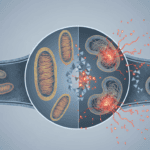

Your brain uses roughly 20 percent of your body’s energy despite making up only 2 percent of its mass. That enormous appetite for power comes from mitochondria, the cellular power plants that churn out ATP to fuel every thought you have. When those power plants start to malfunction, neurons die. Now scientists are testing a targeted approach: designer peptides that sneak directly into damaged mitochondria to reinforce their defence systems before the cell reaches the point of no return.
What is mitochondrial protection
Mitochondria face constant assault. The process of burning fuel to make ATP generates reactive oxygen species, unstable molecules that damage proteins, DNA, and lipids if left unchecked. Cells have built-in repair systems, but in neurodegenerative conditions these systems get overwhelmed. Proteins misfold. Energy production falters. The cell’s calcium handling goes haywire. Eventually the mitochondrion signals the cell to self-destruct, a sensible move for damaged tissue but catastrophic when it happens to irreplaceable neurons.
Mitochondrial protection refers to interventions that reinforce these failing defence systems. The traditional approach involves drugs that reach the bloodstream and hope some fraction makes it to brain cells. The new approach is different: scientists design peptides small enough to cross cell membranes but large enough to do meaningful work, then add targeting sequences that direct these peptides specifically into mitochondria.
Think of it as sending a repair crew directly to the power plant instead of hoping they’ll stumble across it in a dark basement.
What the research shows
Laboratory studies demonstrate that mitochondria-targeted peptides can reduce the oxidative stress that accumulates in neurons exposed to toxins or other stressors. When researchers apply these peptides to cultured neurons, several things happen: antioxidant defences ramp up, calcium handling improves, and cells survive exposures that would normally trigger cell death pathways.
In animal models of neurodegeneration, the picture becomes more complex. Peptides that protect cultured neurons sometimes show benefit in living brains, but the effects are often modest and variable between individuals. Some formulations appear to slow the decline in motor neurons in models of certain neurological conditions. Others reduce the accumulation of misfolded proteins in the brain tissue of aging animals. The pattern suggests these peptides work best as one part of a larger cellular defence system rather than as standalone solutions.
What’s clinically important is that the peptides appear tolerable. Researchers haven’t observed major toxicity even at high doses, which suggests if they do show benefit in human patients, the safety profile might be reasonable. That’s not nothing in drug development.
Why cells need this
Evolution doesn’t build redundant systems for idle reasons. Neurons maintain particularly robust defences against mitochondrial stress because brain cells face a special problem: they can’t be replaced. A neuron that dies is gone for life. Your skin replaces itself every few weeks. Your gut lining turns over every few days. Your neurons don’t.
This makes neurons exquisitely sensitive to anything that threatens mitochondrial function. When oxidative stress builds up, when calcium floods in, when energy production drops, these cells don’t have the luxury of dividing into fresh copies. They either adapt their defences or they die. In healthy ageing this balance holds, mostly. In neurodegeneration it doesn’t.
The biological logic of mitochondrial protection is straightforward: neurons evolved defence mechanisms for a reason, and those mechanisms become more critical with age. By supporting these mechanisms with targeted peptides, researchers are essentially amplifying a system the cell already knows how to deploy.
What affects mitochondrial protection capacity
Age is the obvious factor. Mitochondrial defences deteriorate as organisms age. Antioxidant enzyme production slows. DNA repair becomes less efficient. Calcium handling gets sloppy. By the time most people reach their 60s, neuronal mitochondria are distinctly less efficient at clearing oxidative stress than they were in their 20s.
Lifestyle matters too. Physical exercise improves mitochondrial defence capacity in the brain. So does consistent sleep. Conversely, chronic sleep deprivation, sedentary behaviour, and high stress all appear to compromise mitochondrial defences in neurons. Metabolic health matters as well. Cells under glucose stress show reduced capacity to manage mitochondrial oxidative stress.
The specific disease context also shapes how effectively mitochondrial protection might work. In conditions where mitochondrial dysfunction is the primary problem, targeted peptides might help substantially. In conditions where protein misfolding or neuroinflammation drives the pathology, supporting mitochondrial defence is still useful but may prove less transformative.
Genetics influences the response too. Variations in genes that code for antioxidant enzymes affect how well cells can use mitochondrial-targeted interventions.
What remains unknown
The gap between test tube results and clinical benefit remains substantial. Researchers don’t yet know whether mitochondria-targeted peptides that work in cultured neurons will meaningfully slow neuronal loss in living human brains. The blood-brain barrier is formidable. Even if peptides reach the brain, we don’t know how long they persist, how effectively they concentrate in damaged mitochondria versus healthy ones, or whether they trigger unintended signalling effects elsewhere in the cell.
The optimal dosing regimen is unclear. So is the question of whether these peptides work better as preventive therapy in people at risk of neurodegeneration, or as intervention in those already experiencing decline. Combination approaches remain mostly unexplored. Would mitochondrial-targeted peptides work synergistically with other neuroprotective strategies?
Scientists are also still working out the precise mechanisms by which these peptides exert their effects. Do they stabilise protein complexes? Enhance enzyme activity? Modify gene expression? The answer probably involves multiple pathways, but the relative importance of each remains to be determined.
Finally, there’s the question of individual variation. Some people’s cells seem to respond robustly to mitochondrial support; others barely budge. Understanding why may require better biomarkers and more sophisticated patient stratification.
The broader picture is that cellular mitochondria are extraordinarily complex molecular systems, and our ability to modify their function remains crude by comparison. Each new tool helps us learn, but neurodegeneration is unlikely to be solved by any single intervention, mitochondrial or otherwise.

Matt Elliott is the editor of Redox News Today, an independent publication covering peer-reviewed research on cellular health, redox signalling, and related biomedical science.